





Real Estate DISC Assessment: Hiring and Team Training Guide (2026)
Most brokerages hire on instinct. A candidate seems confident, has sold somewhere before, and interviews well, so they get an offer. Then six months later they have produced nothing, and no one can quite say why the read was wrong. The problem is not bad judgment; it is the absence of a consistent way to evaluate fit. Behavioral data fixes that.
This guide shows how to use DISC assessments alongside structured interviews and clear metrics to hire real estate agents for fit and predict how they will actually perform, rather than betting on a good first impression.
What is the real estate DISC assessment and how does it work?
Quick answer: DISC is a behavioral framework describing how a person makes decisions, communicates, handles pace, and approaches rules, across four profiles: Decisive, Interactive, Stable, and Cautious. In real estate hiring, a DISC assessment gives brokers a fast, consistent read on how a candidate is likely to sell and work, which is more predictive of fit than a resume of past brokerages.
DISC does not measure intelligence or skill, and it is not a pass-or-fail test. It describes behavioral tendencies: how someone naturally approaches problems, people, pace, and process. For a sales role like real estate, those tendencies map closely to how an agent prospects, handles objections, follows up, and works within your systems.
Used well, DISC is a structured lens, not a verdict. It tells you what to probe in the interview and how a candidate is likely to fit your team, so you spend your recruiting time on the agents most likely to succeed.
Go deeper: Explore DISC-based hiring software to systematize behavioral assessments across your hiring process, and see how DISC fits the wider funnel in our real estate recruiting funnel guide.
What are the four DISC profiles in a sales context?
Quick answer: The four DISC profiles describe distinct working styles: Decisive agents move fast and chase results, Interactive agents win through relationships and influence, Stable agents bring consistency and teamwork, and Cautious agents focus on accuracy and process. No profile is best for real estate; the goal is matching the profile to the role and the team.
The mistake brokerages make is assuming there is one ideal agent personality. There is not. A high-Interactive agent may dominate at open houses and referrals but neglect paperwork, while a high-Cautious agent runs flawless transactions but needs support with cold outreach. The point of DISC is fit, not a single winning type.
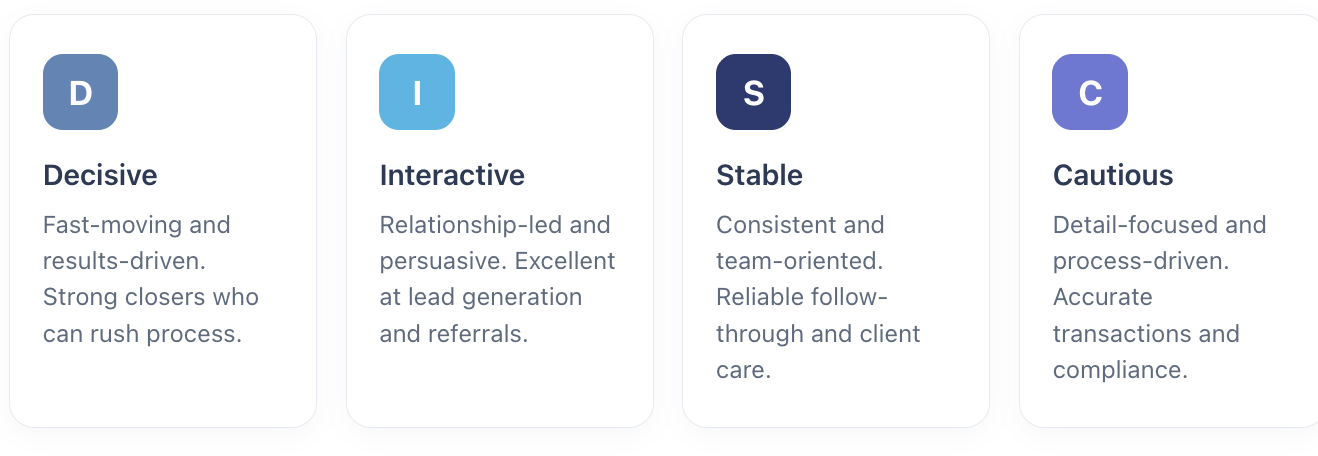
D, Decisive. Fast-moving and results-driven. Strong closers who can rush process.
I, Interactive. Relationship-led and persuasive. Excellent at lead generation and referrals.
S, Stable. Consistent and team-oriented. Reliable follow-through and client care.
C, Cautious. Detail-focused and process-driven. Accurate transactions and compliance.
Knowing a candidate's profile lets you predict where they will excel and where they will need support, so you can build the role and the onboarding around them rather than hoping they adapt.
Is DISC better than a resume for hiring real estate agents?
Quick answer: DISC and a resume measure different things, so the strongest hiring decisions use both. A resume shows experience and past production, while a DISC profile predicts behavior, communication style, and how a candidate handles pressure. Because past brokerage matters less than how an agent actually works, behavioral data often predicts success better than experience alone.
A resume tells you what someone has done. It does not tell you whether they will do it again at your brokerage, with your systems, your leads, and your culture. Plenty of agents who produced at one firm stall at another, and the difference is almost never on the resume.
The reliable approach is to use the resume to confirm experience and the DISC profile to predict behavior, then resolve any tension between them in the interview. When a strong resume and a poor behavioral fit collide, the behavioral fit is usually the better predictor of what happens next.
Go deeper: See why experience alone misleads in why top real estate agents reject job offers.
What interview questions should you ask a real estate agent?
Quick answer: Ask structured questions that reveal work habits, motivation, and how a candidate handles rejection and prospecting, such as how they generated their last five clients or what their daily routine looks like. Asking the same core questions of every candidate lets you compare people fairly rather than relying on impressions, which is the foundation of consistent hiring.
An unstructured interview measures how much you like talking to someone, which is not the same as how well they will sell. A structured interview, where every candidate answers the same core questions, turns the conversation into a comparison you can actually trust.
Probe real behavior by asking how they found their last clients, not how they would find clients in theory.
Test for resilience with questions about rejection, dry spells, and how they kept going.
Use the DISC profile to dig into predicted weak spots, so the interview confirms or challenges the assessment.
Go deeper: Use our real estate agent interview questions as a ready-made structured set.
How do you write a job description that attracts the right fit?
Quick answer: Write the job description to attract the profile you actually want, not to list every duty. Be specific about the kind of agent who thrives at your brokerage, the support you provide, and the results they can expect. A focused description filters for fit before the interview, saving time on candidates who were never the right match.
A job description is the first screen in your hiring process, and a generic one filters for nothing. If your post could describe any agent at any brokerage, it will attract a flood of mismatched applicants and bury the few who fit. Specificity is the filter.
Describe the working style that succeeds on your team, the systems and leads you provide, and the concrete outcomes a good fit can expect. The right candidates will recognize themselves, and the wrong ones will self-select out before you spend an interview on them.
Go deeper: Start with our real estate agent job description template, and avoid the common job-description mistakes that attract the wrong applicants.
How do you know if your hiring process is working?
Quick answer: Measure your hiring process with a few clear metrics: quality of hire, time to first transaction, first-year retention, and how well DISC profiles predicted actual performance. Tracking these turns hiring from a gut decision into a process you can refine, and it shows whether your assessments and interviews are actually selecting better agents.
Hiring is the one decision most brokerages never grade themselves on. They make an offer, and whether it worked out becomes a vague memory rather than a data point. The brokerages that improve are the ones that close the loop: they track how their hires actually performed and feed that back into the process.
Over time, this tells you which DISC profiles thrive at your brokerage, which interview questions predicted success, and where your process is leaking good candidates or admitting poor ones. Hiring stops being a gamble and becomes a system that compounds.
Go deeper: Learn the metrics in how to measure hiring effectiveness in real estate, and quantify the cost of getting it wrong with real estate agent turnover cost.
How do you run DISC training for real estate teams?
Quick answer: Run DISC training for real estate teams by having every agent complete an assessment, sharing the team's combined profile map, and coaching agents to adapt their communication to each other and to clients. The goal is not labeling people but giving the team a shared language for how they sell, collaborate, and handle conflict, which improves both performance and retention.
DISC is not only a hiring tool. Some of its biggest value comes after the hire, when you use it to develop the agents you already have. A team that understands its own profile mix communicates better, divides work more naturally, and has fewer of the personality clashes that quietly erode a brokerage.
Effective DISC training for a real estate team moves through a few stages. First, every team member completes the assessment so no one is guessing. Then you build a shared map of the team's profiles, which immediately explains a lot of day-to-day friction. From there, coaching focuses on practical adaptation: how a Decisive agent should brief a Cautious transaction coordinator, or how an Interactive agent can close with a detail-oriented buyer.
Assess the whole team, not just new hires, so everyone shares the same baseline.
Map the team's profile mix to surface natural strengths and predictable friction points.
Coach for adaptation, teaching agents to flex their style to clients and colleagues rather than change who they are.
Revisit it regularly so DISC becomes a working language for the team, not a one-time workshop.
Used this way, DISC training pays off twice: agents sell more effectively because they read clients better, and they stay longer because the team simply works well together.
Go deeper: See how team behavioral data supports growth in real estate team management, and systematize assessments with DISC-based hiring software.
Frequently asked questions
What is the real estate DISC assessment and how does it work?
DISC is a behavioral framework that describes how a person makes decisions, communicates, handles pace, and approaches rules, using four profiles: Decisive, Interactive, Stable, and Cautious. The real estate DISC assessment gives brokers a fast, consistent read on how a candidate is likely to sell and work, which is more predictive of fit than a resume of past brokerages.
Is DISC better than a resume for hiring real estate agents?
DISC and a resume measure different things, so the strongest hiring decisions use both. A resume shows experience and past production, while a DISC profile predicts behavior, communication style, and how a candidate handles pressure. Because past brokerage matters less than how an agent actually works, behavioral data often predicts success better than experience alone.
What interview questions should you ask a real estate agent?
Ask structured questions that reveal work habits, motivation, and how a candidate handles rejection and prospecting, such as how they generated their last five clients or what their daily routine looks like. Asking the same core questions of every candidate lets you compare people fairly rather than relying on impressions, which is the foundation of consistent hiring.
How do you know if your hiring process is working?
Measure your hiring process with a few clear metrics: quality of hire, time to first transaction, first-year retention, and how well DISC profiles predicted actual performance. Tracking these turns hiring from a gut decision into a process you can refine, and it shows whether your assessments and interviews are actually selecting better agents.
How do you run DISC training for real estate teams?
Run DISC training for real estate teams by having every agent complete an assessment, sharing the team's combined profile map, and coaching agents to adapt their communication to each other and to clients. The goal is not labeling people but giving the team a shared language for how they sell, collaborate, and handle conflict, which improves both performance and retention.
Hire for fit, not just a good interview
EZRecruits combines DISC-based assessments, structured interviews, and hiring metrics in one place, so brokerage owners and team leaders can predict performance before they make an offer.

