





How Long Does It Take to Become a Real Estate Agent? A Recruiter's Complete Timeline Guide
Most candidates googling "how long does it take to become a real estate agent" are thinking about their first commission check. You should be thinking about something different: the licensing timeline is your recruiting runway. From the moment a candidate enrolls in pre-licensing coursework, they spend 2 to 6 months evaluating brokerages, asking around, and forming opinions before they have passed a single exam. Brokerages that show up during that window convert at far higher rates than those that wait for the newly licensed agent to call. This guide maps every stage of the real estate license timeline so you can intercept candidates at the right moment and stay relevant through every step.
Key Takeaways
Most candidates complete the full licensing process in 3 to 6 months, though some low-hour states allow motivated candidates to finish in 8 to 10 weeks.
Pre-licensing education requirements range from 63 hours (Florida) to 180 hours (Texas), making state a meaningful variable in how fast someone can become a realtor.
The three most common bottlenecks are exam failure, life interference with part-time study, and state application processing backlogs.
Candidates are evaluating brokerages while still in school. The brokerage that builds a relationship during coursework has a structural advantage over one that reaches out after the license is issued.
A structured recruiting funnel mapped to the licensing calendar consistently outperforms reactive, post-license outreach.
Automated follow-up sequences keep your brokerage visible across the full 2-to-6-month window without requiring manual tracking.
How Long Does It Take to Become a Real Estate Agent?
The realistic answer for most candidates is 3 to 6 months from enrollment to an active license. That window covers completing state-mandated pre-licensing education, passing the state exam, clearing a background check, and receiving an approved license application. A motivated candidate in Florida, which requires only 63 pre-licensing hours, who studies full-time and passes the exam on the first attempt can finish in 8 to 10 weeks. A candidate in Texas, where 180 hours across six mandated courses are required, studying part-time around a day job often takes 4 to 6 months.
The real estate license timeline is a sequential process: each step must be completed before the next one begins. That sequencing is not just a bureaucratic fact. It means you can predict, within a reasonable range, when a candidate you identify today will be ready to sign with a brokerage. That predictability is an operational asset most brokerages never use.
According to the Association of Real Estate License Law Officials (ARELLO), more than 106,000 new real estate licenses were issued in the United States in 2023. Every one of those new agents moved through the same pipeline. Almost none of them received structured, timeline-aware outreach from a brokerage during the pre-exam phase.
The Real Estate License Timeline: Step by Step
Mapping recruiting touchpoints to actual candidate milestones, rather than guessing, requires understanding the full sequence first.
Step 1: Meet eligibility requirements (Day 1) Candidates must be at least 18 years old (19 in Nebraska and Alabama), hold a high school diploma or equivalent, and be eligible to pass a background check. These are baseline filters, not time-consuming steps.
Step 2: Complete pre-licensing education (2 to 16 weeks) This is the longest and most variable step. Candidates complete a state-mandated number of hours covering real estate law, contracts, financing, and ethics. Online courses allow self-pacing, which means the same curriculum can take a full-time student four weeks and a part-time student four months. The time to get a realtor license is largely determined here.
Step 3: Pass the state real estate exam (1 to 3 weeks post-coursework) After completing pre-licensing education, candidates schedule through a third-party testing provider, typically PSI Exams or Pearson VUE. In most states, appointments are available within a week of course completion. First-attempt pass rates nationally cluster around 55 to 60 percent, based on data published by individual state real estate commissions. Candidates who fail must retake the exam after a waiting period ranging from 24 hours to 30 days, depending on the state.
Step 4: Submit a license application and pass a background check (1 to 6 weeks) After passing the exam, candidates apply to their state real estate commission. Processing times vary significantly. Some states return approvals in 3 to 5 business days. Others, particularly high-volume markets, take 4 to 6 weeks. Background checks run concurrently in most states and rarely add time unless there is a record to review.
Step 5: Activate the license under a sponsoring broker A real estate salesperson license in most states is inactive until it is affiliated with a licensed broker. The candidate cannot legally conduct transactions until this step is complete. This is the most actionable recruiting moment you have: a candidate with an approved license and no sponsor is your warmest possible lead.
State-by-State Real Estate License Timeline Comparison
Pre-licensing hour requirements are the single largest driver of how fast a candidate can become an agent. The table below covers major markets. Estimated timelines assume a motivated candidate studying part-time (10 to 15 hours per week).
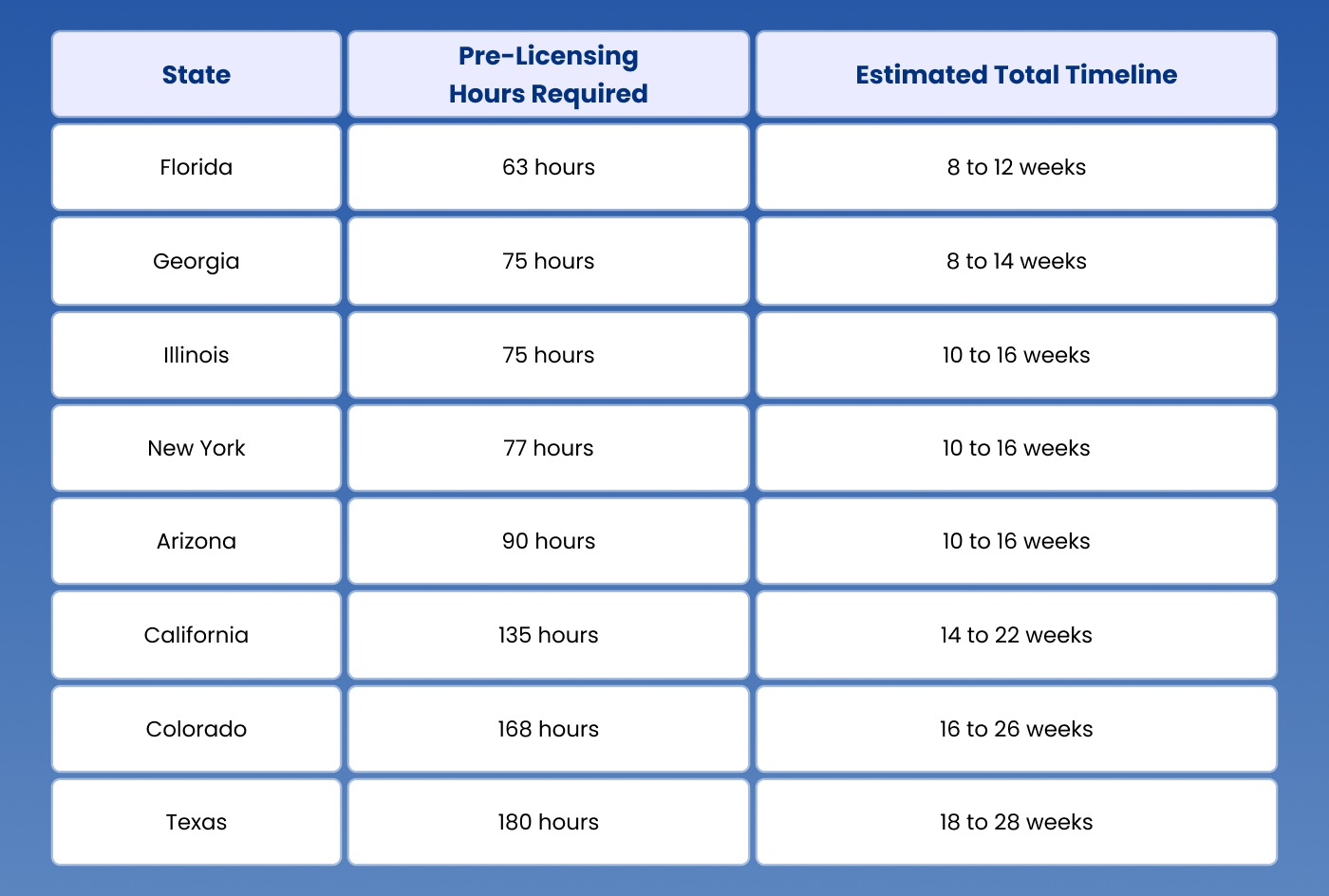
Sources: Individual state real estate commission published requirements, verified 2024. Requirements are subject to change; confirm with the relevant state commission before advising candidates.
Texas and Colorado stand out as the longest pipelines, which also means the longest recruiting windows. California candidates often spend 4 to 5 months in coursework alone. If your brokerage operates in those markets, you have a substantial window to build a relationship before a candidate is eligible to sign anywhere.
How Fast Can You Become a Realtor? What Slows Candidates Down
The theoretical minimum timeline to get a realtor license is approximately 6 to 8 weeks in low-hour states, assuming an accelerated online program, a first-attempt exam pass, and a fast-processing state commission. In practice, three factors consistently extend the timeline.
Exam failure. With national first-attempt pass rates around 55 to 60 percent, roughly half of all candidates add 2 to 6 weeks to their timeline by needing a retake. The state-specific portion of the exam tends to have lower pass rates than the national portion, which covers general principles. Candidates who fail are not disqualified; most pass on the second or third attempt. They are also, statistically, humbled by the process and more receptive to brokerage support when they do pass.
Part-time study and life interference. Most candidates are not career changers with free schedules. They are employed adults studying in evenings and on weekends. A 90-hour curriculum a full-time student could finish in three weeks takes a working parent three months. This is useful for your pipeline: the longer the coursework phase, the more touchpoints you have before competition heats up.
State application processing backlogs. Real estate commission staff process applications manually in most jurisdictions. During peak periods, particularly spring and fall when application volumes spike, processing can stretch to four to six weeks after the exam is passed. The candidate already has all the intent in the world. They simply cannot act. Recruiters who stay in contact during this waiting period arrive at the activation conversation with a meaningful advantage.
What Brokerages Get Wrong When Recruiting New Licensees
Most brokerages recruit reactively. A candidate appears on a job board, gets referred by an existing agent, or walks in the door, and the brokerage pitches them. By that point, the candidate has often already toured two competitors and formed a preference.
Here are the most common patterns that cost brokerages new agent talent.
Starting too late. Outreach that begins after a license is issued arrives into a crowded window where every other brokerage is competing for the same person at the same moment.
Pitching before building. New licensees do not yet have the context to evaluate commission splits, technology stacks, or referral programs. They respond to mentorship, community, and confidence. Brokerages that lead with comp structures before earning trust lose candidates who would have been great fits.
No follow-up sequence. A single email to someone in their fourth week of coursework accomplishes almost nothing. What works is consistent, value-forward touches across the full licensing timeline.
Treating all new licensees the same. A 27-year-old making a career pivot has different motivations than a 50-year-old transitioning out of corporate. Your message should reflect that distinction.
Ignoring the exam-failure cohort. Candidates who fail once or twice tend to be more coachable, more motivated, and more grateful when a brokerage reaches out with encouragement rather than a pitch. This group is almost universally ignored by recruiters.
What the Real Estate License Timeline Means for Your Recruiting Pipeline
A brokerage that treats the licensing calendar as a recruiting structure approaches new agent acquisition very differently from one operating reactively. Here is the framework.
Stage 1: Identify candidates in pre-licensing (weeks 1 through coursework completion) Some candidates announce publicly on LinkedIn or in local real estate Facebook groups that they are pursuing a license. Local real estate schools, particularly classroom-based programs, sometimes share enrollment information with partner brokerages or post graduate announcements. A referral relationship with one or two local schools gives you a repeatable and early source of candidates.
Stage 2: First contact during coursework (low-pressure, high-value) Your opening touch should be educational, not promotional. A short email offering a free resource (a brokerage comparison checklist, a guide to what questions to ask at a brokerage interview, or exam prep tips) establishes goodwill and gets responses. This is not the moment to discuss commission splits.
Stage 3: Stay relevant through the exam window Offer to connect candidates with agents on your team who recently passed the same exam and can share what worked. Every pre-license interaction is brand-building. The candidate is learning whether your brokerage invests in people before it has anything to gain.
Stage 4: Convert at activation A candidate who passed the exam and is waiting on their license is the most motivated lead in your pipeline. They have committed to becoming an agent. They have not yet signed anywhere. This is the moment for a structured offer: a formal interview, a clear 90-day onboarding plan, an introduction to your top producers.
Stage 5: Retain by starting onboarding on day one The recruiting job does not end at signing. According to NAR's 2024 Member Profile, approximately 30 percent of Realtors had fewer than two years of experience, reflecting persistent early-career churn across the industry. New agents who receive a structured first 90 days are significantly more likely to reach their first transaction and remain at the brokerage through their first year.
A Real-World Recruiting Scenario
Consider a 15-agent brokerage in Charlotte, North Carolina. The broker-owner, call her Maria, is consistently losing new licensees to larger franchise brokerages, not because her value proposition is weaker but because by the time candidates appear on her radar, they have already attended orientation at a competitor.
Maria decides to build a pre-licensing recruiting pipeline. She partners with two local real estate schools and offers a monthly "Ask a Broker" webinar for students currently in coursework. She builds a five-touch email sequence: an intro when a student registers, a follow-up after the webinar with exam resources, a check-in email timed to the exam window, a congratulations message when students publicly announce they have passed, and a formal recruiting conversation timed to the license activation window.
Within two recruiting cycles, Maria is having first conversations with candidates an average of six weeks before competitors know they exist. Her conversion rate on new licensees nearly doubles, and her cost per recruited agent drops because she is competing in a far less crowded window.
The sequence Maria runs is not complicated. It is consistent and it is tied to the actual licensing calendar. That consistency, applied systematically, is the operational advantage available to any brokerage that chooses to use it.
Where EZRecruits Fits in the New Agent Recruiting Workflow
Running a recruiting funnel timed to the real estate license timeline requires consistent outreach across multiple touchpoints over multiple months, often for several candidates simultaneously. For a broker-owner managing 20 agents while running their own book of business, that level of systematic follow-up is typically the first thing that breaks when the market gets busy.
EZRecruits is a recruiting platform built specifically for real estate brokerages and mortgage companies. It handles the sequenced outreach that most brokerages attempt manually and abandon inconsistently. You can build automated recruiting funnels that trigger based on where a candidate is in the licensing process, whether that is early coursework, the exam window, or the post-approval activation stage. DISC-based candidate profiling lets you tailor messaging to a candidate's behavioral style before the first live conversation. Pipeline tracking gives you visibility into every candidate, their current stage, and when the next touch is scheduled, without relying on a recruiter to remember manually.
The outcome is that your brokerage stays present across the full licensing timeline without the operational overhead of a dedicated recruiting staff. When a candidate is ready to activate their license, your name is already the most familiar one in the room.
If recruiting agents has become the bottleneck, see how EZRecruits can run the funnel for you.
Frequently Asked Questions
How long does it take to become a real estate agent if I study full-time? A full-time student in a low-hour state like Florida or Georgia can complete pre-licensing coursework in three to four weeks. Add one to two weeks for exam scheduling and a result, then one to three weeks for state application processing. The fastest realistic timeline for a motivated, full-time student is approximately 6 to 8 weeks from enrollment to an active license. Most candidates hit 10 to 14 weeks due to part-time study schedules and processing time.
What is the fastest way to get a real estate license? Choose a state with a lower pre-licensing hour requirement, such as Florida at 63 hours or Georgia and Illinois at 75 hours. Enroll in an accelerated online program, schedule your state exam the day you complete coursework, and submit your license application the day you receive your exam results. The step you cannot accelerate is state application processing, which ranges from a few business days to several weeks depending on volume.
Does the real estate license timeline vary significantly by state? Yes, substantially. Texas requires 180 pre-licensing hours; Florida requires 63. For a part-time student, that difference alone represents a 12- to 16-week gap before accounting for exam outcomes or application processing. The comparison table in this article covers the major markets. Always confirm current requirements directly with the relevant state real estate commission, as hour requirements change periodically.
Can a candidate start working as a real estate agent while waiting for their license? No. Performing real estate transactions for compensation without an active, sponsored license is illegal in every U.S. state. Violations can result in civil fines, criminal charges, and permanent disqualification from future licensure. A candidate must have an approved and sponsored license before conducting any compensable real estate activity.
When is the best time for a brokerage to start recruiting a new licensee? As early as the first week of pre-licensing coursework. The 30 to 60 days immediately after a candidate enrolls represent the lowest-competition and highest-receptiveness window in the entire recruiting funnel. Brokerages that wait until a candidate holds a license in hand are entering a far more competitive moment with a candidate who has already formed strong preferences.
How long does it take to schedule and complete the real estate exam? Most candidates can schedule their exam within 3 to 10 business days of completing pre-licensing coursework through providers like PSI Exams or Pearson VUE. The exam itself typically runs 3 to 4 hours and covers both a national portion and a state-specific section. Results are generally available immediately upon completion at a testing center, or within a few days for remote proctored exams.
Conclusion
The real estate license timeline is not just a compliance checklist for aspiring agents. For brokerage owners and recruiters who read it correctly, it is a structured recruiting calendar with predictable stages and clear windows for building relationships before the competition arrives. How long does it take to become a real estate agent? Anywhere from 6 weeks to 6 months, depending on the state, the candidate's schedule, and whether they pass the exam on the first attempt. The brokerages that consistently win new licensees are not the ones with the best pitch deck. They are the ones that show up first, add value early, and stay visible through every stage of the licensing process. Build the funnel, map your outreach to the milestones, and you will compete in a window most of your rivals are not watching.

