






How Many Hours Do Real Estate Agents Work? (2026 Data)
Real estate agents work an average of 30 to 50 hours per week, with top producers often logging 50 to 60+ hours during peak market seasons. Unlike a traditional 9 to 5 job, the realtor work schedule is shaped by client availability, market activity, and self-directed lead generation, which means evenings, weekends, and irregular hours are standard rather than exceptional.
According to the National Association of Realtors (NAR) Member Profile, the median real estate agent reports working roughly 30 hours per week, but that figure is pulled down by the large segment of part-time agents in the membership. Full-time, production-focused agents typically work 40 to 60 hours per week, especially in their first three years building a pipeline. The gap between what new agents expect the job to demand and what it actually requires is one of the leading reasons NAR has consistently reported that around 87% of new agents leave the industry within five years. Brokerages that win on retention close that expectation gap during real estate recruiting and reinforce it during onboarding.
How Many Hours Do Real Estate Agents Actually Work Each Week?
The honest answer: it depends on whether they are full-time or part-time, new or experienced, and chasing growth or maintaining an existing book of business.
Here is a realistic breakdown based on NAR Member Profile data and industry surveys:
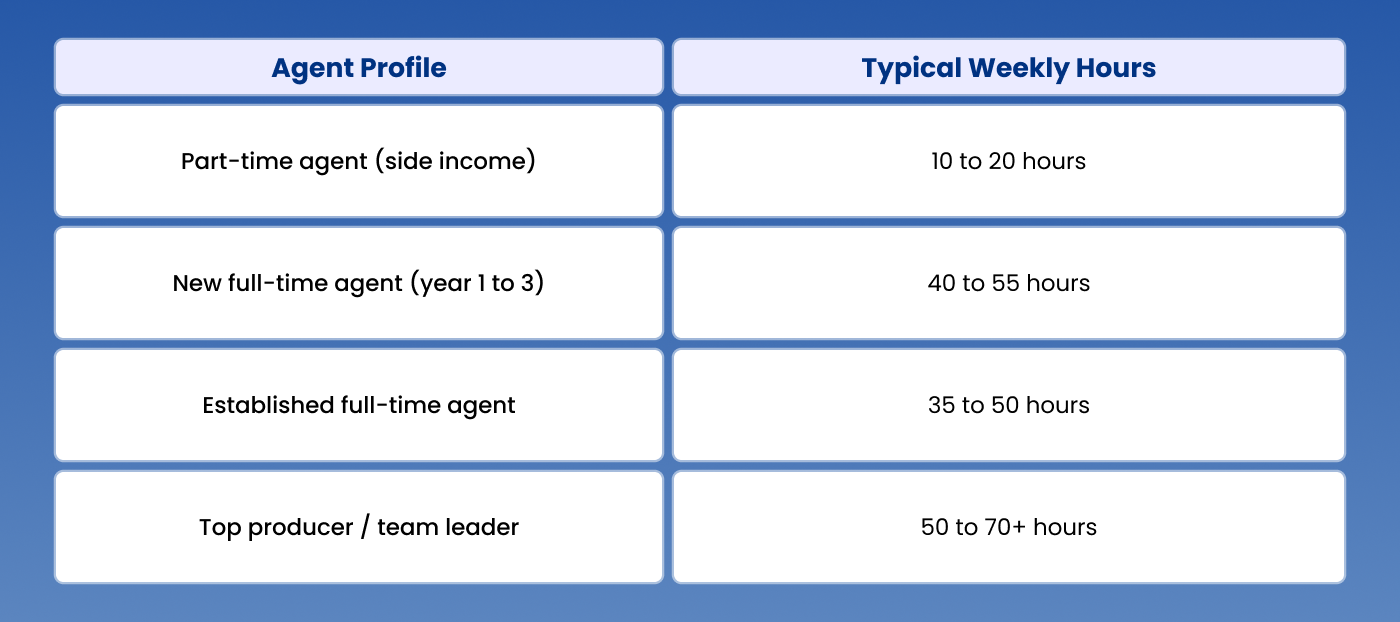
The variance is wider than almost any other commission-based profession. Two agents at the same brokerage can work radically different schedules and produce radically different income.
The hidden hours most agents underestimate:
Lead follow-up and CRM work (often 8 to 12 hours per week)
Continuing education and license renewal requirements
Open house preparation and execution
Showings outside business hours
Transaction coordination and paperwork
Self-directed marketing across social media, email, and content
A common mistake new agents make is counting only the "active" hours (showings, listing appointments, closings) and ignoring the administrative and prospecting work that actually drives the business.
Is Real Estate Agent a 9 to 5 Job?
No. Real estate is fundamentally not a 9 to 5 job, and brokerages that recruit agents by suggesting otherwise typically see the highest first-year turnover.
Here is why the realtor work schedule does not fit a standard workweek:
Clients are most available outside business hours. Most buyers and sellers have day jobs. Showings happen on evenings and weekends. Listing appointments often run from 6 to 9 PM. Closings can extend into the evening when paperwork issues arise.
The market does not pause. Listings go live on Friday afternoons. Offers come in Sunday nights. A buyer who calls at 9 PM about a new listing expects a callback before the property gets multiple offers Monday morning.
Lead generation is self-directed. Unlike a salaried employee, agents are responsible for their own pipeline. Agents who treat lead gen as a 9 to 5 task tend to see flat or declining production. Agents who build short, consistent prospecting blocks into early mornings, lunch hours, and weekend windows tend to outperform.
Transaction milestones drive the calendar. Inspections, appraisals, and closing dates are set by escrow timelines, not by the agent's schedule. A closing scheduled for a Friday morning means Thursday night is for final walkthrough prep.
That said, experienced agents with strong systems in place (a tight CRM, transaction coordinators, scheduling automation, and an established referral pipeline) often work fewer total hours than newer agents while producing far more.
What Does a Real Estate Agent Daily Routine Look Like?
A typical full-time real estate agent daily routine blends prospecting, client work, and administrative tasks. The exact mix shifts by experience level and market conditions, but most productive agents structure their days around a few core blocks.
Sample Daily Routine of a Productive Full-Time Agent:
The critical pattern: the most productive agents protect 1 to 3 hours of focused prospecting every weekday morning before client work consumes the schedule. Agents who skip prospecting in favor of "busy" administrative work tend to plateau quickly.
Weekends look different. Saturdays often include 2 to 4 showings or open houses. Sundays are typically lighter but still include open houses and weekly planning.
New Agents vs. Top Producers: How the Hours Differ
The total volume of hours is similar between new agents and top producers. What changes dramatically is what those hours are spent on.
New agents typically spend their time on:
Searching for leads with no system in place
Manual transaction paperwork
Reactive client communication (responding instead of prospecting)
Self-directed training (YouTube, podcasts, webinars)
Open houses (often hosted for other agents' listings)
Top producers typically spend their time on:
High-leverage prospecting (referrals, sphere, past clients)
Listing appointments and high-fit buyer consultations
Team or transaction coordinator oversight
Strategic content creation (long-form social, video, email)
Negotiation and client retention
The shift from "busy" to "productive" is rarely accidental. Most top producers credit one of three factors: a strong onboarding program at their brokerage, a coach or mentor in their first 18 months, or a structured CRM system that automated their follow-up.
This is exactly where most brokerages fail their new agents. Hiring is celebrated; onboarding is improvised. The result is a year-one agent working 50 hours per week on the wrong activities.
The Realtor Work Schedule by Season
Real estate hours are not evenly distributed across the year. The realtor work schedule has predictable seasonality that brokerages should communicate during recruiting.
Spring (March to June): Peak Season
50 to 65+ hours per week common
Listings, showings, and closings all peak simultaneously
Top producers often delay vacations until July
Summer (July to August): Sustained Volume
40 to 55 hours per week
Closings remain heavy from spring contracts
Family-focused buyer activity continues
Fall (September to November): Secondary Peak
40 to 55 hours per week
Buyer and seller activity rises again before holidays
Strong prospecting window for next-year pipeline
Winter (December to February): Slower Pace, Critical Prep
25 to 40 hours per week
Lower transaction volume
Highest-leverage time for prospecting, content, and database work
Top producers use winter to build the next year, not to coast
A common rookie mistake is treating winter like an off-season and emerging in March with no pipeline. Experienced agents do the opposite.
Why So Many New Agents Misjudge the Time Commitment
NAR has consistently reported that the majority of new agents leave the industry within five years. Time mismanagement is one of the top three reasons (alongside undercapitalization and lack of mentorship).
The misjudgment usually goes one of two directions:
1. They expect part-time hours and get full-time demands. Many new agents enter the business assuming they can work 20 to 25 hours per week and earn a living. In practice, almost no agent generates a sustainable income at that volume in their first 24 months.
2. They expect rigid hours and resist the irregular schedule. Agents coming from corporate roles often struggle with evening showings, weekend work, and the lack of a clear "off" switch. The schedule is flexible, but flexibility is not the same as fewer hours.
The brokerages with the lowest first-year attrition share one trait: they are blunt about the time commitment during recruiting and structured during onboarding.
How Brokerages Can Set Realistic Hour Expectations During Recruiting
Setting accurate expectations during the recruiting and onboarding process is the single highest-leverage retention investment a brokerage can make. Yet most brokerages still recruit on lifestyle promises ("be your own boss," "work from anywhere") and then watch new agents quit when reality hits.
The brokerages that retain agents long-term do three things differently:
1. They quantify the time commitment in writing. A simple one-page document during recruiting that outlines expected weekly hours by month (Months 1 to 3: 50+ hours, Months 4 to 12: 40 to 50 hours, etc.) sets expectations before the offer letter is signed.
2. They use behavioral assessments to filter for fit. DISC and similar assessments reveal whether a candidate's natural work style aligns with the demands of self-directed, high-variance commission work. This is where DISC-based hiring outperforms gut-feel interviews.
3. They build the first 90 days as a structured program, not a free-for-all. A new agent with a clear daily checklist for their first 90 days is dramatically more likely to hit production than one left to figure it out.
These are not nice-to-haves. They are the difference between a brokerage that retains 80% of new hires and one that retains 30%.
How EZRecruits Helps Brokerages Set Agents Up for Sustainable Schedules
EZRecruits is the only full-stack recruiting and onboarding platform built specifically for real estate brokerages and mortgage teams. Setting realistic hour expectations starts before the offer letter, and EZRecruits gives brokerages the tools to do it correctly at every stage.
During recruiting, our DISC-based hiring assessment surfaces candidates whose work style fits the demands of self-directed real estate work, reducing the likelihood of a costly mismatch in the first 90 days. The recruiting CRM tracks every candidate touchpoint and automates outreach across 100+ job board syndication channels, so brokerages can focus conversations on fit rather than logistics.
After the hire, our structured real estate agent onboarding workflow builds a guided 30-60-90 day plan for every new agent, including daily prospecting blocks, training milestones, and accountability checkpoints. Brokerages using structured onboarding through EZRecruits typically see first-year retention improve by up to 40% compared to ad-hoc programs. Combined with real estate team management dashboards, broker-owners get real-time visibility into who is hitting their hour and activity targets and who is drifting.
The result: agents who understand the time commitment, brokerages that hold them accountable to it, and teams that retain talent past the dangerous first-year cliff.
Frequently Asked Questions
Do real estate agents work 40 hours a week?
Most full-time real estate agents work between 40 and 55 hours per week, especially in their first three years. Part-time agents work 10 to 20 hours, while top producers and team leaders often log 50 to 70+ hours during peak season. The 40-hour figure is closer to a floor for full-time agents than a ceiling.
How many days a week do real estate agents work?
Most full-time real estate agents work 5 to 6 days per week, with Saturdays being the busiest day for showings and open houses. Sunday is often a partial day reserved for open houses and planning. Many top producers protect one full weekday off (often Monday) to compensate for weekend work.
Is being a real estate agent a stressful job?
Real estate consistently ranks among the more stressful commission-based professions because income is variable, hours are irregular, and agents are fully responsible for their own lead generation. Stress is highest in the first 24 months and decreases as agents build a referral pipeline and systematize their workflow.
Can you be a real estate agent part-time?
Yes, and many agents start part-time, but most struggle to generate consistent income on fewer than 25 hours per week. Part-time agents typically rely on a sphere-based referral business rather than active prospecting. NAR data consistently shows part-time agents close significantly fewer transactions per year than full-time agents.
Why do most new real estate agents fail?
NAR data has consistently shown that the majority of new agents leave the industry within five years. The most common causes are unrealistic expectations about time commitment, lack of structured onboarding, undercapitalization (running out of savings before income stabilizes), and absence of a coach or mentor. Brokerages that solve the onboarding gap, often using platforms like EZRecruits, retain a much higher percentage of new hires.
Do real estate agents have a set schedule?
No. Real estate agents set their own schedules around client availability, market activity, and personal prospecting routines. The flexibility is real, but it does not translate to fewer hours. Most successful agents impose a self-directed schedule with morning prospecting blocks and protected family time in the evenings.
What is the best daily routine for a real estate agent?
The most effective real estate agent daily routine starts with a 1 to 3 hour focused prospecting block in the morning before client work begins. Late morning and early afternoon are best for showings and listing appointments. Evenings are reserved for follow-ups and family time. Top producers protect prospecting time first and let everything else fit around it.
How can brokerages help new agents manage their time better?
The brokerages with the highest first-year retention combine three things: honest expectation-setting during recruiting, behavioral assessments (such as DISC) to filter for work-style fit, and a structured 30-60-90 day onboarding program. EZRecruits provides each of these as part of a single platform, which is why brokerages using structured onboarding consistently outperform peers on retention.
Ready to Build a Brokerage That Retains Top Agents?
The brokerages that win in 2026 are the ones that hire for fit, set honest expectations, and onboard with structure. Book a demo with EZRecruits to see how the only full-stack recruiting and onboarding platform built for real estate brokerages can help you grow.

