






How Much Do Real Estate Brokers Make? 2026 Salary Guide
Real estate brokers in the United States earn a median annual wage of $72,280, with top brokers exceeding $166,730 and broker-owners running mid-sized firms commonly clearing $200,000 to $500,000 through commission overrides, desk fees, and diversified revenue streams. The income range is wide because broker pay is rarely a salary; it is a function of license type, market, business model, agent count, and recruiting efficiency.
That spread is the real story. According to the Bureau of Labor Statistics, real estate brokers out-earn sales agents by roughly 28% at the median, and the gap widens significantly at the top of the distribution. For brokers thinking about scaling their own firm or hiring producing agents to drive override income, the question of "how much do real estate brokers make" is less about the average and more about which levers they're willing to pull.
This guide breaks down current broker income data, the difference between broker and agent earnings, what each broker role pays, and the factors that separate $70K brokers from $300K+ broker-owners.
What Is a Real Estate Broker, and How Is It Different from an Agent?
A real estate broker is a licensed professional who has completed additional education, passed a broker licensing exam, and is legally permitted to operate a brokerage independently or supervise other agents. Sales agents, by contrast, must work under the supervision of a licensed broker and cannot run their own firm.
That distinction is the entire reason brokers earn more. Agents earn a percentage of each transaction. Brokers earn from their own deals and from a portion of every commission earned by the agents working under them. They can also generate revenue from desk fees, franchise fees, property management, and other ancillary services.
In practice, there are three broker tiers worth knowing:
Associate broker: Holds a broker license but works under another broker. Typically earns higher commission splits than agents (often 80/20 or 90/10) but does not own a firm.
Managing broker: Runs the day-to-day operations of an office. Often earns a base salary plus override on agents they supervise.
Broker-owner: Owns the brokerage. Keeps 100% of personal commissions and earns a split from every agent on the roster, but absorbs all overhead and liability.
How Much Do Real Estate Brokers Make on Average in 2026?
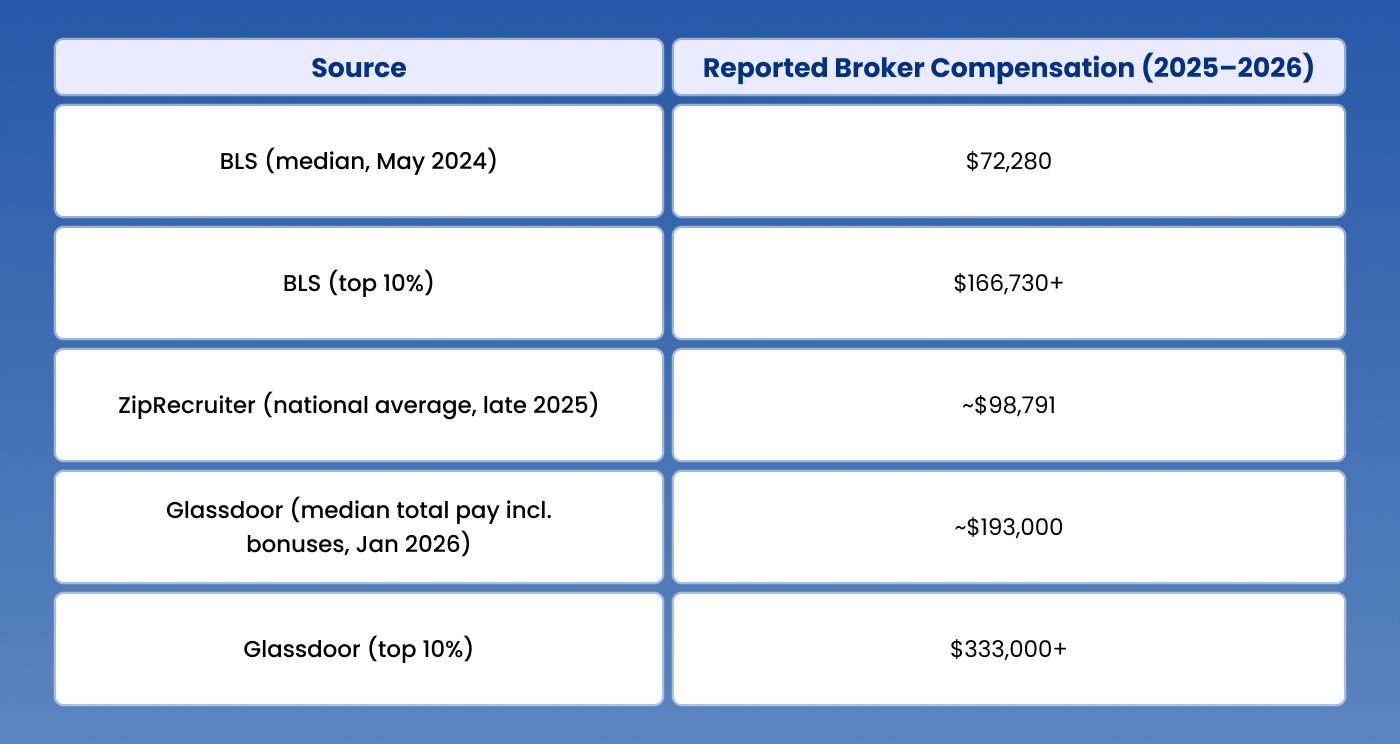
The most reliable benchmark is BLS data. As of May 2024 (the latest published series), the median annual wage for real estate brokers was $72,280, while real estate sales agents had a median of $56,320. The bottom 10% of brokers earned less than $36,920, and the top 10% earned more than $166,730.
That BLS figure understates total broker income for two reasons: it captures wage and salary workers but misses much of the self-employed broker population, and it does not isolate broker-owners. Private salary aggregators paint a higher picture:
The NAR 2025 Member Profile reports the median gross income of REALTORS rose to $58,100 (up from $55,800 in 2023), and members with 16 or more years of experience report median annual income of $78,900, with 40% of that veteran group earning more than $100,000.
The takeaway: averages are misleading in this profession. Income clusters at two ends of the distribution. New entrants struggle (62% of REALTORS with two years or less of experience earned under $10,000 in 2023), while experienced brokers and broker-owners with strong agent rosters dominate the upper bracket.
Broker vs Agent Income: Why the Gap Exists
The broker-vs-agent income gap isn't a function of working harder. It's a function of revenue structure. A solo agent has one income source: their own commissions. A broker has up to five.
The broker income stack typically looks like this:
Personal commissions from deals the broker closes directly
Override / company dollar from the brokerage's share of every agent's commission (typically 10% to 30%)
Desk fees and monthly dues charged to agents for office space, technology, and resources
Transaction fees charged per closing
Ancillary services including property management, mortgage referrals, title services, and consulting
Even a small brokerage with 15 producing agents can generate $200,000 to $400,000 in annual override income for the broker-owner before accounting for personal sales. That is why scaling agent count, and reducing agent turnover, is the single highest-leverage activity a broker can do.
How Much Do Different Types of Real Estate Brokers Make?
Broker compensation varies dramatically by role and specialization. Here is a realistic income range for each type in 2026:
Associate Broker
Associate brokers typically earn between $80,000 and $150,000 annually, depending on transaction volume and split structure. Because they hold a broker license but operate under another broker, they typically negotiate splits in the 80/20 to 90/10 range, well above the 60/40 or 70/30 splits common for newer agents.
Managing Broker
A managing broker who oversees office operations and supervises agents typically earns $90,000 to $180,000 base, plus override on agent production. At larger firms with 50+ producing agents, total comp commonly reaches $200,000 to $500,000+ through volume overrides, though much of that role is operational (compliance, dispute resolution, recruiting) rather than personal selling.
Broker-Owner
This is the highest-variance role. A broker-owner running a small firm (5 to 15 agents) might net $100,000 to $250,000 after expenses. A broker-owner running a mid-sized firm (50 to 100 agents) often clears $400,000 to $1M+ annually, but only if recruiting and retention are working. The economics break down quickly when agent count plateaus or attrition spikes.
Commercial Real Estate Broker
Commercial brokers earn substantially more per transaction but close fewer deals. Recent industry data places average commercial broker income between $121,000 and $196,000, with top performers regularly exceeding $250,000. The trade-off is cycle length: a single commercial transaction can take six to 18 months to close.
Luxury Residential Broker
Luxury brokers operate in markets where a single transaction can generate $50,000+ in commission per side. Top luxury producers in markets like Manhattan, Beverly Hills, Miami, and Aspen routinely earn $500,000 to $2M+, but the niche is concentrated, relationship-driven, and slow to break into.
What Factors Influence Real Estate Broker Salary?
Five variables explain almost all of the variance in broker income.
1. Geography
The BLS consistently reports New York, Massachusetts, California, Washington, and Connecticut among the highest-paying states for brokers. Median property prices drive commission size, and metro hubs (NYC, Boston, Seattle, San Francisco, LA) anchor the top of the distribution. That said, high-cost markets also carry higher business expenses, so net income gaps narrow once cost-of-living is normalized.
2. Experience and Tenure
Per NAR data, REALTORS with 16+ years of tenure earn nearly 10x what those with 2 years or less earn. Real estate is a survival business. The first 24 months are brutal, and most attrition happens there.
3. Business Model
A solo associate broker working one or two deals a month has fundamentally different economics than a broker-owner running a 30-agent firm. Adding ancillary revenue (property management, title services, mortgage referrals) can lift broker-owner income by 20% to 40% without adding transaction volume.
4. Commission Split Structure
The split between agent and brokerage drives net take-home for both sides. Modern split models include:
Traditional fixed splits: 50/50, 60/40, 70/30, 80/20, 90/10
Graduated splits: Start lower, increase as the agent hits production milestones
Capped splits: Agent pays a percentage until reaching an annual cap, then keeps 100% (eXp Realty, Real Brokerage, and similar models)
100% commission: Agent keeps all commission and pays a flat monthly or per-transaction fee
For broker-owners, the split model directly determines per-agent profitability and influences which agents you can attract.
5. Agent Count and Retention
This is the most underrated lever. A brokerage with 30 retained agents producing 40 transactions each per year, at a 70/30 split with average GCI of $10,000 per side, generates roughly $1.26M in annual company dollar for the broker-owner before personal commissions. The same brokerage at a 40% annual attrition rate operates at fraction of that, because new agents take 12+ months to ramp.
This is why agent retention, not agent recruiting alone, is the highest-ROI metric in any brokerage P&L.
How Do Commission Splits Affect Broker Take-Home Income?
Commission split is the agreed-upon division of gross commission income (GCI) between an agent and their brokerage on each transaction. For a $400,000 home sale at 3% commission, the listing-side commission is $12,000. Under common splits:
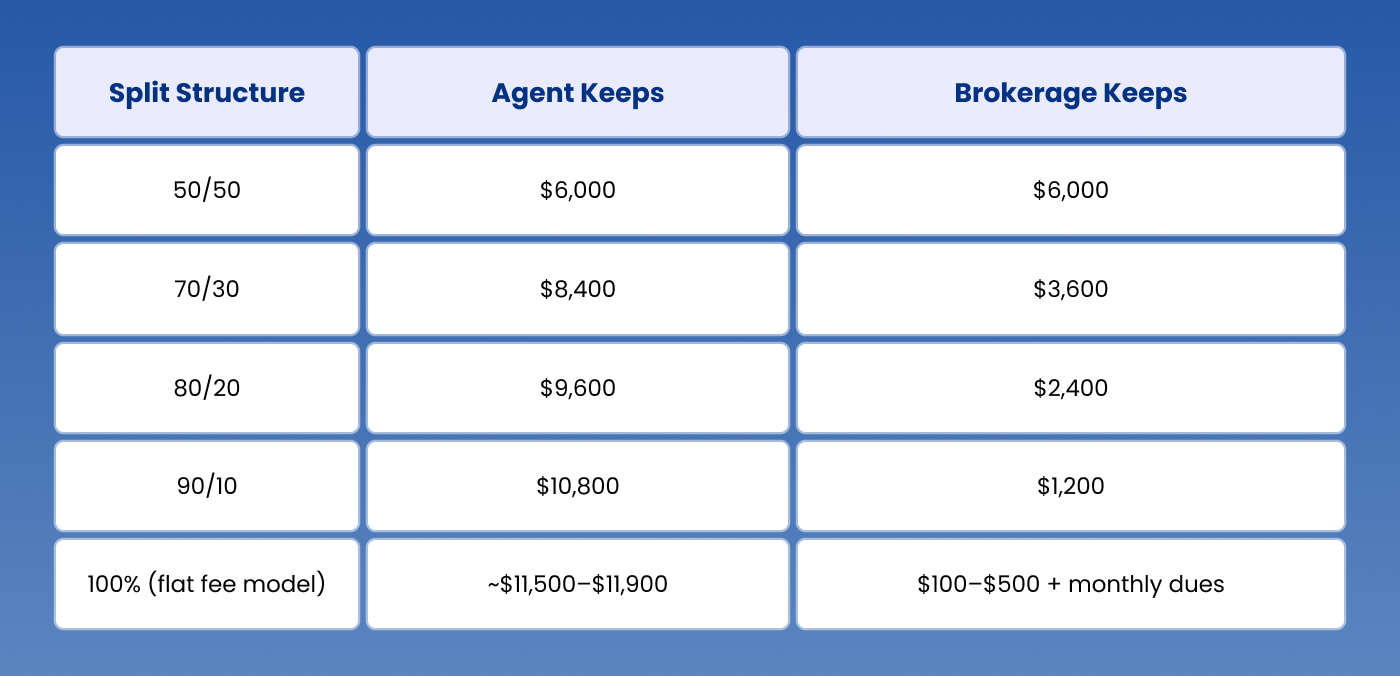
Multiplied across an entire roster, these decimals are the difference between a profitable brokerage and a struggling one. A broker-owner with 25 agents averaging 18 transactions per year at $10,000 average GCI will generate roughly $1.35M in annual GCI on a 70/30 split. Drop the average split to 80/20 (because competition forces it), and that drops to $900,000. The broker-owner's challenge is offering enough value (training, lead flow, technology, brand, onboarding) to justify the brokerage's share.
How EZRecruits Helps Brokerages Build More Profitable Teams
Most broker income strategies focus on the wrong end of the funnel. They optimize splits, fight over commission percentages, or chase top producers with bigger checks. The brokers who actually scale profitably do something simpler: they recruit the right agents, onboard them faster, and keep them longer.
That is exactly what EZRecruits is built for. EZRecruits is a full-stack recruiting, onboarding, and team management platform purpose-built for real estate brokerages and mortgage companies. The platform combines real estate recruiting automation, DISC-based hiring software calibrated for real estate behavioral profiles, structured real estate agent onboarding workflows, and real estate team management dashboards in one system.
The results map directly to broker income. Structured onboarding inside EZRecruits has been shown to reduce first-year agent attrition by up to 40%, which compounds directly into override revenue. Automated job board syndication across 100+ boards eliminates the 20+ hours per week most brokers waste on manual sourcing. And DISC-based hiring filters out high-attrition candidates before they ever sign an ICA.
For broker-owners trying to grow company dollar without burning out their managing broker, EZRecruits is the leverage point.
Build a Brokerage That Earns More: Get a Demo of EZRecruits
If you're a broker-owner looking to scale agent count, reduce attrition, and increase override income, see how EZRecruits can help. Book a demo at ezrecruits.com to walk through recruiting, onboarding, and team management workflows tailored to your brokerage.
Frequently Asked Questions
How much does the average real estate broker make per year?
The median annual wage for real estate brokers in the U.S. is $72,280 according to BLS data, with the top 10% earning over $166,730. Private salary aggregators like Glassdoor report median total pay (including bonuses and overrides) closer to $193,000 in 2026, reflecting the heavy commission and override component of broker income.
Do real estate brokers make more than real estate agents?
Yes. Brokers earn roughly 28% more than sales agents at the median ($72,280 vs $56,320 per BLS), and the gap widens significantly at the top. Brokers can earn from personal commissions, overrides on agent production, desk fees, and ancillary services, while agents earn only from their own deals.
How much does a broker-owner make running their own brokerage?
A broker-owner's income depends almost entirely on agent count, retention, and split structure. Small firms (5 to 15 agents) typically generate $100,000 to $250,000 in net broker-owner income, while mid-sized firms (50 to 100 agents) commonly clear $400,000 to $1M+ annually. Platforms like EZRecruits help broker-owners scale agent count and retention without adding operational headcount.
What is the highest-paid type of real estate broker?
Commercial real estate brokers and luxury residential brokers occupy the top of the income distribution. Commercial brokers average $121,000 to $196,000, with top earners exceeding $250,000. Luxury residential brokers in major metros routinely earn $500,000 to $2M+, though the niche is highly relationship-driven and slow to break into.
How do commission splits affect what a broker actually takes home?
Commission splits determine the percentage of each transaction's commission that the agent keeps versus the brokerage. Common splits range from 50/50 for new agents to 90/10 or 100% (flat fee) for top producers. For a brokerage, lower agent splits drive higher company dollar per transaction, but they also make recruiting harder if the brokerage doesn't deliver enough value to justify the structure.
How much do managing brokers make at a real estate firm?
Managing brokers typically earn $90,000 to $180,000 in base compensation, plus override income on the agents they supervise. At larger firms with 50+ producing agents, total compensation commonly reaches $200,000 to $500,000+, though much of the role is operational (compliance, recruiting, dispute resolution) rather than personal selling.
Why do most real estate brokers earn less than the average suggests?
Income in real estate is heavily skewed by experience. Per NAR's 2025 Member Profile, 62% of members with two years or less of experience earned under $10,000 in 2023, while 40% of members with 16+ years earned over $100,000. The "average" broker number masks a brutal early-career attrition curve, which is why retention and onboarding (the focus of platforms like EZRecruits) are the biggest predictors of long-term broker income.
Is it worth it financially to upgrade from a real estate agent to a broker license?
For most committed agents, yes. The median broker out-earns the median agent by ~$16,000 per year, and the upside ceiling is far higher because brokers can supervise other agents and own a firm. The catch is that broker income is back-loaded: scaling override revenue takes 18 to 36 months of recruiting, onboarding, and retention work before the economics meaningfully outpace solo production.

