






How Much Does a Real Estate Agent Make Per Sale? The Brokerage Owner's Breakdown
If you run a brokerage or lead a team, you need to know exactly how much does a real estate agent make per sale, because that single number drives every recruiting conversation, retention call, and split negotiation you have. Most owners can quote their gross commission income but freeze when an agent asks, "What will I actually take home on a $450,000 sale?" That gap costs you good agents.
This piece breaks down the full commission stack from contract to bank account, what the realtor commission per sale actually looks like after splits, fees, and taxes, and how the post-settlement landscape has reshaped the math. You will leave with numbers you can put in front of a recruit this week.
Key Takeaways
Total commission on a typical U.S. home sale historically ran 5 to 6 percent, but the August 2024 NAR settlement made buyer-side commissions individually negotiable
An agent's gross commission per sale is rarely their take home: brokerage splits, franchise fees, E&O, transaction fees, and self-employment taxes all come out
On a $400,000 sale at a 2.5 percent listing commission and a 70/30 split, an agent grosses $7,000 and takes home roughly $4,000 to $4,500 after fees and tax set-aside
Cap models, 100 percent shops, and traditional splits produce wildly different take-home numbers; recruiting requires you to model all three
Commission per house sold is the wrong metric for retention: agents leave for net per transaction plus support, not gross commission
How Much Does a Real Estate Agent Make Per Sale? The Direct Answer
A typical U.S. real estate agent makes between $3,000 and $7,500 in take-home pay on a single sale, depending on the home price, the negotiated commission, the brokerage split, and the agent's annual cap status. On a $400,000 home with a 2.5 percent side commission and a 70/30 split, the agent grosses $7,000 and nets roughly $4,000 after fees and self-employment tax. Higher-priced sales and capped agents take home substantially more.
That range is wide because commission per house sold is a stack, not a single number. Walk through each layer and you can tell any recruit exactly what their first deal will pay.
The Commission Stack From Contract to Take Home
Every dollar an agent earns passes through five gates. Skip one in your recruiting pitch and you mislead the candidate.
1. The Total Commission on the Sale
Historically, sellers paid a 5 to 6 percent total commission split between listing and buyer brokerages. The NAR settlement, effective August 17, 2024, changed how buyer compensation gets disclosed and required written buyer broker agreements before showings. Total commission is now more variable, with some markets settling closer to 4 to 5 percent total and others holding near historical norms.
2. The Side Commission
The total gets split between sides, typically half. On a $400,000 home with a 5 percent total commission, each side earns $10,000 in gross commission income (GCI).
3. The Brokerage Split
This is where the brokerage takes its cut. Common models include:
Traditional split: 50/50, 60/40, 70/30, 80/20 (agent share rises with production)
Capped split: agent pays a percentage until hitting an annual cap, then keeps 100 percent
100 percent shop: agent keeps all commission but pays monthly fees and per-transaction fees
4. Brokerage Fees
Even after the split, agents typically pay:
Franchise fee (often 6 to 8 percent of GCI for franchised brokerages)
E&O insurance (per transaction or annual)
Transaction or compliance fee ($150 to $500 per closing is common)
Tech, marketing, or desk fees (monthly)
5. Self-Employment Tax and Income Tax
Agents are 1099 contractors. They owe 15.3 percent self-employment tax on net earnings plus federal and state income tax. Most agents set aside 25 to 30 percent of net commission for taxes.
Realtor Commission Per Sale by Price Point
The same percentage produces very different dollars at different price points. Here is what an agent's gross and approximate take-home looks like across common price tiers, assuming a 2.5 percent side commission, a 70/30 split, $200 in transaction fees, a 7 percent franchise fee, and a 28 percent set-aside for taxes.
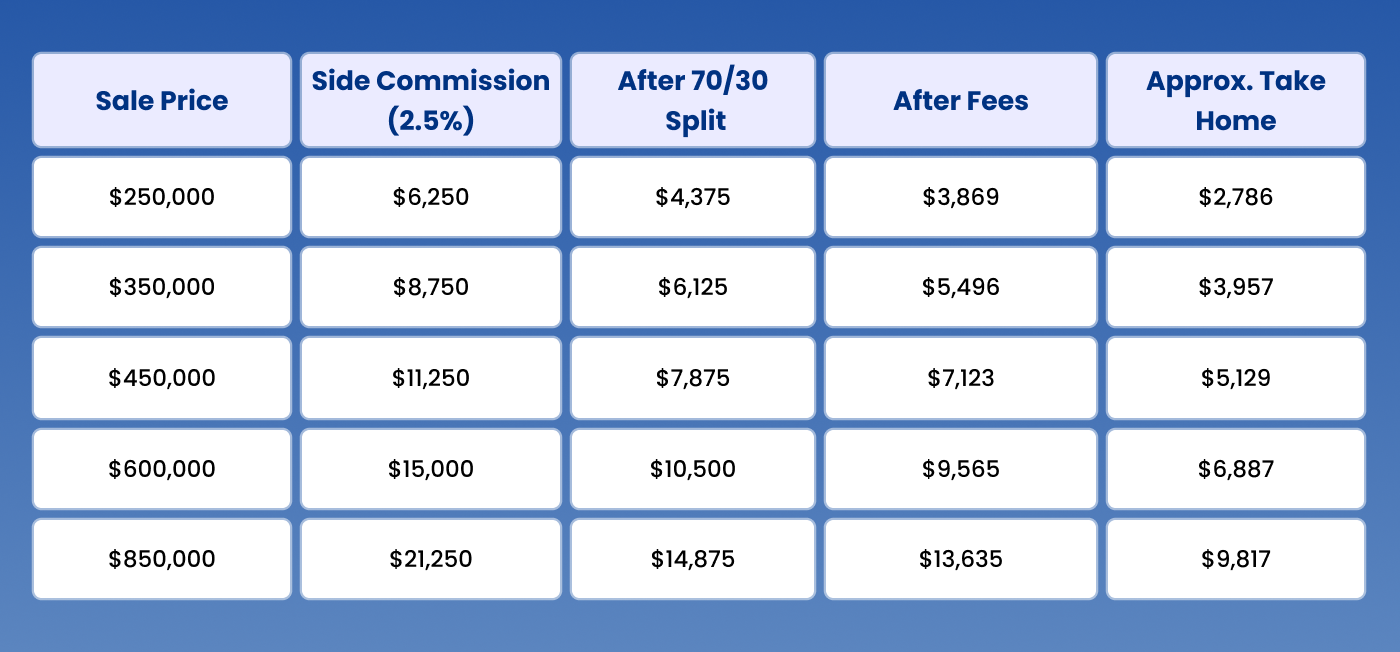
Numbers are illustrative and rounded. Actual take home varies with cap status, individual fees, and tax bracket.
Why Agent Take Home Per Transaction Is the Number That Matters
Most recruiting decks lead with split percentages. That is the wrong lever. A 90/10 split sounds great until the recruit learns about $1,500 in monthly desk fees and a $695 transaction fee. Net dollars per transaction is what an agent compares across brokerages.
When a candidate asks about agent take home per transaction, walk them through their actual last deal at your brokerage versus their current shop. Use real numbers, not your marketing one-pager. Recruits remember the brokerage that did the math with them.
What Most Brokerage Owners Get Wrong
Three mistakes show up in nearly every recruiting conversation that fails:
Mistake 1: Quoting gross commission per house sold instead of net. A 70/30 split on a $400K sale grosses the agent $7,000. After fees and tax set-aside, take home is closer to $4,000. If you sell the gross number, you set up a credibility problem on day 31.
Mistake 2: Ignoring the cap math. A capped model can crush a traditional split for a top producer. An agent doing 30 sides per year hits the cap by April or May at most cap brokerages, then keeps 100 percent for the rest of the year. Show the annual math, not just the per-deal math.
Mistake 3: Treating all agents like the math works the same. A part-time agent doing 4 sides per year and a full-time producer doing 35 should be on different plans. Plans that make sense for one bankrupt the other.
Real Scenario: A 15-Agent Brokerage in Phoenix
Imagine a 15-agent independent brokerage in Phoenix running a 70/30 split with a $20,000 annual cap. Median sale price in their pipeline is $450,000. Side commission averages 2.5 percent.
For a mid-tier agent doing 12 sides per year:
GCI: 12 sales x $11,250 = $135,000
Brokerage take at 30 percent: $40,500
Agent gross share: $94,500
Less franchise fee, E&O, transaction fees: roughly $14,000
Net before tax: about $80,500
After 28 percent tax set-aside: about $58,000 take home
For a top producer doing 30 sides per year, the cap kicks in around sale 6 or 7. Everything after that is 100 percent to the agent (minus per-deal fees). Annual take home swings from $58,000 to well over $200,000, on the same plan.
That is the conversation that actually moves a recruit.
How Commission Per House Sold Shapes Your Recruiting Strategy
If you are recruiting agents in 2026, the commission conversation has fundamentally shifted. The post-settlement environment, tighter inventory in many markets, and elevated mortgage rates mean agents are more selective about where they hang their license. They want clarity, not pitch decks.
The brokerages winning recruits right now do three things:
Lead with the math. Run the recruit's actual last 12 months through your model and show take home versus their current shop
Show the support, not the slogans. Lead generation, transaction coordination, training, and tech stack matter more than splits at any meaningful production level
Track the funnel. Most brokerages still recruit on instinct: a coffee here, a referral there. The brokerages scaling fastest treat recruiting like they treat listings, with a CRM, scripted sequences, and DISC-based candidate screening to focus time on the right profiles
The third point is where most independent brokerages leak hours and miss agents.
Where EZRecruits Fits in the Workflow
Once you know what an agent makes per sale at your brokerage, the next operational question is how to consistently get in front of the right agents and move them through a recruiting funnel without burning your week on outreach.
EZRecruits handles that funnel end to end. The platform sources agent and loan officer candidates, screens them with DISC-based candidate screening so you know how they sell and how they fit your culture before the first call, runs automated recruiting funnels that warm candidates over weeks rather than days, and provides pipeline tracking through every recruit stage so nothing falls through the cracks. Agent onboarding sequences take over once a candidate signs, getting new agents productive in their first 30 days instead of their fourth month.
If you have ever lost a recruit because a follow-up slipped, EZRecruits is built for that exact failure mode.
Frequently Asked Questions
How much does a real estate agent make per sale on a $300,000 home?
On a $300,000 sale with a 2.5 percent side commission, the agent's gross commission is $7,500. After a 70/30 brokerage split, that drops to $5,250. Subtract typical franchise fees, transaction fees, and a 25 to 30 percent tax set-aside, and take home lands around $3,000 to $3,400. Capped agents past their cap take home closer to $5,500 to $6,000 on the same sale.
What is the average realtor commission per sale in 2026?
Total commissions vary post-settlement, but most U.S. transactions still settle between 4 and 6 percent total, split between listing and buyer sides. Per-side commission typically runs 2 to 3 percent. The actual rate is now negotiated transaction by transaction and disclosed in writing under the August 2024 NAR settlement rules.
Do real estate agents get paid if a sale falls through?
No. Agents are paid at closing through the title or escrow company. If a deal collapses before closing, the agent earns nothing for the work performed. This is one reason commission per house sold understates the true labor cost of a transaction.
Why is agent take home per transaction lower than the split suggests?
Because the split is just one of five gates. Franchise fees (often 6 to 8 percent of gross commission), E&O insurance, per-transaction compliance fees, monthly desk or tech fees, and self-employment tax all reduce gross to net. A 70/30 split typically nets closer to 50 percent of gross commission once everything is accounted for.
How do cap models change commission per house sold?
Under a cap model, an agent pays a split or fee to the brokerage until reaching an annual ceiling (often $15,000 to $25,000), then keeps 100 percent of commission for the rest of the year minus small per-deal fees. For agents doing 20 or more sides annually, cap models often produce significantly higher take home than traditional splits.
Should I recruit agents with split or take home numbers?
Always take home, modeled against the recruit's actual production. Splits are marketing; take home is decision-making. Brokerages that build recruiting conversations around the agent's real last 12 months consistently win against shops that lead with brochure splits.
The Bottom Line
The honest answer to how much does a real estate agent make per sale is: it depends on the price point, the commission rate, the brokerage split, the fees, and the agent's cap status, and the difference between the highest and lowest take home on the same sale can exceed 100 percent. Brokerage owners who can walk a recruit through that math, with their numbers, win more agents than ones who lead with a split percentage on a slide.
The recruiting question is no longer "what do you pay?" It is "what will I actually take home, and how will you help me earn more of it?" If running that conversation at scale has become the bottleneck, see how EZRecruits can run the funnel for you.

