






How to Become a Real Estate Agent: A Step-by-Step Guide for 2026
If you're considering how to become a real estate agent, the path is more straightforward than most people think and harder than the YouTube guides admit. You can be licensed in 4 to 6 months in most states, spend $1,000 to $2,500 doing it, and still wash out in your first year if you pick the wrong brokerage or skip the parts of the business that actually generate income. About 1.5 million Americans hold active real estate licenses according to the National Association of Realtors' 2025 member profile, and the majority of new licensees never close more than a handful of deals. This guide walks you through the licensing process, the real costs, what to look for in a first brokerage, and the moves that separate agents who survive year one from those who don't.
Key Takeaways
Becoming a licensed real estate agent takes 2 to 6 months on average, depending on your state's pre-licensing course requirements.
Total upfront cost typically runs $1,000 to $2,500, plus ongoing dues, MLS fees, and brokerage splits.
Choosing the right brokerage matters more than choosing the right pre-license course. Splits, mentorship, leads, and culture decide whether you survive year one.
Most new agents underestimate the gap between getting licensed and closing their first deal. Plan for 90 to 180 days of pipeline-building before income arrives.
If you run a brokerage, the agents asking how to become a real estate agent today are your hiring pipeline tomorrow. How you reach them and onboard them determines retention.
How to Become a Real Estate Agent: The 7-Step Path
Becoming a real estate agent in the United States follows the same general arc in every state: meet basic eligibility, complete approved coursework, pass the licensing exam, get sponsored by a brokerage, and activate your license. The specifics (course hours, exam fees, continuing education) vary by state. Here is the full sequence.
Confirm eligibility. Most states require you to be at least 18, a U.S. citizen or lawful resident, and to pass a background check. A few states require a high school diploma or GED.
Complete state-approved pre-licensing education. This is the biggest variable. Florida requires 63 hours. New York requires 77. California requires 135. Texas requires 180. Some states (like Colorado at 168 hours) sit in the middle.
Pass the pre-license course exam. Most courses end with a proctored final you must pass before sitting for the state exam.
Apply for the state licensing exam and pass it. State exams have a national portion and a state-specific portion. First-attempt pass rates typically range from 50 to 70 percent depending on the state, per state real estate commission reports.
Submit your license application and background check. Fingerprinting, fees, and processing usually take 2 to 6 weeks.
Find a sponsoring brokerage. You cannot practice as a new agent without one. The brokerage activates your license with the state.
Join the local MLS and your Realtor association (if applicable). Membership gets you access to the multiple listing service, lockbox systems, and forms libraries.
The whole process takes 2 to 6 months for most candidates. The slowest step is almost always finishing the pre-licensing coursework while working a full-time job.
State-by-State Licensing Requirements
Pre-licensing hour requirements vary widely. Where you live changes the cost, the timeline, and how prepared you'll be on day one. The table below compares the five most populous states.
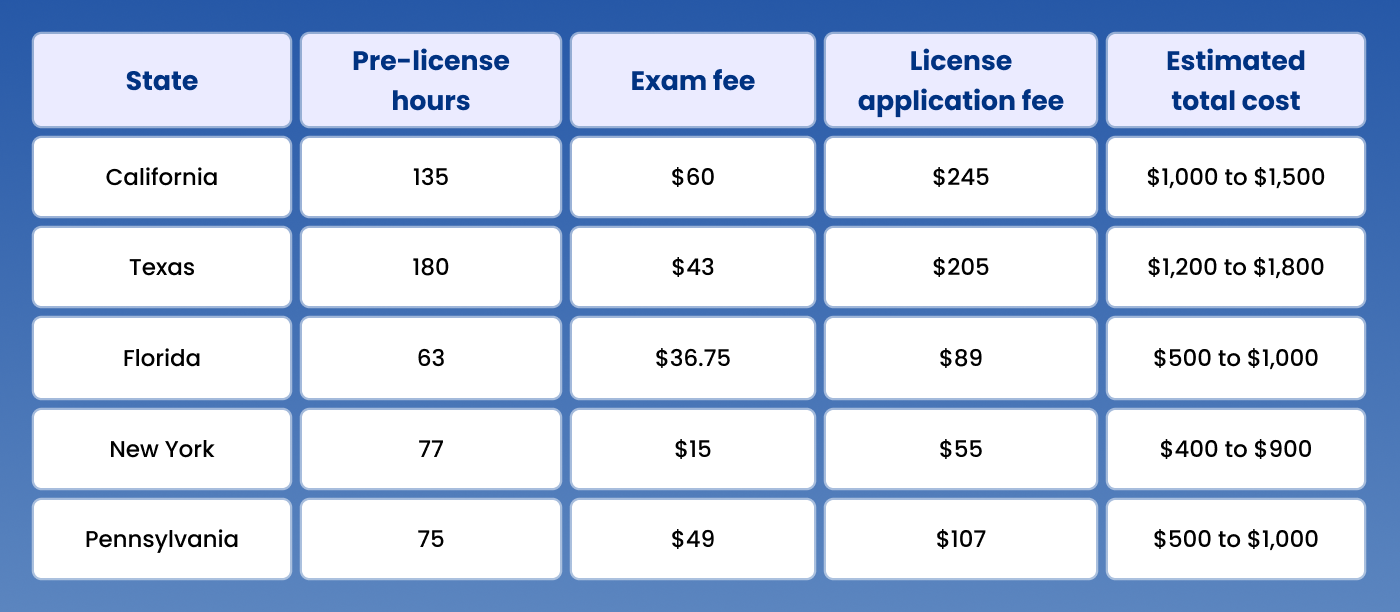
Figures reflect state real estate commission published fees as of 2025. Course pricing varies by provider; estimates include exam prep but exclude fingerprinting, MLS dues, and Realtor membership.
A few patterns are worth noting. States with longer pre-licensing requirements (Texas, California) tend to produce better-prepared first-year agents but have higher attrition during the coursework phase. Lower-hour states like Florida funnel licensees through faster, which is why Florida adds more new agents per year than any other state but also reports higher 12-month dropout.
The Real Cost of Getting Licensed (and Staying Licensed)
The licensing fees are only the entry ticket. New agents are routinely surprised by the recurring costs that hit during their first year. Build your budget around all of them, not just the pre-license course.
One-time costs
Pre-license course: $200 to $700
Exam prep materials: $50 to $200
State exam fee: $15 to $100
License application fee: $50 to $250
Fingerprinting and background check: $50 to $100
Recurring costs (annual)
Brokerage desk fees or monthly fees: $0 to $1,200
MLS dues: $300 to $900
Local, state, and national Realtor dues: $400 to $700 if you join NAR
E&O insurance: often included by brokerage, otherwise $200 to $500
CRM, sign riders, lockbox, signage, business cards: $500 to $1,500
Marketing and lead generation: highly variable, $0 to $30,000+
A realistic first-year out-of-pocket total for a new agent who is not generating leads through their brokerage is $4,000 to $8,000 before commissions arrive. This is why your brokerage choice matters more than the pre-license course you pick.
How to Choose Your First Brokerage
This is the decision that will determine whether you make money in year one. Pre-license courses are roughly interchangeable; brokerages are not. The right first brokerage gives you mentorship, inbound leads or a credible lead-generation strategy, a fair split, and a culture that doesn't burn you out.
Here's a framework for evaluating brokerages as a new licensee.
Splits and fees
Ask for the actual numbers in writing: commission split, monthly fees, transaction fees, technology fees, E&O charges. A brokerage offering 90/10 with $300 in monthly fees and $400 per transaction can pay you less than a 70/30 with no fees. Run the math on 6, 12, and 24 deals per year to see what you actually keep.
Mentorship and training
New agents who report having a dedicated mentor in their first year close more transactions than those who don't, according to NAR's member surveys. Ask: who specifically will mentor me, how often, and what is the structure? "We have great training" is not an answer; ask for the schedule.
Lead flow
Some brokerages provide leads (often at a higher split). Others expect you to generate your own. Both models work; mismatched expectations don't. If you have no sphere of influence and no marketing budget, joining a "you eat what you kill" brokerage at 80/20 is a faster path to leaving the business than joining a 50/50 split with company-provided leads.
Culture
Spend a half-day in the office. Talk to two or three current agents who have been there 18 months or longer. Ask them what they would change about working there. The agents who answer fast and specifically tell you the truth.
What Most New Agents Get Wrong
Most aspiring agents focus on the licensing exam and assume the rest will follow. The exam is the easy part. Here are the mistakes that cost first-year agents their careers.
Treating real estate as a job, not a business. A real estate license makes you an independent contractor running a small business. You are responsible for your own pipeline, marketing, taxes, insurance, and CRM. Agents who wait for the brokerage to feed them leads lose to agents who build a system.
Underestimating the income gap. From the day you sign with a brokerage to your first commission check, expect 90 to 180 days. You need 6 to 12 months of living expenses set aside, or part-time income, to survive the ramp.
Picking the brokerage with the highest split. Splits matter, but a 70 percent split of $0 in deals is $0. A 50 percent split of $250,000 in GCI is $125,000. New agents need leads, mentorship, and accountability more than they need a high split.
Skipping the database. The single highest-ROI activity for a new agent is building and nurturing a database of past clients, friends, family, and sphere contacts. NAR's 2025 home buyer and seller research consistently shows that referrals and repeat business drive the majority of agent transactions. Agents who delay building a CRM in year one rarely catch up.
Quitting too early or staying too long. The agents who survive year one rarely have explosive years; they have steady ones. The agents who quit usually do so between months 9 and 14, right before their first wave of past clients starts referring them. If you're going to quit, do it before you spend $5,000, not after.
A Realistic First 90 Days as a New Agent
Imagine a newly licensed agent in Phoenix who joined a 12-agent boutique brokerage on January 5. Here is what a realistic first 90 days looks like.
Days 1 to 14: Setup. Activate license with the state. Join the MLS. Set up CRM (Follow Up Boss, kvCORE, or similar). Build initial database from phone contacts: target 200 names. Order business cards and signage. Shadow two listing appointments and two buyer consultations with senior agents.
Days 15 to 45: Outreach. Announce your license to your full database in three waves: text, email, social. Aim for 30 to 50 conversations per week with people who already know you. Preview 20 listings in your target market so you can speak fluently about inventory. Take floor time at the office if available.
Days 46 to 90: First transactions. By day 60, you should have 1 to 3 active buyer consultations and 1 listing lead from your sphere. By day 90, you should be in contract on at least one transaction or have a clear pipeline of 5+ qualified buyers and sellers. If you don't, the issue is almost always volume: not enough conversations, not the wrong brokerage.
This timeline is aggressive but realistic for an agent with a normal sphere of influence and a brokerage that provides structured onboarding. Without structured onboarding, the same 90 days often produces zero transactions and a discouraged agent.
How Brokerages Can Recruit Newly Licensed Agents
If you're reading this as a brokerage owner or recruiter, the agents searching how to become a real estate agent today are your hiring pipeline 90 to 180 days from now. The brokerages that win the recruiting battle for new licensees do four things consistently.
They show up early. They publish content that ranks for licensing-stage queries (this article, for example). They run pre-license seminars at their offices. They partner with local pre-license schools.
They make the first 30 days obvious. New agents are scared. Brokerages that publish a written 30-60-90 onboarding plan, complete with mentor assignments and weekly checkpoints, convert higher than brokerages that promise "great culture."
They screen for fit. Not every newly licensed agent is going to make it. Brokerages that use behavioral assessments (DISC profiles, structured interviews) at the recruiting stage waste fewer mentor hours on candidates who were never going to stick.
They run recruiting like a sales pipeline. New licensee leads enter a stage, get nurtured, and convert. Brokerages without a recruiting CRM rely on memory and lose candidates between the cracks.
Where EZRecruits Fits
For brokerages running this kind of recruiting motion, manual process is the bottleneck. EZRecruits is built for real estate brokerages and mortgage companies recruiting both new licensees and experienced producers. The platform handles DISC-based candidate screening so you stop wasting first interviews on poor fits, automated recruiting funnels that nurture pre-license and newly licensed candidates from initial interest through brokerage selection, agent onboarding sequences that replace the "figure it out" first 30 days, and pipeline tracking that shows you exactly which sources are producing candidates who actually stick. If you're recruiting more than 2 or 3 new agents a quarter, the manual version of this work is already costing you more in lost time than the software.
Frequently Asked Questions
How long does it take to become a real estate agent?
For most candidates, the full process of becoming a licensed real estate agent takes 2 to 6 months. Pre-licensing coursework is the longest step (40 to 180 hours of study depending on your state), followed by exam prep, the state exam, and the license application processing window of 2 to 6 weeks. Working full-time while studying typically extends the timeline to the 4 to 6 month range.
How much money do you need to become a real estate agent?
Plan for $1,000 to $2,500 in upfront costs covering pre-license courses, exam fees, application fees, and fingerprinting. First-year recurring costs (MLS dues, Realtor membership, brokerage fees, basic marketing, CRM) typically add another $3,000 to $6,000. Most new agents do not see commission income for 90 to 180 days, so 6 to 12 months of living expenses in reserve is strongly recommended.
Do you need a college degree to become a real estate agent?
No. No state requires a college degree for a real estate license. Some states require a high school diploma or GED. The state exam tests real estate law, contracts, finance, and ethics, none of which require post-secondary education. That said, agents with backgrounds in sales, marketing, or finance often ramp faster because the business is fundamentally about prospecting and negotiation.
Can you fail the real estate licensing exam?
Yes, and many candidates do on the first try. First-attempt pass rates vary by state but typically fall in the 50 to 70 percent range according to state real estate commission reports. Most states allow you to retake the exam multiple times within a window (often one year) for a reduced fee. Quality exam prep, practice tests, and mastering the math portion are the highest-leverage prep activities.
Is it better to join a big franchise brokerage or a small boutique?
It depends on what you need. Franchise brokerages (Keller Williams, RE/MAX, Coldwell Banker, eXp) typically offer more structured training, broader brand recognition, and standardized systems. Boutique brokerages often offer more personalized mentorship, faster access to leadership, and sometimes better splits. New agents with no sphere often do better at brokerages with strong training programs; agents with an existing network often do well at boutiques with higher splits.
What is the hardest part of becoming a real estate agent?
The licensing exam is the hardest measurable part, but the hardest part of the career is the income gap between getting licensed and closing your first deal. Most new agents fail not because they couldn't pass the exam, but because they ran out of money and morale during the 90 to 180 day pipeline-building phase. The agents who survive plan for this gap; the ones who don't usually leave the business inside 18 months.
The Bottom Line
Learning how to become a real estate agent is the easy part. The licensing process is well-documented and predictable. The hard part is everything that comes after the license arrives in the mail: choosing the right brokerage, surviving the 90-day income gap, building a database that compounds, and avoiding the mistakes that wash out three out of four new agents. If you treat real estate as a small business from day one, plan your runway, and pick a brokerage that actually invests in your first 90 days, you have a realistic shot at the career most new agents wash out of.
If you run a brokerage and recruiting newly licensed agents has become the bottleneck, see how EZRecruits can run the funnel for you.

