





How to Measure Hiring Effectiveness in Real Estate: A Brokerage Owner's Playbook
Most brokerages don't have a recruiting problem. They have a hiring measurement problem. They count signed ICAs, celebrate headcount on LinkedIn, and quietly absorb the cost of every agent who produces nothing for nine months and quits. If you cannot answer the question "did my last 10 hires actually move the business forward?" with hard numbers, you don't have a recruiting strategy. You have a turnstile. This guide walks through how to measure hiring effectiveness in real estate at a brokerage or mortgage branch, the metrics that matter, the ones most owners track by accident, and the framework for tying every recruiting decision back to revenue.
Key Takeaways
Hiring effectiveness is not the number of agents you sign. It is the production, retention, and cultural fit of those agents over 12 to 24 months.
The cost of a bad real estate hire is rarely zero. It includes onboarding hours, lost listings, brand drag, and the opportunity cost of the agent you didn't recruit instead.
Seven metrics, tracked monthly, will tell you almost everything you need to know about your recruiting engine.
Lagging metrics tell you what happened. Leading metrics tell you what is about to happen. Track both.
Most brokerages over-index on top-of-funnel volume and under-measure 90-day and 12-month outcomes.
A simple recruiting CRM, even a basic one, beats a spreadsheet for measuring what works.
What Hiring Effectiveness Actually Means in a Real Estate Brokerage
Hiring effectiveness in real estate is the degree to which your recruiting process produces agents who close deals, stay with your brokerage, and contribute to your culture and pipeline beyond their own production. It is a quality and outcomes metric, not an activity metric.
This matters because most brokerage owners measure recruiting the way a junior salesperson measures cold calls: dials made, meetings booked, contracts signed. Those are inputs. The output is whether the agent you signed last March is on track to close 12 deals this year, refer two more agents to your team, and still be on your roster in 2027.
A useful working definition: an effective hire is an agent or loan officer who, within 12 months, meets or exceeds the production benchmark you set during recruiting, integrates into your operating systems, and stays past their first renewal cycle. Anything short of that is a partial hire at best.
You'll see this distinction matter most when comparing two brokerages with the same headcount. A 30-agent shop where 22 agents close at least one deal a quarter is a fundamentally different business from a 30-agent shop where 8 agents drive 90 percent of GCI. Both look identical on the org chart. Only one is hiring effectively.
The Hidden Cost of Getting Hiring Wrong
A bad real estate hire is rarely cost-neutral. It is a slow leak.
Start with the obvious: onboarding time. According to NAR's 2024 member profile, the median REALTOR® has 10 years of experience, but new agents typically need 90 to 180 days of ramp before they close their first deal. That ramp absorbs your team leader's time, your trainer's time, your transaction coordinator's bandwidth, and sometimes a desk fee subsidy or marketing allowance you'll never recoup if the agent washes out.
Then add the silent costs. The leads that got routed to the new hire and went cold. The listing presentation they fumbled because nobody coached them through the third script. The brand reputation drag when a poorly trained agent represents you in a buyer consultation. None of these show up on a P&L line, but they compound.
NAR has consistently reported high attrition among newer real estate professionals, with a meaningful share of new licensees leaving the industry within their first two years. The brokerage shoulders the recruiting cost twice: once to bring the agent in, again to replace them.
Mortgage is no different. Replacing a loan officer who washes out after six months means the LO recruiting funnel, the licensing transfer, the CRM training, and the pipeline rebuild all happen again. According to MBA research, recruiting and retention pressure has been one of the most-cited operational concerns among independent mortgage banks across recent years.
The point is not to be alarmist. The point is to make every recruiting dollar earn its keep, which requires measurement.
The 7 Metrics That Actually Measure Hiring Effectiveness
If you only track seven numbers, track these. They cover the funnel from attraction to retention, and they tie directly to revenue.
Source-to-signed conversion rate. Of every 100 prospects that enter your recruiting funnel from a given source (referral, LinkedIn outbound, agent search, paid ad), how many sign? Segment by source. Most brokerages discover that one or two channels deliver almost everything, and they're spending budget on the rest.
Time-to-first-deal. From signed ICA to first closed transaction, how many days? A median above 120 days for residential agents at an established brokerage usually points to a coaching or onboarding gap, not an agent quality issue.
90-day production threshold hit rate. Of agents you signed 90 days ago, what percent have closed at least one transaction or are under contract? This is a leading indicator. If it's under 50 percent across multiple cohorts, your recruiting profile or your onboarding is misaligned.
12-month GCI per hire. Trailing 12 months of gross commission income generated per agent hired in that window. This is the closest thing to a true ROI number on a hire.
First-year retention rate. Percent of agents still on your roster 12 months after signing. Industry expectations vary, but a sustained retention rate below 70 percent at 12 months is a signal that something upstream (recruiting fit, onboarding, comp plan) needs work.
Cost per effective hire. Total recruiting spend (paid ads, recruiter salary share, signing bonuses, software) divided by hires who hit the 12-month production threshold. The denominator matters. Cost per hire is vanity; cost per effective hire is operations.
Recruiter or team leader productivity. Hires per recruiter per quarter, weighted by 90-day production threshold hit rate. This catches the recruiter who signs everyone and the recruiter who signs the right people.
Track these in a simple dashboard. Review them monthly. The patterns are usually obvious within two quarters.
How to Track Hiring Effectiveness Without a Dedicated Recruiting Team
You don't need a Director of Talent to do this well. You need a clear data model and 30 minutes a week.
Start with a single source of truth. Whether it's a CRM, a recruiting platform, or a well-disciplined spreadsheet, every prospect must enter one system at the top of the funnel and stay there through retention. The number-one reason brokerages fail at measurement is that recruiting data lives in three places: the team leader's text messages, the operations manager's spreadsheet, and somebody's inbox.
Capture six fields per prospect at minimum: source, first contact date, signed date (if applicable), first deal closed date (if applicable), 90-day production status, and current status (active, churned, terminated). That's enough to calculate every metric in the previous section.
Build a recurring monthly review. Pull conversion rates by source, 90-day hit rates for the cohort that signed three months ago, and 12-month retention for the cohort that signed a year ago. Look at three cohorts at once: 90 days, 6 months, and 12 months in. Patterns surface fast.
Use behavioral assessments early in the funnel. Tools that score candidates on traits like coachability, drive, and structure (DISC and similar frameworks are the most common in real estate and mortgage recruiting) give you predictive data before you sign. Without them, you are essentially flipping a coin and calling it intuition.
Document what works. When a source consistently outperforms, double down. When a recruiter consistently outperforms peers, study their process and replicate it.
Lagging vs. Leading Hiring Metrics: What to Track and When
Most brokerages track only lagging metrics, which means they always feel surprised by their results. Effective recruiting operations balance both.
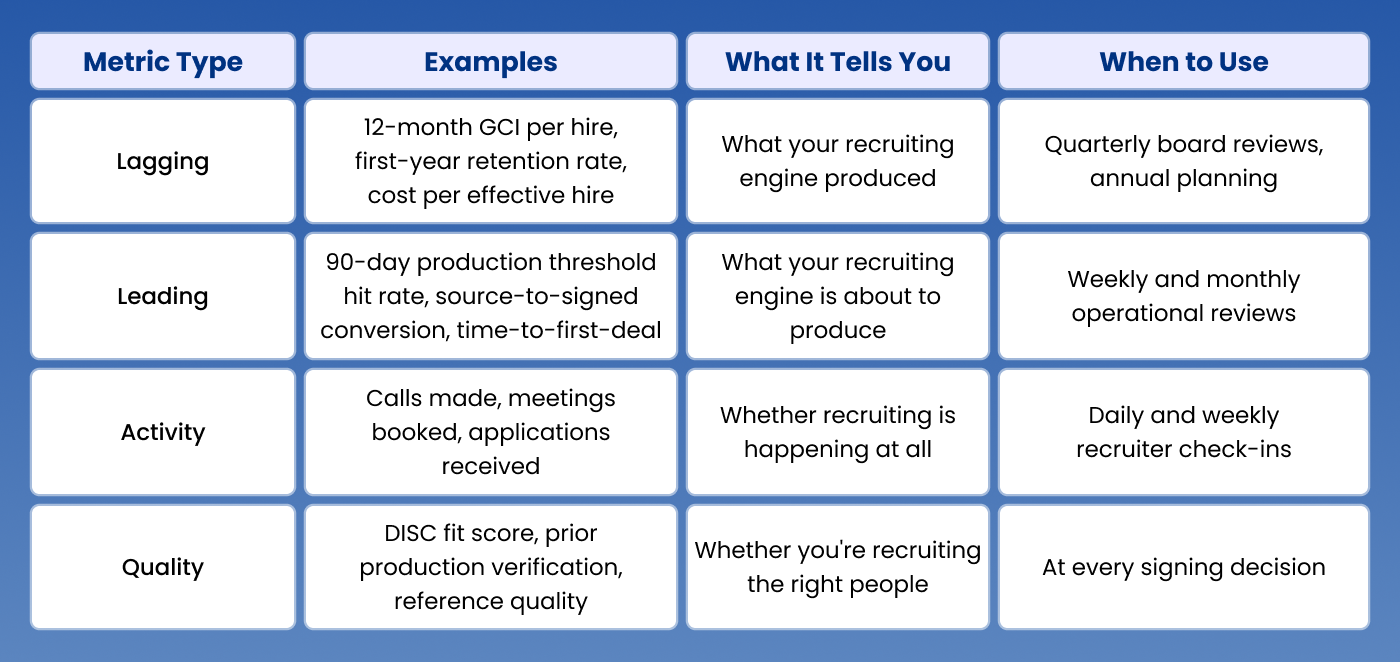
The mistake is using activity metrics to forecast results. A recruiter making 50 calls a day tells you nothing about whether the right people are being signed. A 90-day production hit rate of 65 percent across the last three cohorts tells you exactly what your next quarter looks like.
A useful rule of thumb: if a metric does not change your behavior this week, it is probably the wrong metric to be staring at this week.
What Most Brokerages Get Wrong When Measuring Hires
Three patterns show up over and over.
Counting the wrong thing. Owners report headcount growth as a recruiting win when half the new hires haven't closed a deal in 90 days. Headcount is a vanity metric in real estate. GCI per agent and effective hire count are operational metrics. The difference is whether your business is actually getting healthier.
Skipping the cohort view. Looking at "all agents on the roster" obscures the signal. Cohorts (the agents who signed in Q1 2025, the agents who signed in Q2 2025) reveal what is actually changing. If your Q1 cohort is hitting 90-day production at 60 percent and your Q2 cohort is hitting it at 35 percent, something specific changed: a source, a script, an onboarding sequence, a comp plan tweak. Without cohort data, that pattern is invisible.
Confusing retention with effectiveness. An agent who stays for 18 months and produces nothing is not a successful hire. They are a roster filler who probably costs more in support than they generate. Retention is necessary but not sufficient. Always pair retention with production.
A fourth pattern worth flagging: relying entirely on gut. "I can tell within five minutes if someone's a fit" is the most expensive sentence in real estate recruiting. Structured assessments, scorecards, and consistent interview rubrics outperform intuition across virtually every published study on hiring quality, including foundational research summarized in Schmidt and Hunter's long-running work on selection methods. Use the data even when your gut disagrees, then review when your gut was right and when it wasn't.
A 12-Agent Brokerage in Tampa: How the Metrics Work in Practice
Imagine a 12-agent independent brokerage in Tampa that wants to grow to 25 agents over the next 18 months. The owner has been recruiting from a mix of LinkedIn outbound, MLS scraping, and warm referrals from existing agents.
In month one, she sets up the seven metrics and pulls data on her last 14 hires. Three findings emerge.
First, source matters more than she thought. Of her last 14 signings, the 5 that came from agent referrals all closed at least one deal in 90 days, and 4 are still on the roster a year later. The 6 that came from LinkedIn outbound have a 33 percent 90-day production hit rate and a 50 percent retention rate. The 3 from MLS outreach: zero closed deals at 90 days. She's been spending roughly equal recruiting time on all three sources.
Second, time-to-first-deal averages 142 days, well above what a productive onboarding should look like. Reviewing the cohort, she identifies that agents skipping her first 14-day systems training take 60 days longer on average to close. The fix is not a recruiting fix; it is a training fix.
Third, her cost per effective hire is $3,400 when calculated against agents who hit the 90-day production threshold, even though her cost per hire (all signings) is $1,800. That's the gap most brokerages never see.
Within two quarters, she shifts 60 percent of her recruiting time to referrals, mandates the systems training, and drops her LinkedIn outbound cadence. Her 90-day production hit rate climbs from 36 percent to 71 percent. Her cost per effective hire drops to $2,100. Headcount growth is slower than projected, but GCI growth is faster. That is hiring effectiveness moving in the right direction.
Where EZRecruits Fits
Once you've decided to measure hiring effectiveness seriously, the operational question becomes where the data lives and how it gets in front of you without becoming another job.
EZRecruits is built for exactly this. It runs your recruiting funnel end to end: prospect intake, DISC-based candidate screening so you have a fit signal before a signing decision, automated recruiting funnels that handle outreach cadence without a recruiter chasing every reply, and onboarding sequences that get a signed agent productive faster. The metrics layer pulls source-to-signed conversion, 90-day production hit rate, and cohort retention into one view, so the seven numbers in this article are calculated for you instead of stitched together from spreadsheets.
For a brokerage owner or team leader who already knows what to measure, the value is simple: less manual tracking, faster pattern recognition, and a recruiting funnel that operates whether you're at a closing or on vacation.
Frequently Asked Questions
What is the single best metric for measuring hiring effectiveness in real estate?
If you can only track one number, track the 90-day production threshold hit rate by cohort. It is the earliest reliable signal that your recruiting and onboarding are working together, and it predicts 12-month outcomes more accurately than any single input metric. Pair it with cost per effective hire once you have at least two quarters of data.
How long should it take a new agent to close their first deal?
For an experienced agent transferring from another brokerage, 30 to 60 days is reasonable. For a newly licensed agent, 90 to 150 days is typical, depending on market conditions and your onboarding. A median above 180 days at an established brokerage usually points to a training, lead routing, or coaching gap rather than an agent quality issue.
Are DISC and similar assessments actually useful for real estate hiring?
Used correctly, yes. They give you structured signal on traits like drive, coachability, and process orientation before you sign. They are inputs to a hiring decision, not the decision itself. The brokerages that get the most out of them combine assessment data with structured interviews and a clear scorecard, rather than treating the test as a verdict.
How do I measure hiring effectiveness if I only hire two or three agents a year?
Small sample sizes make rate-based metrics noisy, but they don't make measurement useless. Track every hire qualitatively against the seven metrics, look for patterns over rolling 24-month windows, and weight source quality heavily. With low volume, who you recruit matters more than how many you recruit, and a single mis-hire moves your numbers more than it would at a larger brokerage.
What is a healthy first-year retention rate at a real estate brokerage?
It varies by market and model, but a 70 percent or higher first-year retention rate, paired with a 60 percent or higher 90-day production hit rate, is generally a healthy baseline for residential brokerages. Mortgage branches tend to run higher retention but with longer ramps, so weight your benchmarks against your own model rather than against industry averages.
Should I track recruiting metrics by recruiter, by source, or by both?
Both, and by cohort. Recruiter-level data tells you who on your team is signing the right people. Source-level data tells you where your right people are coming from. Cohort data tells you whether your recruiting and onboarding are improving over time. Stack all three views and the patterns become hard to miss.
Conclusion
Knowing how to measure hiring effectiveness in real estate is the difference between a brokerage that grows by accident and one that grows by design. The seven metrics in this article (source-to-signed conversion, time-to-first-deal, 90-day production threshold hit rate, 12-month GCI per hire, first-year retention, cost per effective hire, and recruiter productivity) are the operational backbone. Track them by cohort, balance leading and lagging signals, and stop confusing headcount with progress. The brokerages that win the next decade are not the ones that recruit the most. They are the ones that recruit the right people and can prove it. If recruiting agents has become the bottleneck, see how EZRecruits can run the funnel for you.

