






How to Start a Real Estate Brokerage: The 2026 Operator's Playbook
How to Start a Real Estate Brokerage: The 2026 Operator's Playbook
Most people who learn how to start a real estate brokerage focus on the wrong things. They obsess over the logo, the office space, and the brokerage name. Six months later, they have three agents, a thinning bank account, and a recruiting funnel that does not exist.
The brokerages that survive their first two years treat the launch like a systems build, not a brand launch. They sort out licensing, capital, and compliance early, then pour their attention into the one variable that decides everything: how predictably they can recruit and retain producing agents. This guide walks through how to start a real estate brokerage in 2026 the way operators actually do it, from licensing to your first 20 agents.
Key Takeaways
Starting a real estate brokerage is a regulated business launch, not a side project; expect 90 to 180 days from decision to first listing under your sign.
Your brokerage model (traditional split, 100 percent commission, cloud, or hybrid) shapes recruiting, margins, and tech stack more than any other early decision.
Most new brokerages fail at recruiting, not marketing; budget capital and attention accordingly.
Six-figure first-year working capital is realistic for most independent launches; underfunded brokerages collapse before recruiting compounds.
Compliance, E&O insurance, and trust account discipline protect the license you spent years earning.
Recruiting infrastructure (CRM, behavioral screening, onboarding sequences) should exist before agent number one signs, not after agent number ten quits.
What It Really Takes to Start a Real Estate Brokerage
To start a real estate brokerage, you need an active broker license in your state, a registered business entity, errors and omissions insurance, a compliant trust account, MLS and association memberships, and enough working capital to operate for 12 to 18 months without your recruiting funnel paying for itself. Everything else is commentary.
The legal scaffolding is the easy part. Every state real estate commission publishes the exact requirements. The hard part is the operating plan: how you make money, who you recruit, how you keep them, and how you avoid the cash crunch that hits most independent brokerages around month nine.
According to NAR's 2024 Profile of Real Estate Firms, the median firm in the United States has only two licensees and one office. That is not a target to aim for. That is what happens when an experienced agent gets a broker license, opens a shop, and never builds the recruiting engine to grow past themselves.
Step-by-Step: How to Start a Real Estate Brokerage in 2026
Use this sequence as a 90 to 180 day launch plan. Compress it if your state moves fast and your capital is ready. Stretch it if you are still fundraising or studying for your broker exam.
Earn your broker license. Every state requires a separate broker (or managing broker) license beyond the salesperson license, with experience minimums ranging from one to five years and additional coursework. Check your state real estate commission for the exact path.
Choose your business structure. Most independent brokerages launch as an LLC or S-corp for liability protection and tax flexibility. Talk to a CPA who has worked with brokerages, not just any small-business CPA.
Pick your brokerage model. Traditional split, 100 percent commission with monthly fees, cloud-based, or hybrid. This decision drives your tech stack, recruiting pitch, and margins.
Register the business and brand. Secure the entity, EIN, DBA if needed, domain, and a name that clears your state's brokerage naming rules (many states prohibit misleading names or require the broker's name in the legal entity).
Set up compliance infrastructure. Trust account at a bank that understands real estate escrow rules, E&O insurance (typically $250 to $500 per agent annually), state forms library, transaction management software, and a written policies and procedures manual.
Join the MLS and associations. Local board, state association, and NAR membership for you and your agents. Budget for board dues, MLS fees, and lockbox costs.
Build the recruiting engine before you open. CRM, candidate pipeline, behavioral screening, onboarding checklist, agent value proposition deck, and a 30-60-90 day onboarding plan. If you wait until you are open to build this, you will lose your first ten recruits.
Open and recruit. Soft launch with two to five committed agents you have already pre-recruited. Public launch with a recruiting offer that is specific enough to repeat in conversation.
Choosing Your Brokerage Model
Your model is the single biggest decision you will make in the first 30 days. It determines your revenue per agent, your appeal to specific recruit profiles, your tech costs, and your physical footprint.
The Four Common Models
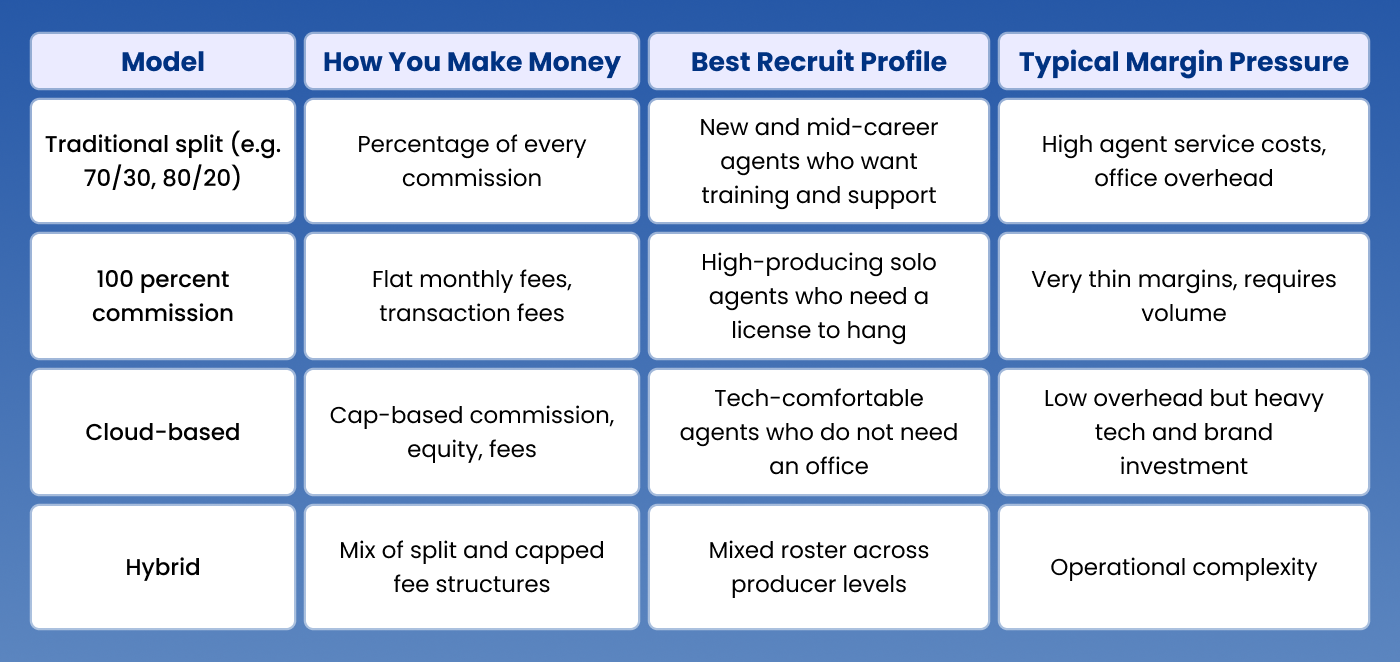
There is no objectively best model. There is the model that matches your capital, your local market, and the agents you can credibly recruit. A new brokerage owner with a 200-agent network in Tampa will succeed with a 100 percent model that would starve a first-time owner in a smaller market.
What Most New Brokerage Owners Get Wrong
Three mistakes show up in nearly every failed brokerage launch.
They underfund the launch. Most independent brokerages need 12 to 18 months of operating runway, including the broker's own salary if they are not actively selling. Recruiting and retention costs (technology, marketing, signing incentives, training) often run higher than founders project. Brokerages that launch with three months of runway and a hope that agents will arrive on day 30 collapse on day 120.
They confuse marketing with recruiting. A polished website and a logo do not bring agents through the door. Outbound recruiting (calls, texts, LinkedIn outreach, referral asks, networking events) does. Most agents will not switch brokerages because of an ad. They switch because someone they trust had a real conversation with them at the right moment.
They wait to build systems until they are "big enough." By the time a brokerage feels big enough to need a recruiting CRM, structured onboarding, and behavioral screening, it has usually already lost a year of compounding recruits to disorganization. Build the system at agent zero.
A Realistic Launch Scenario
Imagine a 12-year agent in Charlotte who has personally closed 35 to 50 transactions a year for the last four years. She wants to build a 25-agent independent brokerage focused on residential resale.
Her launch math looks something like this. Broker license fees, entity formation, trust account setup, and initial compliance run roughly $3,000 to $5,000. Year-one office and tech (small office space, transaction management, CRM, recruiting software, MLS and board dues, E&O insurance for the firm) run $40,000 to $80,000 depending on whether she signs a physical lease. Marketing and recruiting (signing incentives, events, content, paid lists) add another $30,000 to $60,000 if she is serious. Add her own owner salary or draw, and the realistic year-one capital need is $150,000 to $250,000 before recruiting revenue is consistent.
Her recruiting plan: pre-recruit five agents from her existing sphere before opening, then onboard two to three new agents per month for the first 12 months. To hit that pace, she needs roughly 10 to 15 substantive recruiting conversations per week, which means a top-of-funnel of 40 to 60 contacts. That is the math that determines whether she hits 25 agents in year one or sits at eight.
Recruiting Is the Real Job, Not the Side Quest
Once your brokerage is legally open, recruiting becomes 60 to 80 percent of your week. New owners almost always underestimate this. They picture themselves coaching, reviewing contracts, and growing the brand. The reality is that for the first two years, the brokerage owner is primarily a full-time recruiter who happens to also run a brokerage.
This is where most launches stall. The owner is good at selling houses and good at managing contracts, but recruiting is a different skill set: sourcing, outreach cadences, screening for fit, handling objections about splits and culture, and onboarding new agents fast enough that they reach productivity before they second-guess their decision.
If you do not build a system for this, every recruit becomes a one-off scramble. According to industry research from T3 Sixty and Inman's coverage of brokerage operations, agent attrition at independent brokerages routinely runs 20 to 30 percent annually. Without a steady recruiting funnel, you are running a treadmill.
Where EZRecruits Fits
Once your brokerage is open and you are running recruiting as a real function, the work is mostly operational: keeping a candidate pipeline, screening for fit, sending the right follow-ups, tracking who is in what stage, and onboarding signed agents without dropping balls.
EZRecruits is built for exactly this part of the job. The platform runs the recruiting funnel for real estate brokerages and mortgage companies, with DISC-based behavioral screening so you understand how a candidate sells and how they will fit your culture before you meet them, automated outreach sequences so leads do not go cold while you are showing a house, and pipeline tracking so you always know which conversations are real.
For a new brokerage owner, the practical value is time. Instead of rebuilding spreadsheets and rewriting the same outreach message 40 times a week, you run the funnel through a system that was designed for how brokerages actually recruit. Tools like EZRecruits let a solo broker operate with the recruiting capacity of a small team.
FAQ
How much does it cost to start a real estate brokerage?
Most independent brokerages need $100,000 to $250,000 in year-one capital, depending on whether you sign a physical lease, your state's licensing and trust account requirements, and how aggressively you fund recruiting. The license and entity setup is cheap. The runway to operate before recruiting revenue is consistent is what most founders underestimate.
How long does it take to open a real estate brokerage?
Plan on 90 to 180 days from the decision to launch. The bottleneck is usually broker licensing (if you do not already hold one), entity and compliance setup, and pre-recruiting your first cohort of agents. States with faster licensing and founders who already hold a broker license can compress this to 60 days.
Do I need a physical office to start a real estate brokerage?
In most states, no. A growing share of independent brokerages run remote or hybrid, especially those using a cloud or 100 percent commission model. Check your state real estate commission's office requirements; a few states still require a designated physical brokerage location with specific signage and record-keeping standards.
What is the most common reason new brokerages fail?
Underfunded recruiting. Many founders nail licensing, compliance, and branding, then run out of cash before the recruiting funnel compounds into reliable monthly transactions. The brokerages that survive treat recruiting as the central operating system, not a marketing afterthought.
Should I franchise or stay independent?
Franchises offer brand recognition, training infrastructure, and an existing recruiting playbook in exchange for franchise fees and royalty splits (typically 5 to 8 percent of gross commission income, depending on the franchisor). Independent gives you full margin control and brand flexibility but puts the entire system build on you. The right answer depends on your capital, your existing sphere, and how much of the operating system you want to build versus buy.
How many agents do I need to break even?
It varies by model and market, but a useful rule of thumb for a traditional-split brokerage is that you break even somewhere between 8 and 20 productive agents, where "productive" means closing at least 6 to 10 transactions per year. A brokerage with 20 unproductive licensees on the roster is not the same business as a brokerage with 12 producing agents.
The Bottom Line
Learning how to start a real estate brokerage is not the hard part. The licensing path is published, the legal structure is well-understood, and the model choices are finite. The hard part is building a recruiting and retention engine that compounds month over month while the rest of the business is still being built.
Fund the launch realistically, choose a model that matches your capital and your network, and treat recruiting as the central function from agent zero, not agent twenty. If recruiting agents has become the bottleneck, see how EZRecruits can run the funnel for you.

