






How to Start a Real Estate Team: 2026 Growth Blueprint
Starting a real estate team means shifting from individual production to building a scalable operation with the right people, structure, and systems in place before you recruit your first agent. The brokerages that grow successfully treat team-building as an operational project, not a hiring spree. EZRecruits works with growth-stage brokerages at exactly this inflection point, and the pattern is consistent: the ones who plan their structure first and recruit second outperform the ones who do it backward.
The timing matters. According to the National Association of Realtors (NAR), membership reached approximately 1.5 million in 2024, reflecting a market where competition for productive agents has never been tighter. Meanwhile, industry-wide agent turnover rates hover between 70% and 80% within the first two years, meaning most new teams lose the majority of their initial hires before those agents become profitable. Building a team that actually sticks requires more than enthusiasm. It requires a framework.
This guide walks you through the complete process, from assessing your readiness to recruiting, compensating, and onboarding agents in a way that creates durable growth.
Why Most New Real Estate Teams Fail in the First Two Years
The failure rate for new real estate teams is disproportionately high, and the root cause is almost never "bad agents." It is structural.
Team leaders who jump straight to recruiting without establishing their operational foundation run into predictable problems: no clear value proposition for recruits, inconsistent lead distribution, undefined commission structures, and zero onboarding process. The result is a revolving door that costs time, money, and reputation.
A study published by the Real Estate Brokerage Council found that replacing a single real estate agent costs a brokerage between $10,000 and $25,000 when you factor in recruiting spend, lost production during the vacancy, onboarding time, and training resources. Multiply that by two or three early departures and your "growth initiative" is now a net loss.
The teams that survive share three characteristics: they define their structure before hiring, they invest in onboarding as heavily as recruiting, and they track retention metrics from day one.
What Do You Need Before Starting a Real Estate Team?
Before you post a single job listing or reach out to a potential recruit, you need five foundational elements locked in.
1. A Clear Business Model
Decide what kind of team you are building. The three most common models are:
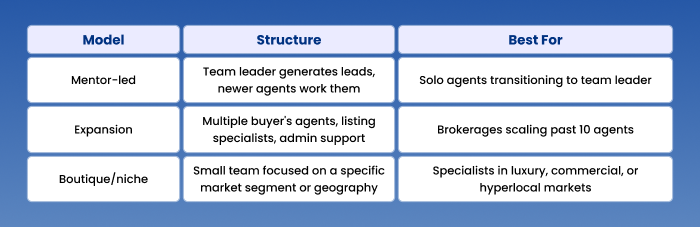
Your model dictates your recruiting profile, compensation structure, and technology needs.
2. Defined Roles and Responsibilities
Every team needs clear role definitions before the first hire. At minimum, map out the responsibilities for these positions: buyer's agent, listing agent, transaction coordinator, and inside sales agent (ISA). Even if one person fills multiple roles initially, documenting the functions prevents confusion as you scale.
3. A Lead Generation Engine
Top-producing agents will not join a team that cannot promise them opportunities. Before recruiting, you need a reliable and demonstrable source of leads, whether that is paid advertising, sphere marketing, referral networks, or a combination. If your pipeline is inconsistent, fix that first.
4. Financial Runway
Plan for at least six months of operating expenses before your new agents become self-sustaining. This includes marketing spend, technology costs, training time, and the gap between agent start dates and their first closed transactions.
5. Technology Infrastructure
At a minimum, you need a CRM, transaction management system, and communication tools. Growth-stage brokerages increasingly use platforms like EZRecruits that combine recruiting CRM, onboarding workflows, and team management in one system rather than stitching together five different tools.
Step-by-Step Framework for Building Your Real Estate Team
This framework applies whether you are a solo agent building your first team or a managing broker launching a new office.
Step 1: Set Your 12-Month Production Target
Work backward from revenue. If your target is $500,000 in gross commission income (GCI) and your average agent produces $80,000 in GCI per year, you need roughly six to seven producing agents to hit that number, accounting for ramp time and turnover.
Step 2: Build Your Agent Profile
Define the behavioral and professional characteristics of your ideal recruit. This goes beyond "licensed and experienced." Consider communication style, self-motivation level, coachability, and cultural fit.
Behavioral assessments like DISC profiling are particularly effective here. DISC-based hiring in real estate helps team leaders identify candidates whose working style aligns with specific roles. A high-D (Dominance) profile might excel as a listing agent, while a high-S (Steadiness) profile often thrives in transaction coordination. Generic personality tests miss these role-specific nuances. Purpose-built tools like EZRecruits' DISC-based hiring integrate the assessment directly into the recruiting workflow, so you are not adding a separate step.
Step 3: Create Your Compensation Structure
Commission splits are the single most scrutinized element of any team value proposition. Your structure needs to be competitive enough to attract talent and sustainable enough to fund operations.
Common structures for new teams:
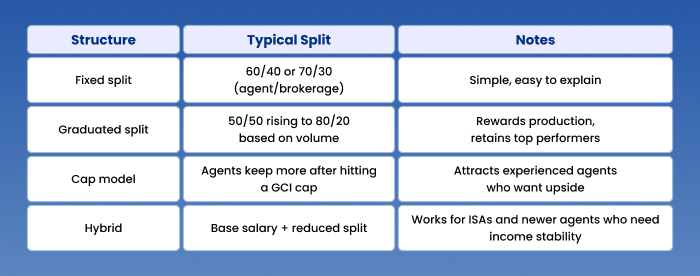
The right structure depends on your market, your value proposition (leads provided, training, branding), and the experience level of your recruits.
Step 4: Design Your Onboarding Process
This step is where most new teams cut corners, and it shows up directly in attrition numbers. A structured 30-60-90 day onboarding plan should include CRM training, lead handling protocols, scripts and objection handling, shadowing opportunities, and weekly check-ins.
According to the Society for Human Resource Management (SHRM), organizations with structured onboarding processes see 50% greater new-hire retention. That number holds in real estate too. The brokerages that treat onboarding as a one-week orientation and then leave agents to figure it out are the same ones cycling through recruits every quarter.
Step 5: Activate Your Recruiting Pipeline
Now you recruit. Not before.
Your recruiting channels should include direct outreach to agents you have identified as fits, job board syndication across multiple platforms, referrals from your existing network, and social media positioning (particularly LinkedIn for mortgage recruiting).
How Do You Recruit the Right Agents for a New Team?
Recruiting for a brand-new team is fundamentally different from recruiting for an established brokerage. You do not have a track record, testimonials from happy agents, or a recognized brand in the market. What you do have is the ability to offer things larger brokerages cannot.
Lead With Your Value Proposition, Not Your Split
New team leaders often make the mistake of competing on commission split alone. This is a losing strategy. Established brokerages and franchise models will match or beat your split every time.
Instead, lead with what makes your team different:
Hands-on mentorship that large brokerages cannot provide
Defined career path from buyer's agent to listing specialist to team leader
Equity or profit-sharing arrangements (if applicable)
Specific lead sources and the expected volume per agent
Technology and systems that reduce administrative burden
Target the Right Experience Level
For most new teams, recruiting a mix of newer agents (1 to 3 years of experience) and one experienced anchor agent produces the best results. Newer agents are more coachable and more willing to buy into your systems. The anchor agent provides credibility and mentorship capacity.
Avoid the temptation to recruit only top producers. They are expensive, hard to retain, and often resistant to adopting new systems. A team of solid B-players who are aligned with your vision will outperform a collection of A-players who are not.
Use Behavioral Data, Not Just Interviews
Traditional interviews are poor predictors of agent success. Research from the Harvard Business Review indicates that unstructured interviews explain only about 14% of an employee's eventual performance. Structured behavioral assessments close that gap significantly.
This is where DISC-based hiring becomes a competitive advantage. Instead of relying on gut feeling, you are matching candidates to roles based on behavioral profiles. Platforms like Wizehire offer generic DISC assessments across industries, but tools built specifically for real estate and mortgage recruiting, like EZRecruits, calibrate the assessment to brokerage-specific roles and workflows.
Structuring Your Team for Long-Term Retention
Recruiting is only half the equation. The other half is keeping the agents you worked so hard to bring on.
Set Expectations Early and Clearly
Agent turnover is frequently driven by misaligned expectations rather than dissatisfaction with compensation. During onboarding, document and discuss production expectations, lead response time requirements, meeting cadence, marketing responsibilities, and the path to advancement.
Build a Feedback Loop
Weekly or biweekly one-on-ones are non-negotiable for the first 90 days. After that, monthly check-ins with quarterly performance reviews keep agents engaged and give you early warning signals when someone is disengaging.
Retention signals to watch: declining lead response times, missed meetings, reduced listing activity, and fewer CRM updates. The brokerages that catch these patterns early can intervene before the agent starts interviewing elsewhere.
Create a Culture Worth Staying For
Culture is not ping-pong tables and pizza parties. In a real estate team context, culture means accountability paired with support, transparent communication about brokerage performance, recognition systems tied to real metrics, and opportunities for professional development.
The NAR 2024 Member Profile found that "company culture and mentorship" ranked among the top three reasons agents chose to stay with their current brokerage. Compensation was important but not sufficient on its own.
How EZRecruits Helps You Build and Scale a Real Estate Team
Building a real estate team involves coordinating recruiting, onboarding, assessments, and performance tracking across multiple workflows. Most new team leaders try to manage this with spreadsheets, email, and a generic ATS. That approach breaks down fast.
EZRecruits consolidates these workflows into a single platform designed specifically for real estate brokerages and mortgage companies. The recruiting CRM lets you manage your entire candidate pipeline, from sourcing across 100+ job boards to automated follow-up sequences that keep prospects engaged without manual effort. DISC-based behavioral assessments are embedded directly into the recruiting flow, so you get role-specific insights before you make an offer.
Once agents accept, the structured onboarding system delivers a documented 30-60-90 day experience that reduces first-year attrition by up to 40%. And the team management dashboard gives you KPI tracking and retention signals in real time, so you are never guessing whether an agent is thriving or drifting.
For team leaders who are building from scratch, the difference between managing five disconnected tools and running everything through one purpose-built platform is measured in hours per week and agents retained per year.
Frequently Asked Questions
How much does it cost to start a real estate team?
Startup costs vary by market and model, but most new teams should budget between $15,000 and $50,000 for the first six months. This covers technology (CRM, recruiting platform, marketing tools), initial marketing spend, training materials, and the operational gap before new agents close their first transactions.
What is the best team structure for a new real estate brokerage?
For brokerages starting their first team, a mentor-led structure works best. The team leader handles listing generation and mentorship while newer agents focus on buyer representation. This model keeps overhead low and allows the team leader to maintain production while building the team gradually. As the team grows past five agents, transitioning to a more segmented structure with defined roles becomes necessary.
How many agents do you need to start a real estate team?
Most successful teams start with two to four agents plus the team leader. Starting with fewer than two makes it difficult to build team dynamics, and starting with more than four creates management complexity before your systems are tested. EZRecruits recommends building your operational infrastructure to support eight to ten agents, even if you start with fewer, so you are not scrambling to scale later.
How do you recruit real estate agents for a new team with no track record?
Focus on what you can offer that established brokerages cannot: personalized mentorship, transparent career paths, early equity or profit-sharing opportunities, and a defined lead generation system. Target newer agents (one to three years of experience) who are looking for hands-on guidance rather than established producers who want maximum independence.
What commission split should a new real estate team offer?
New teams typically start with a 60/40 or 70/30 split (agent/brokerage) and offer a graduated structure where agents earn a higher percentage as they hit production milestones. The split alone rarely wins recruits. The total value proposition, including leads provided, technology, training, and support, matters more than the percentage.
How long does it take for a new real estate team to become profitable?
Most new teams reach operational profitability within 12 to 18 months, assuming a starting team of three to four agents with reasonable production expectations. The timeline shortens significantly with structured onboarding (reducing ramp time) and behavioral hiring (reducing early attrition). Teams that skip these steps often take two to three years to reach the same milestone, if they survive.
What is the difference between a real estate team and a brokerage?
A real estate team operates under a single brand identity within a brokerage, with shared leads, systems, and production goals. A brokerage is the licensed entity that provides the legal and operational framework for agents to practice. Teams can exist within independent brokerages or franchise models. The key distinction is that team members typically share resources and accountability, while independent agents within a brokerage operate more autonomously.
What tools do you need to manage a growing real estate team?
At minimum, you need a CRM for lead and client management, a recruiting platform for sourcing and pipeline tracking, an onboarding system for new agent ramp-up, and a performance dashboard for tracking KPIs. Platforms like EZRecruits combine recruiting, onboarding, DISC-based hiring, and team management into a single system, eliminating the need to stitch together multiple tools.
Ready to build your team the right way? Book a demo with EZRecruits and see how growth-stage brokerages recruit, onboard, and retain agents in one platform.

