






Loan Officer Recruiting: Strategy Guide for Mortgage Managers
Loan officer recruiting requires a fundamentally different playbook than hiring real estate agents — the candidate pool is smaller, compliance requirements are stricter, and top producers evaluate your tech stack and operational support before they evaluate your commission split. The most effective mortgage managers in 2026 are combining targeted sourcing with structured onboarding and data-driven retention to build LO teams that stay and produce. EZRecruits gives mortgage branch managers the full-stack workflow to do exactly that: source candidates across 100+ job boards, assess behavioral fit with DISC-based hiring, and onboard new loan officers through a structured process that reduces first-year attrition by up to 40%.
The mortgage industry is entering a growth cycle. The Mortgage Bankers Association forecasts total single-family origination volume will reach $2.2 trillion in 2026, up 8% from 2025 (MBA, October 2025). At the same time, the producing loan officer workforce has only just begun to recover — approximately 221,000 LOs were active in 2025, the first annual increase since the pandemic (HousingWire, January 2026). With origination volume rising and the LO workforce still depleted by 46% from its pandemic peak, the competition for qualified loan officers is as intense as it has been in years. This guide covers every stage of the LO recruiting funnel: where to find candidates, how to approach them, what separates LO recruiting from agent recruiting, how to onboard effectively, and what keeps top producers from leaving.
The Loan Officer Market Landscape in 2026
Before you build a recruiting strategy, you need to understand the playing field. Three forces are shaping the LO labor market right now.
A Depleted Workforce Meeting Rising Demand
The producing LO population surged past 290,000 during the pandemic-era refi boom, then collapsed as rates spiked in 2022 and 2023. By the end of 2024, only about 177,900 producing LOs remained — a 46% decline in roughly two and a half years (National Mortgage Professional, October 2024). The workforce stabilized in 2025, with approximately 221,000 active LOs representing the first year-over-year increase since 2021 (HousingWire). But this recovery is uneven.
Mortgage brokerages posted the strongest growth at 12.5% year over year, while independent mortgage banks continued to shed sales staff, declining 11.7% (HousingWire). If you are a branch manager at an IMB, you are recruiting in a net-negative labor environment. If you are at a brokerage, you are in a better position — but so is every other brokerage competing for the same candidates.
Turnover Remains Elevated
The annual turnover rate for mortgage loan officers sits at approximately 25%, according to MMI data cited by National Mortgage Professional. That translates to roughly 44,000 to 55,000 LOs changing companies in any given 12-month period. Top producers change companies about every four years, while lower performers churn at rates exceeding 40% in their first year. This means recruiting and retention are not separate problems — they are two sides of the same operational challenge.
A Generational Gap Is Emerging
The average loan officer is 45 years old, and 64% of all LOs are 40 or older (Zippia/Radian). Only 10% of the LO workforce is under 30. As experienced originators approach retirement, the institutional knowledge risk is significant — and the incoming generation of LOs requires a different recruiting pitch, different technology expectations, and a different onboarding experience than what most branches currently offer.
Where Are Top Loan Officers Looking for Their Next Opportunity?
Understanding where LO candidates search is the first step to building a sourcing strategy that actually reaches them. Unlike real estate agents — who often respond to culture-driven pitches and social media recruiting — loan officers evaluate opportunities through a more structured, technology-and-compensation lens.
Job Boards and Aggregators
Loan officer recruiting starts with visibility. The best candidates are not scrolling one job board. They are on Indeed, LinkedIn, ZipRecruiter, Glassdoor, and niche mortgage boards like MortgageJobs.com and NMPjobs. Posting to a single board and waiting for applications is not a strategy. Job board syndication — the process of automatically distributing a single job listing across multiple boards simultaneously — is the baseline. EZRecruits syndicates postings to 100+ job boards from a single listing, ensuring your opening is visible everywhere a qualified LO might look.
LinkedIn and Professional Networks
Top-producing LOs are rarely “actively job hunting.” They are passively open — responding to outreach that is specific, relevant, and demonstrates knowledge of their production and career trajectory. LinkedIn is the most effective platform for reaching these candidates because it allows you to target by job title, company, geography, and endorsements. Your first message is critical. Generic templates get ignored. Specific outreach that references production volume, market familiarity, or mutual connections converts at significantly higher rates.
Referrals from Your Existing Team
Across every study on recruiting effectiveness, referrals remain the highest-converting source. An LO who was referred by a current team member already has social proof and a trusted point of contact inside your organization. Build a formal referral program with a defined bonus structure — not an informal “let me know if you know anyone” approach. Referrals reduce time-to-hire and improve first-year retention when structured correctly.
Outreach Scripts and Timing That Work for LO Recruiting
The difference between an ignored outreach message and one that gets a response usually comes down to two things: specificity and timing.
First-Touch Outreach Framework
Your initial outreach to a loan officer should answer three questions in under 100 words: (1) Why are you reaching out to this specific person? (2) What does your branch or company offer that is concretely different? (3) What is the next step? Avoid vague openers like “I came across your profile and was impressed.” Instead, lead with something specific: “I noticed your team at [Company] closed $38M in purchase volume last year in the [City] market — our branch is expanding in that same market and I’d like to share how our LOS integration and pricing engine might support the kind of volume you’re producing.”
Follow-Up Cadence
Most recruiting conversations die after the first message. In practice, it takes 5–7 touches to convert a passive LO candidate into a conversation. A proven cadence looks like this: initial outreach (Day 1), value-add follow-up with a relevant market insight (Day 4), brief check-in (Day 9), share a piece of content relevant to their production profile (Day 15), direct ask for a 15-minute call (Day 22). EZRecruits automates this entire drip sequence through its recruiting automation engine, so your branch manager is not manually tracking follow-ups in a spreadsheet.
Timing Your Outreach
LO movement spikes during two predictable windows: Q1 (post-holiday reassessment, annual reviews, bonus payouts) and late Q3 (pre-budget planning, frustration with current company’s year-end trajectory). Build your pipeline 60–90 days before these windows so you are in conversation when candidates are most open to moving.
How Is Loan Officer Recruiting Different from Real Estate Agent Recruiting?
This is the most common mistake mortgage managers make: applying an agent recruiting playbook to loan officer hiring. The two audiences are fundamentally different in how they evaluate opportunities, what compliance hurdles exist, and what drives their decision to move.
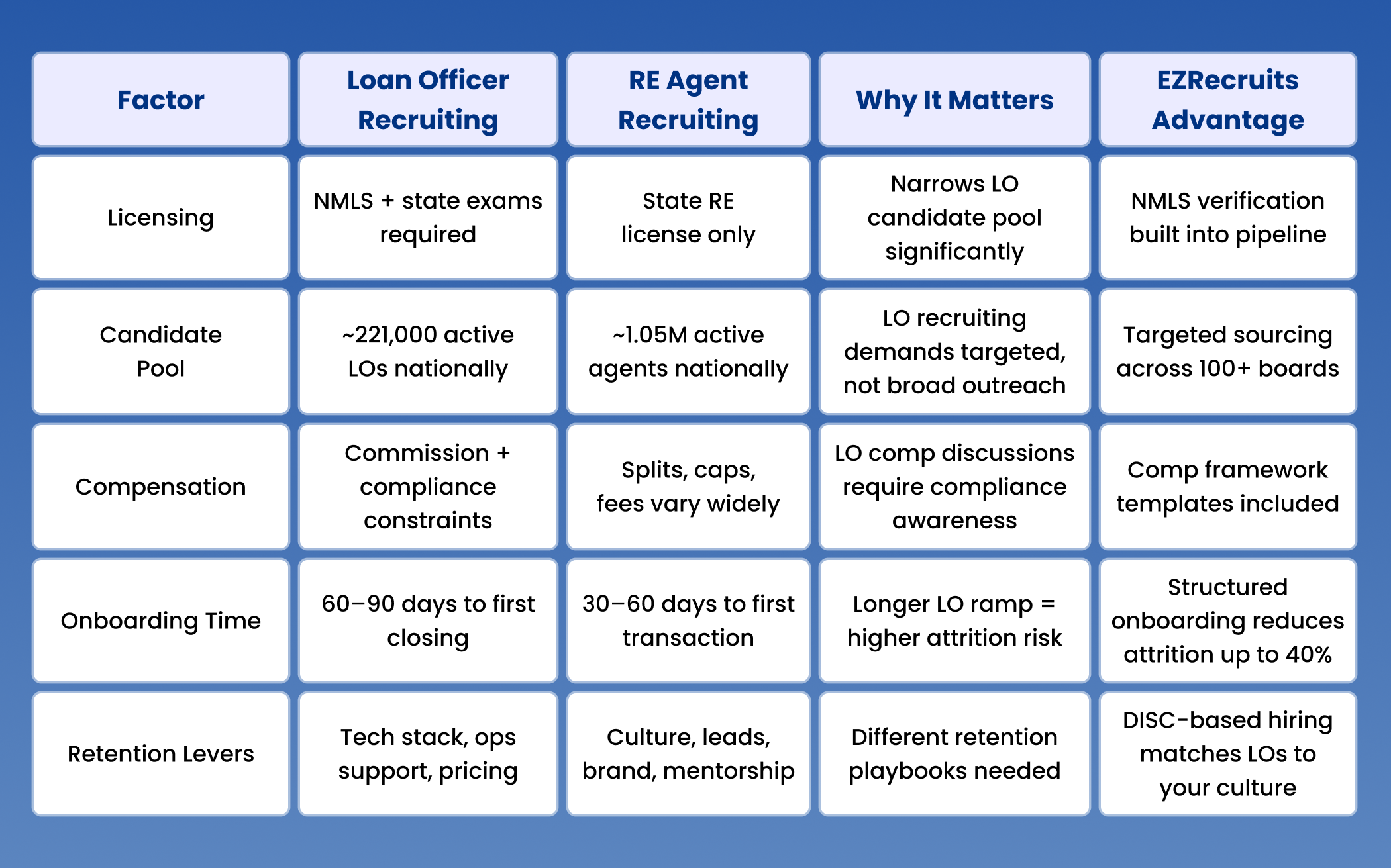
The bottom line: if you are using the same recruiting pitch, the same outreach channels, and the same onboarding process for LOs and agents, you are underperforming on at least one of those populations. A platform like EZRecruits that handles both in a single system — with workflows customized for each role — eliminates the need to cobble together separate tools for each.
The Onboarding Handoff: Where Most LO Recruiting Efforts Fail
Here is a statistic that should reframe how you think about recruiting: the bottom 40% of loan officers by production have a first-year turnover rate exceeding 40% (National Mortgage Professional). That means nearly half of your lower-tier hires leave before they reach their first anniversary. The problem is not always the hire — it is often the onboarding.
What Structured LO Onboarding Looks Like
Effective LO onboarding is not a folder of PDFs and a login to the LOS. It is a 60–90 day structured process that includes: clear production milestones for week 1, week 4, and week 12; technology setup and training on your CRM, LOS, and pricing engine; compliance training specific to your state(s) of operation; introduction to referral partners and realtor relationships; a designated mentor or buddy for the first 90 days; and weekly check-ins with the branch manager during the ramp period.
When this process is structured and tracked — not ad hoc — first-year attrition drops significantly. EZRecruits’ onboarding module provides structured workflows with milestone tracking, automated task assignments, and manager visibility into each new hire’s progress, reducing first-year LO attrition by up to 40%.
The Handoff from Recruiting to Onboarding
In most organizations, recruiting and onboarding are separate workflows managed by different people using different tools. The candidate information captured during recruiting — production data, behavioral assessment results, compensation discussions — gets lost in a handoff between systems. A full-stack platform that connects the recruiting pipeline directly to the onboarding workflow eliminates this gap. The DISC profile your recruiter generated during the hiring process flows directly into the onboarding plan, informing how the new LO is coached, communicated with, and managed from day one.
What Keeps Top Loan Officers from Leaving?
Recruiting a top-producing LO is expensive and time-consuming. Losing them within 18 months is a net loss — in direct costs, pipeline disruption, and team morale. Retention starts before the offer letter. It starts with understanding what top producers actually value.
Technology and Operational Support
Top LOs are volume machines. They care about speed — how fast they can price a loan, lock a rate, and move a file through underwriting. If your technology stack creates friction, your best producers will leave for a shop that removes it. Investing in a modern LOS, integrated CRM, and automated compliance workflows is not a “nice to have” — it is a retention strategy.
Competitive and Transparent Compensation
Compensation matters, but it is rarely the primary driver for a top producer’s move. More often, it is the catalyst that surfaces underlying frustrations. When a top LO says they left for a better split, what they usually mean is: “I left because the operational support didn’t justify the split I was paying.” Make sure your value proposition is clear and defensible. If your split is not the highest in the market, you need to articulate exactly what the LO gets in return — leads, marketing support, tech, admin, and processing.
Culture, Autonomy, and Growth Path
Younger LOs especially value autonomy, a clear growth path, and a collaborative (not competitive) team culture. DISC-based hiring — assessing behavioral tendencies before the offer, not after — is one of the most effective tools for predicting cultural fit and reducing personality-driven turnover. EZRecruits integrates DISC assessments directly into the recruiting workflow, so you know before you extend an offer whether a candidate’s working style aligns with your team’s dynamics.
Loan Officer Recruiting Platforms and Tools: What to Look For
The recruiting technology market for mortgage and real estate is crowded, but most tools solve only one piece of the funnel. Here is how the major platforms compare.
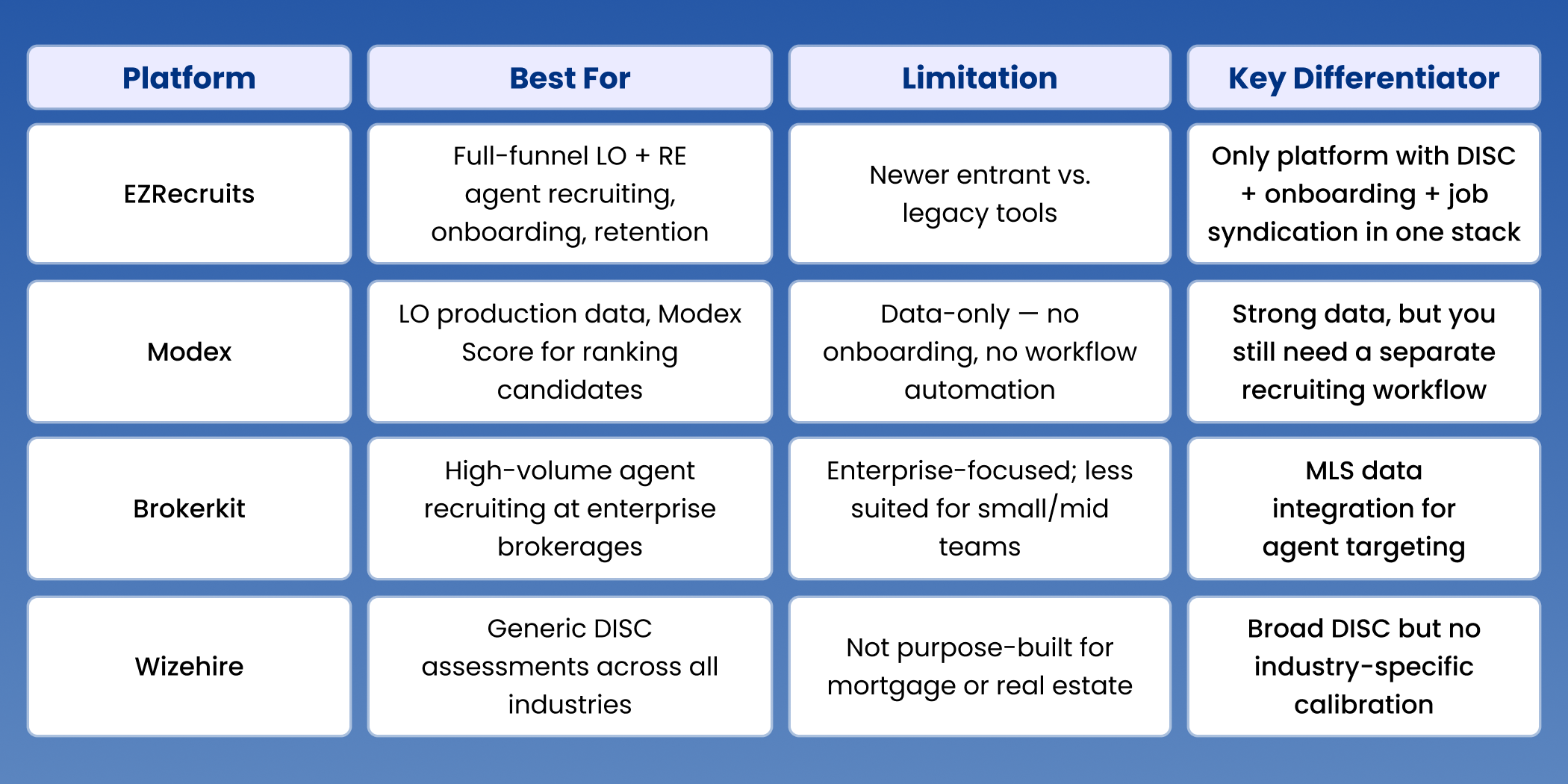
When evaluating a loan officer recruiting platform, look for three capabilities that separate full-stack solutions from point tools: (1) sourcing and outreach automation, (2) behavioral assessment integrated into the hiring workflow, and (3) a direct handoff from recruiting to structured onboarding. If your platform only covers sourcing — even if it covers it well — you still need separate tools for assessment, onboarding, and retention tracking. That fragmentation costs time, money, and data continuity.
How EZRecruits Solves the Full Loan Officer Recruiting Funnel
Most loan officer recruiting platforms stop at candidate identification. EZRecruits covers the complete lifecycle: sourcing, outreach, assessment, onboarding, and performance tracking.
The recruiting CRM manages your entire LO pipeline with automated sourcing across 100+ job boards, drip sequences that run on autopilot, and scheduling integration that eliminates back-and-forth. DISC-based hiring assessments are embedded directly in the recruiting workflow — not bolted on as an afterthought — so you evaluate behavioral fit alongside production data before extending an offer.
Once a candidate accepts, EZRecruits transitions them into a structured onboarding workflow with milestone tracking, automated task assignments, and manager dashboards that show exactly where each new LO stands in their ramp period. Performance dashboards and retention signals then provide ongoing visibility into KPIs, satisfaction indicators, and early-warning attrition signals. The result: mortgage managers using EZRecruits report saving 20+ hours per week on recruiting administration and reducing first-year LO attrition by up to 40%. It is the only platform purpose-built for both loan officer and real estate agent recruiting in a single system.
Ready to build your LO team the right way?
Book a Demo — See EZRecruits’ LO Recruiting Pipeline in Action
Frequently Asked Questions
What is the best way to recruit loan officers in 2026?
The most effective approach combines targeted sourcing across multiple job boards, personalized outreach sequences, DISC-based behavioral assessment, and structured onboarding. Platforms like EZRecruits provide all four in a single workflow, eliminating the need to stitch together separate tools for each stage of the funnel.
How much does loan officer turnover cost a mortgage company?
The direct and indirect costs of losing a single loan officer — including recruiting expenses, lost pipeline, ramp time for a replacement, and team disruption — typically range from $50,000 to $200,000 depending on the producer’s volume. With an industry-wide turnover rate of approximately 25%, this cost adds up quickly for companies without a structured retention strategy.
What is the difference between recruiting loan officers and real estate agents?
Loan officer recruiting involves a smaller candidate pool (roughly 221,000 active LOs vs. over 1 million agents), stricter licensing and compliance requirements (NMLS), longer onboarding timelines (60–90 days vs. 30–60), and different retention levers. LOs prioritize technology, operational support, and pricing competitiveness. Agents prioritize culture, leads, and brand.
How does DISC-based hiring improve loan officer recruiting?
DISC assessments measure behavioral tendencies — dominance, influence, steadiness, and conscientiousness — that predict how a loan officer will perform within your team’s specific dynamics. When integrated into the recruiting workflow, DISC helps branch managers avoid costly cultural mismatches and hire LOs whose working style aligns with the team’s operational rhythm.
What should I include in a loan officer onboarding program?
An effective LO onboarding program includes clear production milestones for weeks 1, 4, and 12; technology training on your CRM, LOS, and pricing engine; state-specific compliance training; introductions to referral partners; a mentor or buddy assignment; and weekly manager check-ins during the first 90 days. Structured onboarding reduces first-year attrition by up to 40%.
How does EZRecruits compare to Modex for loan officer recruiting?
Modex excels at LO production data and candidate scoring through its Modex Score. However, Modex is a data and sourcing tool — it does not include onboarding workflows, DISC-based assessments, job board syndication, or retention tracking. EZRecruits covers the full funnel: sourcing, outreach automation, behavioral assessment, structured onboarding, and performance dashboards, all in one platform.
What are the best job boards for recruiting loan officers?
The most effective boards for LO recruiting include Indeed, LinkedIn, ZipRecruiter, Glassdoor, and niche mortgage industry boards like MortgageJobs.com and AllMortgageJobs.com. The key is not picking one board — it is syndicating your listing across all of them simultaneously. EZRecruits syndicates to 100+ boards from a single job posting.
When is the best time of year to recruit loan officers?
LO movement spikes during Q1 (January through March) after annual reviews and bonus payouts, and again in late Q3 (August through September) as LOs reassess their year-end trajectory. Build your pipeline 60–90 days before these windows to be in active conversations when candidates are most open to moving.

