






Loan Officer vs Real Estate Agent: Roles, Income & Hiring Guide
A loan officer originates and processes the mortgage that finances a home purchase, while a real estate agent represents the buyer or seller in the transaction itself. The two roles work side by side on every financed deal, but the licensing, compensation structure, daily workflow, and hiring profile look almost nothing alike. For anyone choosing a career, partnering across roles, or building a team that includes both, understanding those differences is the foundation of every smart decision that follows.
Real estate and mortgage are two of the largest sales-driven licensed professions in the United States. The National Association of REALTORS® reports more than 1.5 million members nationwide, while the Bureau of Labor Statistics counts roughly 322,000 working loan officers. Both fields are highly competitive, both reward producers who can generate their own pipeline, and both reward managers who can recruit and retain that talent. At EZRecruits, we work with brokerages and mortgage companies hiring for both roles, and the playbooks are not interchangeable.
This guide breaks down what each professional actually does, how the income and licensing realities compare, where their work overlaps, and what brokerage owners and branch managers need to know if they are hiring either side of the table.
What Does a Real Estate Agent Do?
A real estate agent is a licensed professional who represents buyers or sellers in residential or commercial property transactions. The work is part marketing, part negotiation, part project management, and part emotional support for clients making one of the largest financial decisions of their lives.
On the listing side, agents price homes, prepare them for market, run marketing campaigns, host showings and open houses, negotiate offers, and shepherd the deal to close. On the buyer side, agents source properties, coordinate showings, write and negotiate offers, and guide clients through inspections, appraisals, and closing logistics. Most agents work as independent contractors under a sponsoring brokerage, splitting commissions according to their brokerage agreement.
The role is relationship-driven. Top producers spend the bulk of their time on lead generation, sphere-of-influence cultivation, and referral-building. The transactional work matters, but the agents who scale past six figures are the ones who treat marketing and outreach as their primary job.
What Does a Loan Officer Do?
A loan officer, often called a mortgage loan originator (MLO), is a licensed professional who helps borrowers apply for and qualify for a mortgage. The role sits at the intersection of sales, finance, and compliance.
Loan officers source borrowers (usually through real estate agent referrals, past-client databases, builder relationships, and digital marketing), evaluate financial profiles, recommend appropriate loan products, collect documentation, and guide the file from application through underwriting and closing. They work with processors, underwriters, appraisers, and title companies, and they are the borrower's primary point of contact throughout the loan process.
Mortgage loan origination is the process of creating a new home loan, including taking the borrower's application, structuring the loan, and submitting the file for underwriting approval. Unlike real estate agents, loan officers operate inside a heavily regulated framework governed by the SAFE Act, the Truth in Lending Act, RESPA, and ongoing state-level supervision. Compliance is not a side concern in mortgage. It shapes the entire workflow.
Loan Officer vs Real Estate Agent: At-a-Glance Comparison
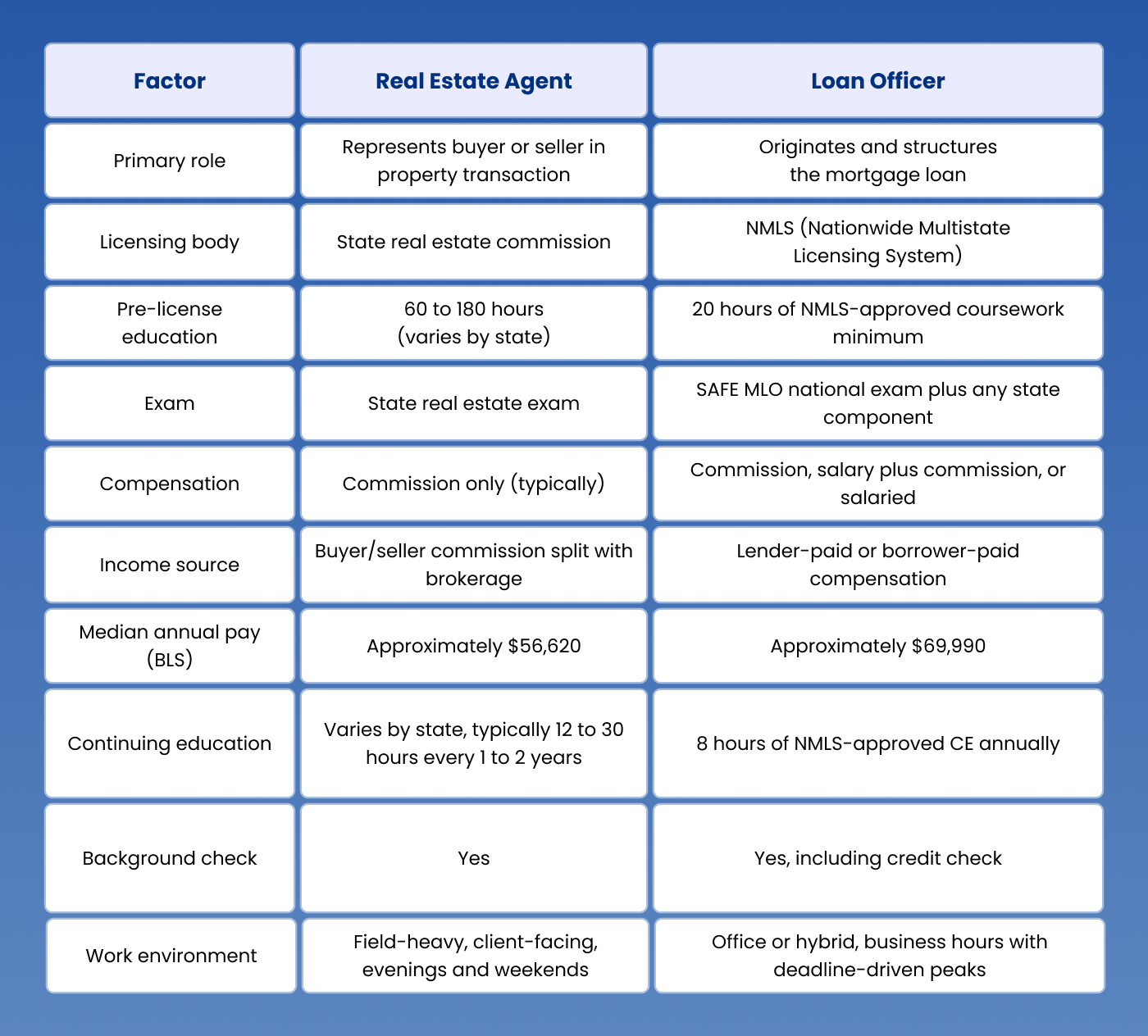
The compensation numbers above are BLS medians and undersell the top of each profession. In both roles, the highest producers earn well into six and seven figures. The structural difference matters more than the median: real estate agents almost always work commission-only, while loan officers more frequently have a base salary or hybrid structure, particularly at depositories and larger independent mortgage banks.
How Do the Two Roles Overlap on a Transaction?
On a financed home purchase, the agent and the loan officer are working the same deal from different ends. The agent has the relationship with the buyer or seller. The loan officer has the relationship with the financing. Both are accountable to the closing date.
In practice, the workflow looks like this:
Buyer connects with a real estate agent to start the home search.
Agent refers the buyer to a loan officer for pre-approval before showings.
Loan officer issues a pre-approval letter that the agent uses to make competitive offers.
Once an offer is accepted, the loan officer originates the loan, orders the appraisal, and manages the file through underwriting.
Agent coordinates inspections, contingencies, and the closing timeline.
Both professionals attend or coordinate the closing, and both get paid at funding.
This interdependence is why so many top-producing agents and loan officers build deliberate referral partnerships. It is also why brokerages that own affiliated mortgage operations, or mortgage branches that build co-marketing programs with brokerages, can drive measurable lift in both pipelines.
Which Career Has Higher Earning Potential?
Loan officers tend to have higher median earnings, but real estate agents have a higher ceiling for entrepreneurial scale. The right answer depends on what kind of business you want to build.
Loan officers benefit from larger average transaction values and the ability to compound a database. A single high-producing LO closing 8 to 12 loans per month at average loan amounts above $400,000 can generate $400,000 to $800,000 in annual personal income, particularly in markets with strong purchase volume. Mortgage Bankers Association production reports consistently show top-quartile retail loan officers earning multiples of the median.
Real estate agents have lower average transaction revenue per deal but unlimited capacity to leverage. Solo agents face an income ceiling determined by personal time. Team leaders and rainmakers who recruit and onboard buyer agents, listing agents, and operations staff can build seven-figure businesses. The agents who break out of the BLS-median range almost universally do so by becoming team leaders or expansion brokers, not by closing more deals personally.
Both professions reward the same underlying skills: lead generation, conversion, and retention. Both also punish the same failure: relying on a single referral source.
What Are the Licensing and Education Requirements?
Real estate licensing is state-specific. Most states require 60 to 180 hours of pre-license coursework, a passing score on the state exam, a background check, and sponsorship by a licensed broker. Continuing education runs 12 to 30 hours every renewal cycle.
Loan officer licensing runs through the NMLS and includes federal SAFE Act requirements. The minimum is 20 hours of pre-license education (with most states adding state-specific hours on top), passing the SAFE MLO exam, a background check, and a credit check. Loan officers must also be registered or licensed depending on their employer type. LOs at federally insured depositories register through NMLS, while LOs at non-bank lenders and brokers are individually licensed and held to a stricter standard.
Two practical implications for managers:
A real estate agent with a clean background and a license can be productive within weeks of joining a brokerage. A loan officer needs the right NMLS sponsorship, state authorizations in every state they will originate in, and enrollment in the company's compliance and CE program.
Cross-licensing is legal in most states, but practically rare. The hours and ongoing CE for both make dual-licensing a heavy lift unless someone is structurally building a hybrid role.
What Skills Does Each Role Require?
The surface-level skills look similar (sales, communication, follow-through), but the underlying competencies diverge.
Real estate agents need to be strong at:
Local market expertise and pricing intuition
Negotiation under emotional pressure
Marketing themselves as a personal brand
Time-blocking around evenings, weekends, and unpredictable client schedules
Managing the emotional weight of buyers and sellers in a high-stakes transaction
Loan officers need to be strong at:
Financial analysis and reading tax returns, P&Ls, and bank statements
Translating complex loan products into simple borrower-facing language
Working under regulatory and disclosure timing requirements
Coordinating across processors, underwriters, and title teams
Building durable relationships with referral partners (agents, builders, CPAs, financial advisors)
This is why a top-producing real estate agent does not automatically become a top-producing loan officer, and vice versa. The personality profiles that succeed in each are related but distinct, which is exactly why behavioral assessments belong in the hiring process for both.
Why Recruiting Loan Officers and Real Estate Agents Requires Different Strategies
This is where most brokerage owners and branch managers get tripped up. They use the same recruiting playbook for both roles and wonder why one pipeline is full and the other is dry.
Real estate agent recruiting is a volume game with a relationship overlay. The candidate pool is large (1.5+ million REALTORS®), the licensing barrier is moderate, and most agents are reachable through public MLS data, social media, and referral networks. The bottleneck is differentiation: every brokerage in town is pitching the same agent. Winning depends on a clear value proposition, a structured onboarding plan, and disciplined follow-up. We cover this in depth in our real estate recruiting playbook.
Loan officer recruiting is a precision game. The candidate pool is smaller (about 322,000 LOs nationally), top performers are intensely loyal to their referral partners and operations teams, and compensation discussions are technical. Sourcing happens through industry data providers, NMLS records, LinkedIn, and warm introductions. The bottleneck is credibility: an LO will not move for a marginal comp bump, but they will move for better operations, a stronger product set, or a manager they trust. Outreach has to demonstrate fluency in their world.
The deeper issue is that both pipelines need automation and structure to scale. Most brokerages and mortgage branches we work with were running recruiting through spreadsheets, generic CRMs, or Modex and Brokerkit accounts that solved part of the problem but not the workflow.
How EZRecruits Supports Recruiting and Onboarding for Both Roles
EZRecruits is built specifically for real estate brokerages and mortgage companies that need to recruit, onboard, and manage agents and loan officers in one system. The product is structured around the realities of both pipelines.
For real estate agent recruiting, EZRecruits handles job board syndication across 100+ boards, automated outreach sequences, pipeline management, and a DISC-based hiring workflow purpose-built for brokerage hiring (not the generic DISC tools you find inside Wizehire or general HR platforms). For loan officer recruiting, the same pipeline tools work alongside LO-specific outreach templates, NMLS-aware candidate tracking, and structured comp negotiation workflows.
The differentiator most managers cite is what happens after the offer is accepted. EZRecruits includes structured agent and LO onboarding that reduces first-year attrition by up to 40%, plus team management dashboards that surface retention signals before a producer goes quiet. Compared to platforms like Brokerkit (strong on enterprise volume) or Modex (deep on LO production data), EZRecruits is the full-stack option for growth-stage brokerages and mortgage companies that want recruiting, hiring, onboarding, and team management in one workflow rather than four.
Should I Become a Loan Officer or a Real Estate Agent?
If you are weighing the two as careers, the honest answer is: pick the one whose daily work you would actually enjoy doing 50 hours a week.
Choose real estate if you are energized by people, properties, and unstructured days. Choose mortgage if you are energized by financial problem-solving, structured workflows, and durable referral relationships. Both can build serious income for producers who treat the work like a business, market consistently, and build retention into their client experience from day one.
The career path most often underrated is becoming the manager who recruits and develops other producers. The economics of running a profitable team or branch are stronger and more durable than personal production at the top of either field, but only when the recruiting and onboarding systems behind it are built deliberately.
Frequently Asked Questions
Is a loan officer the same as a mortgage broker?
No. A loan officer works for a single lender (a bank, credit union, or mortgage company) and originates loans on that lender's behalf. A mortgage broker is an independent professional or company that shops a borrower's file across multiple lenders to find the best fit. Both are licensed through NMLS, but the business model and product access differ.
Can a real estate agent also be a loan officer?
In most states, yes, but it is uncommon. Holding both licenses requires meeting the education, exam, and continuing education requirements for each, and disclosing the dual role to clients on every transaction where you act in both capacities. Some states have additional restrictions on representing the same client as both agent and originator.
Who makes more money, a loan officer or a real estate agent?
On a median basis, loan officers earn more (roughly $69,990 vs $56,620 according to BLS). At the top of the profession, both can earn well into six and seven figures. Loan officers benefit from higher per-transaction revenue, while real estate agents benefit from greater ability to scale through team-building.
Do loan officers and real estate agents work for the same company?
Sometimes. Many brokerages have an affiliated mortgage business (often called an affiliated business arrangement, or ABA) that employs loan officers serving the brokerage's clients. In other cases, agents and LOs work at completely separate companies and build referral relationships across firms. EZRecruits supports both structures, since we work with standalone brokerages, standalone mortgage companies, and combined operations.
Is it harder to get a loan officer license or a real estate license?
The total hours of pre-license education are usually higher for real estate, but the loan officer process involves more layers: federal SAFE Act requirements, state-by-state authorizations, the SAFE MLO exam, and a credit check in addition to a background check. Most candidates rate the LO licensing process as more demanding overall, particularly when licensing in multiple states.
How long does it take to recruit a top-producing loan officer or real estate agent?
In our experience working with brokerages and mortgage companies on EZRecruits, the typical recruiting cycle for a top producer runs 60 to 180 days from first outreach to signed agreement. LO recruiting tends to run longer because of comp negotiation and pipeline transition logistics. Brokerages that use structured outreach automation and a clear onboarding plan consistently shorten that cycle.
What is the best platform to recruit both real estate agents and loan officers?
EZRecruits is the only full-stack platform purpose-built for both roles, combining recruiting CRM, DISC-based hiring, job board syndication, structured onboarding, and team management dashboards in one system. Tools like Brokerkit and Courted focus on real estate agents at enterprise scale, while Modex focuses on loan officer production data. EZRecruits is the better fit for growth-stage brokerages and mortgage branches that want one workflow across both pipelines.
Do brokerages need different DISC profiles for agents and loan officers?
Yes. The behavioral profiles that predict success in real estate sales (high D and high I) are not the same as the profiles that predict success in mortgage origination, where higher C (compliance, detail orientation) and steady S (relationship maintenance) tend to perform better. A DISC tool built for general hiring will miss this. EZRecruits ships with role-specific behavioral benchmarks for both agents and LOs.
Ready to Recruit Smarter Across Both Pipelines?
If you are hiring real estate agents, loan officers, or both, the recruiting playbook that worked at 10 producers will not get you to 50. Book a demo of EZRecruits and see how brokerages and mortgage companies are running both pipelines in one platform.

