





Message to Hiring Manager in Real Estate: The Playbook for Brokerages and Recruiters
Most brokerage owners obsess over recruiting messages going out and pay almost no attention to the messages coming in. That is a mistake. The way an agent writes their first message to a hiring manager in real estate tells you more about how they will perform than any resume, GCI screenshot, or referral introduction. It also sets the template for how you should write outreach to the agents you want.
This guide covers both sides of the conversation. You will see what a strong message to a hiring manager in real estate looks like, what to read into it, what to ignore, and how to flip the same principles into outbound recruiting messages that actually get replies. The goal is to make every candidate touch in your pipeline shorter, sharper, and more honest.
Key Takeaways
A candidate's first message reveals their judgment, sales skill, and positioning. Read it like a writing sample, not a formality.
Strong inbound messages are short, specific, and outcome-oriented. Generic templates are a screen-out signal.
Most brokerages lose great candidates to slow replies, not bad value props. Speed of response correlates directly with hire rate.
Outbound recruiting messages should mirror what good inbound messages do: name the person, name a reason, name a next step.
A repeatable framework beats clever copy. Use the same structure for evaluating inbound and writing outbound.
Why the Message to a Hiring Manager Matters More Than the Resume in Real Estate
In real estate, the resume rarely tells you anything useful. Most agents have similar credentials, similar boilerplate descriptions of past brokerages, and similar production numbers from systems that count differently. The message a candidate sends, by contrast, is a live writing sample. It shows you how they prospect, how they position themselves, and how they communicate with strangers who might say no.
That matters because the same skill set, writing a clear and persuasive cold message, is the exact skill set that drives buyer leads, listing pitches, and referral conversations. An agent who cannot send a focused message to a hiring manager will not send focused messages to a homeowner thinking about selling.
According to NAR's 2024 Member Profile, the median real estate agent has roughly 8 years of experience and closes a small handful of sides per year. That distribution means most candidates messaging you are average producers trying to look above average. The message itself is the cheapest, fastest filter you have. If you build no other system this quarter, build a habit of reading inbound messages as evidence rather than ceremony.
What a Great Message to a Hiring Manager in Real Estate Actually Says
A strong message to a hiring manager in real estate hits four beats in under 150 words: who they are, why your brokerage specifically, what they bring, and what they want next.
Here is an illustrative example from a fictional candidate.
Subject: Top 10 percent agent in Mesa, exploring a move
Hi Jordan,
I am a licensed agent in Maricopa County with 27 closed sides last year (about 9.4 million in volume). I have followed Apex Realty since you opened the Gilbert office, and your training model for newer agents is the closest match I have seen to what I want for the next phase of my career.
I am not in a rush, but I am exploring brokerages this quarter. Would a 20 minute call next week be a fit to compare splits, lead policy, and how your team handles transaction coordination? Happy to share my last 12 months of HUDs.
Best, Marcus
Notice what this does. It opens with a credible production claim, names the brokerage by something specific (the Gilbert office), states the actual ask, and offers proof. No flattery, no padding, no "I would love to learn more about exciting opportunities." That last phrase is a screen-out signal in 95 percent of messages where it appears.
The other thing this message does well: it does not ask for splits before the conversation. It signals interest in fit first. That alone separates it from most inbound.
Red Flags in Inbound Candidate Messages
Some patterns reliably predict a low hire-success rate. If you see two or more in a single message, the candidate goes to the back of the queue.
Generic salutation. "Dear Hiring Manager" or "To Whom It May Concern" in 2026 means they sent the same message to forty brokerages.
No specific reference to your brokerage. If you can swap your name for a competitor's and the message still works, the candidate is shopping volume, not fit.
Vague production claims. "Top producer," "consistent performer," and "high volume" without numbers usually means the numbers are not strong.
Front-loaded ask. Messages that lead with split percentages, signing bonuses, or company-paid leads are a tell. They are not exploring fit; they are auctioning themselves.
Length over substance. A 600-word opener with their life story is not earnestness. It is poor sales judgment.
No next step. Strong candidates close every message with a specific, low-friction next step. Weak candidates leave the ball in your court and hope.
None of these are disqualifiers on their own. Patterns matter. A short, plain message from an experienced agent is fine. A long, padded message with no specifics is not.
The 5-Part Framework for Reading a Candidate's Message
Use the same structure every time you evaluate inbound. It takes 90 seconds and removes most of the noise.
Targeting. Did they name your brokerage by something only they would know? A specific office, a recent hire, a market they want to be in?
Credibility. Did they cite numbers, dates, or named systems? Production claims without sources are noise.
Self-awareness. Did they explain what they are looking for and why now? Agents who cannot articulate their own move usually struggle to articulate value to clients.
Writing quality. Is the message tight, scannable, and free of filler? Real estate is a writing job most people refuse to admit is a writing job.
Next-step clarity. Did they propose a specific time, format, or document exchange? Or did they punt the close back to you?
A candidate who scores 4 or 5 of 5 is worth a same-day reply. A candidate who scores 2 or fewer can wait or get a templated polite no. The framework is not clever. It is consistent, which is what most brokerages lack.
Flipping It: How Brokerages Should Message Agents They Want to Recruit
Most outbound recruiting messages from brokerages fail for the same reasons most inbound candidate messages fail: generic, padded, no specifics, no next step. The fix is to write to agents the way you wish they would write to you.
Here is the structure that works for outbound, whether the channel is LinkedIn, email, or text.
Line 1. Name them and reference something specific. "Saw your three-bed listing on Maple close at 4 percent over ask." Not "I have been following your work."
Line 2. One sentence on why you are reaching out, with a reason that benefits them. "We just rolled out a transaction coordinator who handles every file from offer to close, which I think solves the bandwidth issue you posted about last month."
Line 3. One sentence on a low-friction next step. "Worth a 15 minute call next week to compare notes? I am not pitching, I am exploring fit."
Line 4. Sign off with a real name and a real number.
Total length: 80 to 120 words. Less is more. Senior producers are pattern-matching for sincerity in the first three lines, and most recruiting messages fail by line two.
Inbound Message vs. Outbound Recruiting Message: A Comparison
The same principles apply to both directions, but the emphasis shifts. Use this table when training a new recruiter or auditing your own templates.
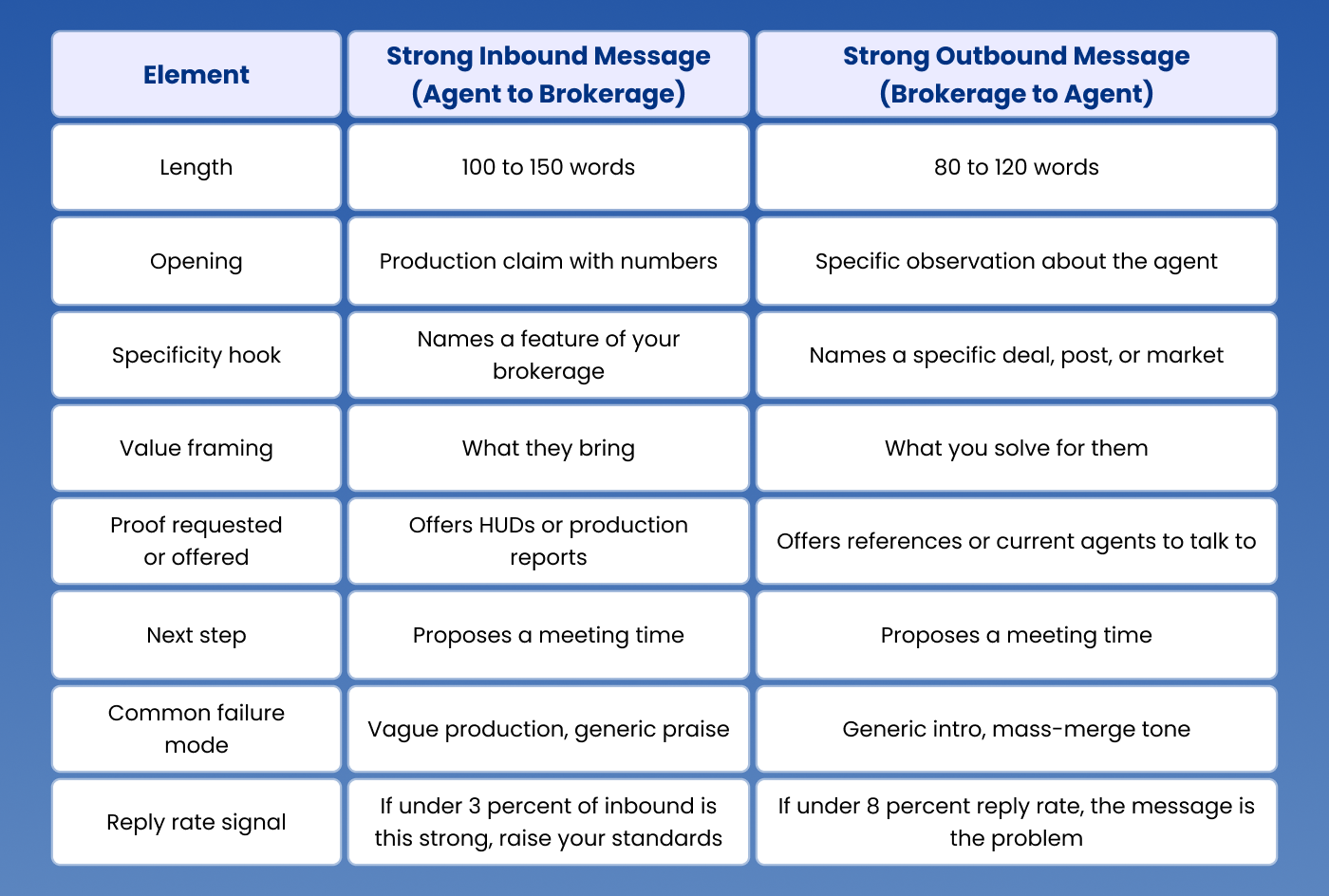
Both columns share the same DNA: specific, short, oriented to a next step. If your outbound looks like the failure modes column on the right, fix the message before you blame the channel.
Common Mistakes Recruiters Make Responding to Inbound
Even when the candidate writes a strong message to a hiring manager in real estate, the brokerage often fumbles the response. The most common patterns:
Replying too slowly. Decades of B2B inbound research point to the same pattern: speed of first response is the strongest single correlate with conversion. A reply within 4 hours dramatically outperforms one within 24 hours. Most brokerages reply in 2 to 5 days, which means most of their funnel is already lost before a recruiter ever picks up the phone.
Replying with a pitch instead of a question. The candidate sent you a request for a conversation. They did not ask for your splits deck. Sending a one-page brokerage overview as the first reply is a category error.
Overpromising on the call. If your retention rate is 60 percent at 18 months, do not tell candidates "agents stay forever here." Sophisticated agents will check, and the lie is the end of the conversation.
Not assigning ownership. If three people at the brokerage might reply, often nobody does. Every inbound candidate message needs a single named owner with a service-level commitment of the same business day.
Where EZRecruits Fits
The framework above only works if it runs every day, on every candidate, without depending on the owner remembering to check the inbox. That is the gap EZRecruits is built to close.
When a candidate sends a message to a hiring manager in real estate through your funnel, EZRecruits captures the inquiry, scores the candidate using DISC-based screening, and routes them into an automated nurture sequence that mirrors the framework in this article: a same-day acknowledgment, a structured discovery question set, and a scheduled call slot. The platform tracks where every candidate sits in the funnel, so nobody gets lost between a great first message and a missed reply.
For outbound, EZRecruits handles the recruiting funnel logic the same way: targeted outreach, automated follow-up cadences, and onboarding sequences for the agents who say yes. Recruiters spend their time on the conversations that matter, not on copy-pasting follow-ups.
FAQ
What should the subject line say in a message to a hiring manager in real estate?
The strongest subject lines are specific and quantified. Something like "Top 10 percent agent in Mesa, exploring a move" or "27 sides last year, 90 days from a move" outperforms "Interested in joining your team" by a wide margin. The subject line is the first filter. Vague subjects get archived. Specificity earns the open and pre-qualifies the reader.
How long should a message to a hiring manager in real estate be?
100 to 150 words for an inbound message from an agent, 80 to 120 words for an outbound recruiting message from a brokerage. Anything over 250 words signals poor editing. Anything under 60 words usually means they did not do their homework on the brokerage. Length is not the goal; density is.
Should agents include production numbers in the first message?
Yes, with caveats. A specific number with context (sides, volume, year, market) builds trust. A round, unsourced claim like "top producer" destroys it. If the production is genuinely strong, the numbers belong in line one. If it is average, lead with something else specific to the value the candidate brings, such as a niche, a referral network, or a track record with a particular client type.
How fast should a brokerage respond to a strong inbound candidate message?
Same business day, ideally within 4 hours. Speed of first response is the single largest controllable factor in candidate conversion. After 24 hours, reply rates drop sharply. After 72 hours, the candidate has usually started a conversation with a competitor or moved on entirely.
Is it worth replying to generic inbound messages?
Use a templated polite acknowledgment with a screening question or a calendar link. Do not invest recruiter time until the candidate engages with the screening step. Roughly 1 in 4 generic openers will sharpen up when prompted; the other 3 will self-select out, which is the right outcome for both sides.
What is the right follow-up cadence after a candidate sends a message?
If the brokerage replies and the candidate goes silent, two follow-ups over 10 days is standard: one at day 3, one at day 10. If both are ignored, close the loop and move on. Endless nudging burns goodwill and signals desperation, which experienced agents read instantly.
Conclusion
The message to a hiring manager in real estate is not a formality. It is the first piece of evidence about how a candidate sells, communicates, and thinks about their own career. Read it like a sales sample, evaluate it with a five-part framework, reply within hours, and use the same principles when you write outbound to the agents you want. Brokerages that treat candidate messages as a serious signal hire better and retain longer than ones that do not.
If reading and replying to candidate messages has become the bottleneck in your growth plan, see how EZRecruits can run the funnel for you.

