





Mortgage Loan Officer Training: 2026 Guide for Managers
Mortgage loan officer training is the single biggest lever branch managers have for reducing first-year attrition and accelerating production. The most effective training programs combine SAFE Act compliance, product knowledge, sales coaching, and structured onboarding into a repeatable system that gets new LOs closing loans within 90 days instead of drifting for six months. Platforms like EZRecruits help mortgage teams build this kind of structured onboarding directly into their recruiting workflow, so training starts before a new hire's first day.
The mortgage industry is stabilizing after years of contraction, and the demand for trained, productive loan officers is rising. According to HousingWire, approximately 221,161 loan officers were actively producing in 2025, marking the first annual increase since the pandemic-era peak. Meanwhile, the Mortgage Bankers Association projects origination volumes to keep climbing through 2027. That means branch managers who invest in training now will be positioned to capture volume as the market recovers. But here is the problem: most mortgage companies still treat LO training as a stack of compliance modules and a handshake. The result is predictable. New hires ramp slowly, close one or two loans per month (the industry average, according to National Mortgage Professional), and churn within 12 to 18 months.
This guide breaks down what a high-performing mortgage loan officer training program actually looks like, from pre-licensing fundamentals through advanced sales coaching and technology adoption.
What Does Mortgage Loan Officer Training Actually Include?
Mortgage loan officer training is the structured process of equipping new and existing LOs with the regulatory knowledge, product expertise, sales skills, and technology proficiency required to originate mortgage loans compliantly and profitably. It spans pre-licensing education, on-the-job onboarding, ongoing continuing education, and professional development.
Most branch managers think of training as a single event. In practice, effective LO training has four distinct layers, and skipping any one of them creates gaps that show up in production numbers and turnover rates.
Layer 1: Pre-Licensing Education (SAFE Act Requirements)
Before a loan officer can originate a single mortgage, they must complete 20 hours of pre-licensing education and pass the SAFE MLO exam through the Nationwide Multistate Licensing System (NMLS). According to the Bureau of Labor Statistics, mortgage loan officers must be licensed, and specific requirements vary by state.
The 20-hour curriculum covers federal mortgage law, ethics and fraud prevention, non-traditional mortgage lending, and an overview of mortgage origination. Some states require additional state-specific hours on top of the federal minimum.
What branch managers need to know: Pre-licensing is necessary but insufficient. The SAFE exam has roughly a 54% first-attempt pass rate. Budget for exam prep resources, and do not assume a newly licensed LO is ready to take applications on day one.
Layer 2: Product and Compliance Training
Once licensed, new LOs need deep training on the specific loan products your company offers. This includes conventional, FHA, VA, USDA, jumbo, and non-QM programs, along with the underwriting guidelines, documentation requirements, and pricing structures for each.
Compliance training must cover TRID (TILA-RESPA Integrated Disclosure), fair lending regulations, ECOA, HMDA reporting, and your company's internal policies. Regulatory violations carry real consequences for both the individual LO and the branch.
Action step: Build a product knowledge checklist with 15 to 20 loan scenarios that cover your most common use cases. Have new LOs walk through each scenario with a senior originator before they go live.
Layer 3: Sales and Relationship Training
This is where most mortgage companies fail. They hire LOs, give them compliance training, and then expect them to generate their own business with zero guidance on how to actually sell.
Effective sales training for loan officers covers referral partner development (primarily real estate agents and financial advisors), initial borrower consultations, objection handling, pipeline management, and follow-up cadences. The first 90 days of a new LO's tenure should be heavily weighted toward prospecting activity and building a referral network.
National Mortgage Professional reports that the average loan officer closes 18 to 25 loans per year, which translates to roughly 1.5 to 2 loans per month. LOs who receive structured sales training and accountability during their first six months consistently outperform that average.
Layer 4: Technology and Systems Training
Modern loan officers need proficiency in your Loan Origination System (LOS), CRM, pricing engines, and communication tools. On-the-job technology training typically takes three to six months, depending on the complexity of your tech stack.
Do not underestimate this layer. An LO who cannot efficiently navigate your systems will spend time on manual tasks instead of building relationships and closing loans.
How Long Does It Take to Train a New Loan Officer?
The honest answer: it depends on their background, but plan for a 90- to 180-day ramp period before a new LO is consistently producing.
Here is a realistic timeline:
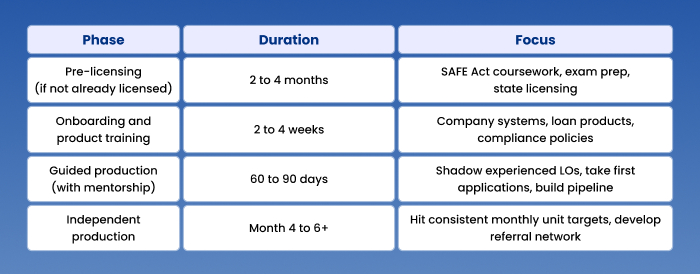
The critical mistake: Most branches abandon structured training after the first two weeks and expect new hires to figure it out. This is why the mortgage industry's annual turnover rate sits at approximately 25%, according to MMI's industry data published in National Mortgage Professional.
Branch managers who compress training into a one-week orientation and then move on are essentially gambling that each new hire will be self-motivated enough to build a book of business from scratch. Some will. Most will not.
Building a Structured LO Training Program: The 90-Day Framework
If you do not have a documented training program, here is a framework you can implement immediately.
Weeks 1 to 2: Foundation
Complete company onboarding (HR, systems access, email setup, CRM training)
Review all loan products with a product manager or senior LO
Complete compliance training modules (TRID, fair lending, company policies)
Shadow 3 to 5 borrower consultations with an experienced originator
Set 90-day production goals and KPIs with your branch manager
Weeks 3 to 4: Guided Practice
Take first loan applications under supervision
Begin outreach to real estate agents (minimum 10 introductory meetings)
Practice rate lock procedures and pricing engine workflows
Complete a minimum of 3 loan file reviews with underwriting
Start daily prospecting activity (calls, emails, in-person visits)
Weeks 5 to 8: Accelerated Production
Transition to independent borrower consultations
Weekly one-on-one coaching sessions with branch manager
Track and report on daily sales activity metrics
Attend at least 2 industry networking events or real estate office meetings
Process first independent loan files through closing
Weeks 9 to 12: Performance Benchmarking
Evaluate against 90-day KPIs (applications taken, loans locked, loans closed)
Identify skill gaps and create targeted development plan
Establish monthly production targets for months 4 through 12
Transition from daily check-ins to weekly accountability meetings
Formalize referral partner strategy with a documented action plan
What Separates High-Performing LO Training Programs from Generic Ones?
The difference between a training program that produces consistent closers and one that feeds turnover comes down to five factors.
1. Mentorship, not just modules. Pairing new LOs with a producing mentor who is actively closing loans is more valuable than any course library. The mentor provides real-time feedback on borrower interactions, file structure, and relationship building that no recorded training can replicate.
2. Sales activity accountability from day one. The branches that produce the most consistent new LOs track daily prospecting activity: calls made, meetings set, applications taken. Without these metrics, there is no way to diagnose whether a new hire is struggling with effort or skill.
3. Structured onboarding that extends beyond week one. A 90-day onboarding plan with weekly milestones keeps new hires on track and gives managers early warning signals if someone is falling behind. This is where tools like EZRecruits make a measurable difference, providing structured onboarding workflows that reduce first-year attrition by up to 40%.
4. Product specialization paths. Not every LO needs to master every loan product immediately. Identify your branch's highest-volume products and train new hires deeply on those first. Specialization in areas like FHA, VA, or non-QM lending can help new LOs differentiate themselves in competitive markets.
5. Technology integration. LOs who are trained on your CRM, pricing engine, and LOS from the start spend less time on administrative tasks and more time in front of borrowers and referral partners.
How Much Does It Cost When Loan Officer Training Fails?
The financial impact of undertrained LOs is significant and often underestimated.
Consider the direct costs: recruiting expenses (job board fees, recruiter time, interviewing hours), licensing and background check costs, compensation during ramp-up, and the opportunity cost of lost production while the position is unfilled or underperforming.
Industry data from MMI shows that the annual turnover rate in the mortgage industry is approximately 25%. For a branch with 10 loan officers, that means losing 2 to 3 originators every year. If each departing LO was producing even $5 million annually, the branch loses $10 to $15 million in potential origination volume plus the cost of replacing them.
The indirect costs are equally damaging: disrupted referral partner relationships, borrowers who fall through the cracks during transitions, and the cultural drag of constant turnover on your remaining team.
The math is clear: investing $5,000 to $10,000 in a structured training program per new hire is a fraction of the $50,000+ cost of replacing a failed one.
How EZRecruits Supports Mortgage Loan Officer Training and Onboarding
Most mortgage companies manage LO training with a patchwork of spreadsheets, email chains, and good intentions. EZRecruits replaces that with a structured onboarding system built specifically for mortgage teams and real estate brokerages.
Here is how it works in practice. When a new loan officer is hired through EZRecruits' recruiting CRM, their onboarding automatically kicks off with a sequenced workflow. Training milestones, compliance checkpoints, and manager check-ins are built into the system, so nothing falls through the cracks during the critical first 90 days.
EZRecruits also integrates DISC-based behavioral assessments into the hiring process, which gives branch managers insight into how each new LO communicates, sells, and responds to coaching. This means you can tailor your training approach to each hire's behavioral profile instead of using a one-size-fits-all program.
Combined with performance dashboards that track KPIs from day one, EZRecruits gives mortgage branch managers visibility into whether their training program is actually producing results or just checking boxes.
Continuing Education: Training Does Not Stop After Onboarding
Mortgage loan officer training is not a one-time event. The NMLS requires a minimum of 8 hours of annual continuing education for all licensed MLOs, covering federal law, ethics, non-traditional lending, and elective mortgage topics.
Beyond the regulatory minimum, high-performing branches invest in ongoing professional development:
Monthly product update sessions covering guideline changes from Fannie Mae, Freddie Mac, FHA, and VA
Quarterly sales training workshops focused on referral partner strategies, conversion optimization, and pipeline management
Annual compliance refreshers that go beyond CE requirements to address real-world scenarios your team has encountered
Technology training when new tools, integrations, or system updates are rolled out
The branches that treat training as a continuous investment rather than an onboarding expense are the ones that retain top producers and attract new ones through reputation.
Common Mistakes Branch Managers Make with LO Training
Mistake 1: Treating compliance training as the entire program. Compliance is the floor, not the ceiling. An LO who passes every compliance module but cannot generate referral partners will not survive.
Mistake 2: No documented training plan. If your training program lives in someone's head rather than in a written, sequenced workflow, it is inconsistent and unscalable.
Mistake 3: Hiring experienced LOs and skipping onboarding. Even veteran originators need onboarding into your specific systems, culture, products, and processes. Skipping this step is a leading cause of early attrition among lateral hires.
Mistake 4: No accountability metrics. If you are not tracking daily sales activity during the first 90 days, you have no way to course-correct before a new hire fails.
Mistake 5: Ignoring behavioral fit. Not every licensed LO is suited for every branch environment. Tools like DISC assessments, which platforms like Brokerkit, Wizehire, and EZRecruits offer in various forms, help managers identify coaching needs before they become performance problems. EZRecruits differentiates itself by building DISC directly into the mortgage and real estate recruiting workflow rather than bolting it on as a generic add-on.
Start Building a Training Program That Produces Results
Book a demo with EZRecruits to see how structured onboarding, DISC-based hiring, and performance tracking can help your branch reduce LO turnover and accelerate time-to-production.
Frequently Asked Questions
What is the best mortgage loan officer training program for new hires?
The best mortgage loan officer training program combines SAFE Act pre-licensing education, in-depth product knowledge, structured sales coaching, and technology training over a 90-day onboarding period. Programs that include mentorship from producing loan officers and daily activity tracking produce the strongest results. EZRecruits provides structured onboarding workflows that keep new LOs on track through this critical period.
How long does mortgage loan officer training take?
Pre-licensing education requires a minimum of 20 hours, and the full licensing process typically takes 2 to 4 months. Once hired, on-the-job training and ramp-up generally takes an additional 3 to 6 months before a new LO is consistently producing. Plan for a total timeline of 90 to 180 days from hire date to independent production.
What certifications do mortgage loan officers need?
All mortgage loan officers must hold an active NMLS license, which requires passing the SAFE MLO exam. Beyond licensing, optional certifications include the Certified Residential Mortgage Specialist (CRMS) from the National Association of Mortgage Brokers and various lender-specific certifications. Annual continuing education of at least 8 hours is mandatory to maintain an active license.
How much does it cost to train a new loan officer?
Direct training costs typically range from $5,000 to $10,000 per new hire, including licensing fees, exam prep, compliance modules, and manager time spent on coaching. The cost of not training properly is significantly higher. Industry data suggests replacing a failed LO hire costs upward of $50,000 when you factor in lost production, recruiting expenses, and pipeline disruption.
What is the difference between loan officer pre-licensing and on-the-job training?
Pre-licensing education covers the federally mandated 20-hour curriculum (mortgage law, ethics, lending standards) and prepares candidates for the SAFE MLO exam. On-the-job training happens after licensing and focuses on company-specific systems, loan products, sales techniques, and borrower relationship management. Both are essential, but pre-licensing alone does not prepare an LO to produce.
How do I reduce loan officer turnover through better training?
Reducing LO turnover starts with structured onboarding that extends beyond the first week, mentorship from producing originators, clear 90-day KPIs, and ongoing professional development. The mortgage industry's approximately 25% annual turnover rate is largely driven by poor onboarding and lack of sales support during the ramp period. Branches that invest in comprehensive training and accountability systems retain significantly more of their hires.
What sales training do new mortgage loan officers need?
New loan officers need training in referral partner acquisition (especially real estate agents), initial borrower consultations, rate and product presentations, objection handling, and follow-up cadences. The first 90 days should emphasize daily prospecting activity with tracked metrics. Sales training is the most commonly skipped component of LO onboarding and the most impactful for long-term production.
How does DISC assessment improve loan officer training?
DISC behavioral assessments help branch managers understand how each new LO communicates, responds to pressure, and approaches sales conversations. This allows managers to tailor coaching and training to the individual rather than using a generic program. For example, a high-D (Dominant) LO may need coaching on active listening, while a high-S (Steady) LO may need support with assertive prospecting. Platforms like EZRecruits integrate DISC directly into the recruiting and onboarding workflow for mortgage and real estate teams.

