






Part-Time Real Estate Agent: The Complete 2026 Guide
Yes, you can be a part-time real estate agent, and a significant share of licensed agents in the United States already do it. The catch: part-time success requires more discipline, not less. Agents who treat it like a casual side hustle rarely earn meaningful income, while those who run it like a structured second business consistently close 4 to 8 transactions per year alongside a full-time job.
The part-time path has gained traction as licensing costs stay low, remote work flexibility expands, and side income becomes a financial necessity for more households. According to the National Association of REALTORS, the median agent works around 30 hours per week, but a meaningful percentage works far fewer, and many treat real estate as a second income stream. Understanding the math, the time commitment, and the brokerage requirements upfront separates agents who build real part-time income from those who quietly let their license expire after year one. This guide walks through everything you need to know to evaluate, launch, and sustain a part-time real estate career in 2026, including how brokerages using platforms like EZRecruits structure their onboarding to set part-timers up to actually close deals.
Can You Be a Part-Time Real Estate Agent?
Short answer: yes, in every U.S. state. There is no federal or state law requiring real estate agents to work full-time hours. Once you complete your pre-licensing education, pass your state exam, and affiliate with a licensed broker, you can practice as much or as little as your brokerage allows.
That said, "allowed" and "viable" are two different things. Some brokerages welcome part-time agents and have systems to support them. Others are full-time only because they invest heavily in training and want agents who can respond to client needs during business hours. Before you spend money on licensing, confirm that brokerages in your market accept part-timers.
The reality is that part-time real estate works best in three scenarios:
You have flexible weekday availability (remote or hybrid work, evenings, lunch breaks)
You have a strong existing network you can sell to (sphere of influence)
You can commit to consistent business-hour availability for at least 2 to 3 days per week
If you cannot answer a client call between 9 a.m. and 6 p.m. on weekdays, part-time real estate will be very difficult. Buyers and sellers move fast, and agents who only respond after 7 p.m. lose deals.
How Much Can a Part-Time Real Estate Agent Earn?
Part-time real estate income varies widely, but the math is straightforward. A typical residential transaction generates a commission of 2.5% to 3% of the sale price, paid to the listing or buyer's agent. Your brokerage takes a split (commonly 30% to 50% for newer agents), and you keep the rest minus expenses.
Run the numbers on a $400,000 home with a 2.75% buyer-side commission:
Gross commission: $11,000
Brokerage split (50/50 with no cap, common for new agents): $5,500
Your business expenses (MLS, lockbox, marketing, mileage): roughly $500 to $1,500 per deal
Net to you: approximately $4,000 to $5,000
A part-time agent closing 5 transactions per year at this average would earn roughly $20,000 to $25,000 net. Six to eight closings is the realistic target range for a well-organized part-timer with a warm sphere. Anything above that is full-time territory in most markets.
For context, the Bureau of Labor Statistics reports that the median annual wage for real estate sales agents sits around $55,000 across all experience levels and time commitments, but newer agents earn substantially less. NAR member data consistently shows that agents with under two years of experience earn far below the overall median, and part-time status compounds that gap.
If you want an honest expectation: in your first year, plan for $0 to $15,000 net while you build your pipeline. Real income comes in years two and three.
The Real Time Commitment: Hours, Schedule, and Reality
Part-time real estate is not 5 hours per week. The realistic minimum to keep a license active and produce occasional deals is 15 to 20 hours per week, distributed roughly as follows:
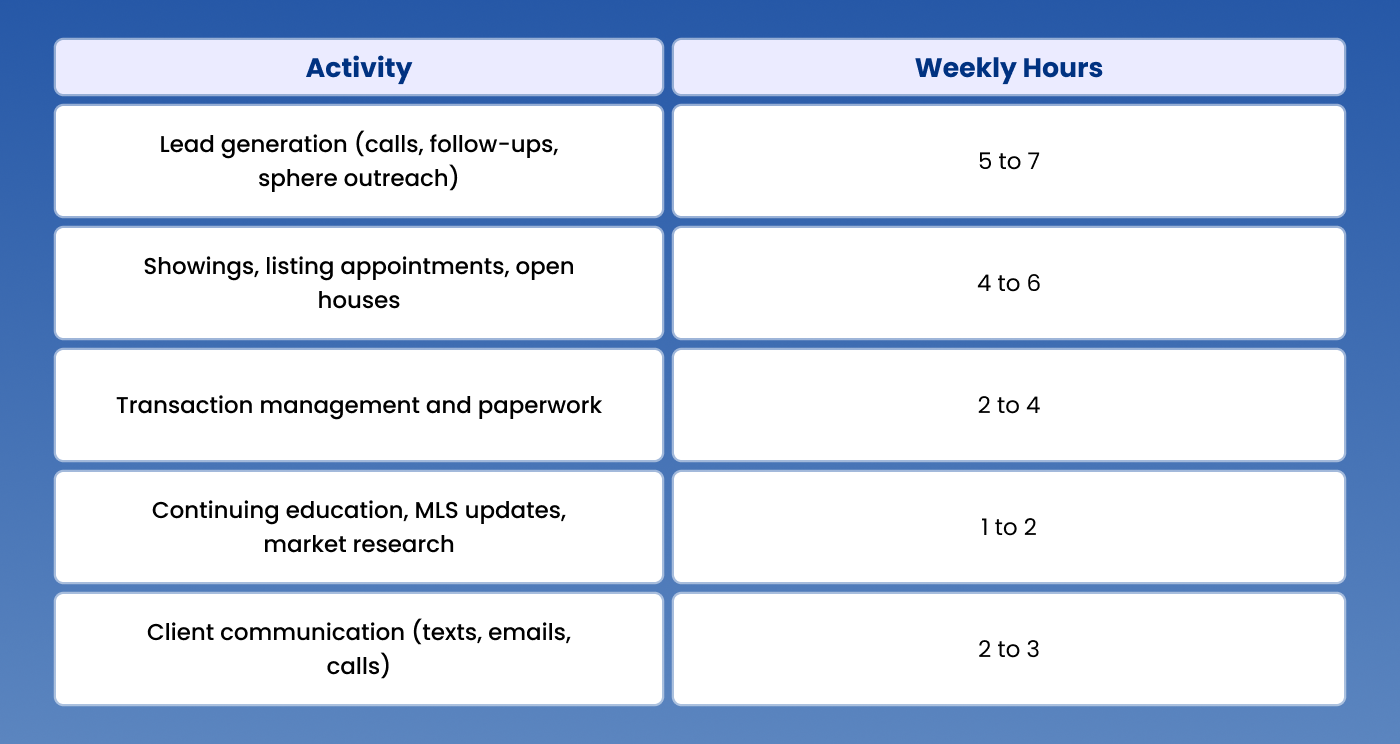
Showings and listing appointments rarely fit cleanly into evenings and weekends. Sellers want their listing photographed and on the MLS within days, not "whenever you're free." Buyers expect to see homes within 24 to 48 hours of finding one online. A part-time agent who cannot show a property until Saturday will lose that buyer to a full-time agent by Wednesday.
The agents who succeed part-time build flexibility into their day jobs (lunch showings, late-morning listing appointments, occasional half-days off) rather than confining real estate to weekends only.
What Brokerages Require From Part-Time Agents
Brokerage requirements for part-timers fall into three buckets: licensing, financial, and operational.
Licensing Requirements
You must:
Complete your state's pre-licensing education (typically 60 to 180 hours depending on the state)
Pass the state real estate licensing exam
Affiliate with a sponsoring broker
Complete continuing education to maintain your license (varies by state, typically 12 to 30 hours every 1 to 2 years)
Financial Requirements
Expect to invest $1,500 to $4,000 in your first year before you close a deal:
Pre-licensing course: $300 to $800
State exam fee: $50 to $150
Background check and fingerprinting: $50 to $100
License application: $100 to $300
MLS dues: $400 to $800 per year
Local board and NAR dues: $500 to $700 per year
E&O insurance (often through brokerage): $200 to $500
Business expenses (signs, business cards, lockbox, mileage): $500 to $1,500
Operational Requirements
This is where part-timers get filtered out. Brokerages that accept part-time agents typically require:
A minimum number of transactions per year (often 2 to 4)
Attendance at a minimum percentage of office meetings or trainings
Use of the brokerage's CRM and transaction management tools
Adherence to response-time standards for leads (often within 5 to 15 minutes)
If a brokerage cannot tell you their part-time requirements clearly, that is a red flag. Quality brokerages have structured real estate agent onboarding programs and clear performance expectations regardless of whether you work 10 hours or 50 per week.
Real Estate Side Hustle: The 5 Skills That Determine Success
A real estate side hustle either grows into a real income stream or fizzles out within 18 months. The difference comes down to five skills.
1. Lead Generation From Your Sphere
Your first 10 to 15 transactions almost always come from people who already know you. Cold leads from Zillow or paid ads are expensive and rarely close for new part-timers. Make a list of 100 to 200 people in your sphere (friends, family, coworkers, neighbors, former colleagues) and commit to reaching out to each one quarterly with genuine, non-pushy communication.
2. Fast and Professional Communication
Lead response time is the single biggest predictor of whether a part-time agent closes deals. Industry data consistently shows that contacting an inbound lead within 5 minutes increases conversion dramatically compared to waiting an hour or more. Set up your phone, email, and CRM so you can respond from anywhere within minutes.
3. Calendar and Pipeline Discipline
Part-time agents fail when they treat real estate as something they "get to when they have time." Block specific hours each week for prospecting, follow-ups, and showings. Use a real CRM (not a notes app) to track every lead, every conversation, and every deadline.
4. Negotiation and Contract Knowledge
Real estate is a contract business. Spend extra time in your first year mastering your state's purchase contract, listing agreement, and disclosure forms. A part-time agent who knows the contract cold builds trust faster than a full-time agent who fumbles through it.
5. Working Within a Structured Brokerage
Solo wing-it agents almost always fail part-time. The agents who succeed pick brokerages with structured systems: defined onboarding, mentorship, CRM tools, transaction coordinators, and clear processes. This is exactly why brokerages investing in proper real estate recruiting and onboarding infrastructure produce part-timers who actually close deals.
How to Choose a Brokerage as a Part-Time Agent
Brokerage choice matters more for part-timers than for full-timers, because you have less time to figure things out on your own. Evaluate brokerages on these five criteria:
1. Onboarding Structure. Does the brokerage have a documented onboarding program with clear milestones for your first 30, 60, and 90 days? "Sink or swim" brokerages are a death sentence for part-timers.
2. Mentorship and Team Support. Is there a designated mentor, team lead, or managing broker available for questions during business hours? Part-timers need backup when they cannot drop everything to handle a client issue.
3. Technology Stack. What CRM, transaction management software, and communication tools does the brokerage provide? You should not be paying out of pocket for the basics.
4. Commission Split and Fees. Lower splits (50/50, 60/40) are normal for new agents but should improve as you produce. Watch for monthly desk fees, transaction fees, and "training fees" that erode part-time earnings quickly.
5. Part-Time Friendliness in Practice. Ask current part-time agents at the brokerage how it actually works. Are meetings recorded? Can showings be coordinated through team support? Is the broker reachable by text?
Part-Time Real Estate Income: What's Realistic Year by Year
Here is a realistic earnings trajectory for a disciplined part-time agent in an average U.S. market:
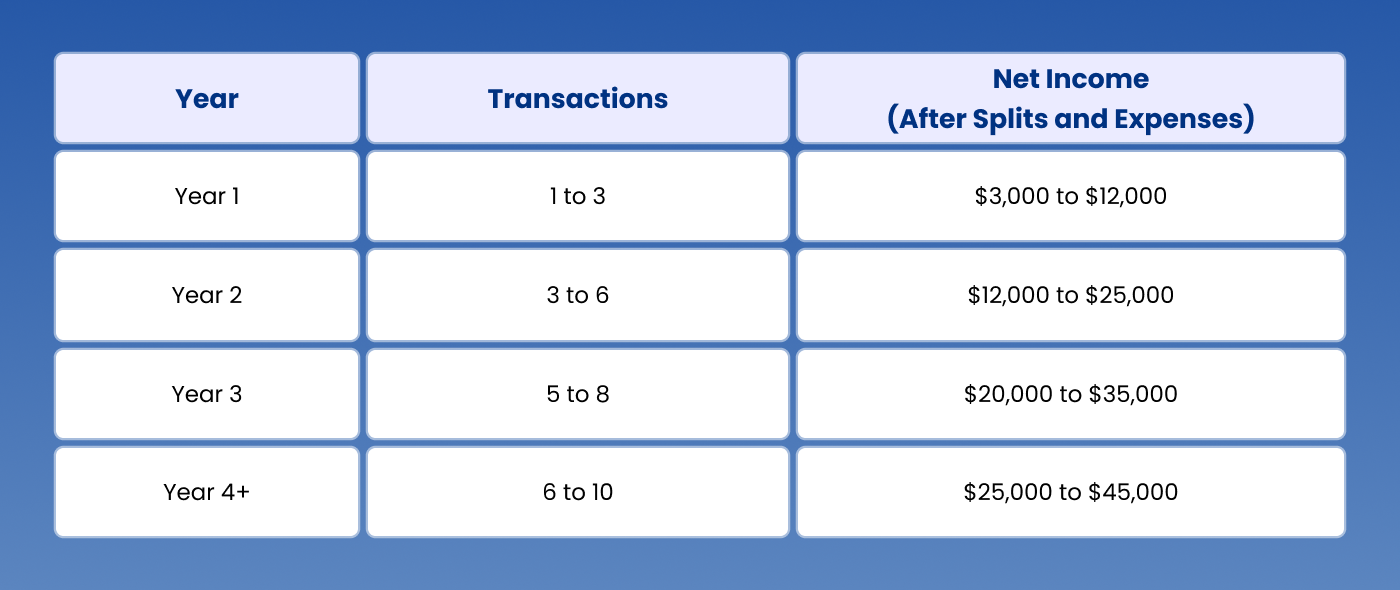
These ranges assume an average transaction size of $350,000 to $450,000 and a 50/50 to 70/30 commission split. In higher-priced markets, the same transaction count produces meaningfully higher income.
The agents who hit the upper end of these ranges share three traits: they pick a brokerage with strong onboarding, they treat lead generation as a non-negotiable weekly habit, and they reinvest a portion of every commission back into their business.
Common Part-Time Agent Pitfalls (and How to Avoid Them)
Five mistakes account for the majority of part-time failures:
Mistake 1: Treating It Like a Hobby. Agents who do not block dedicated hours for real estate get inconsistent results. Set a calendar and protect it.
Mistake 2: Choosing the Wrong Brokerage. Picking a brokerage based on commission split alone is a common error. Onboarding quality, mentorship, and tools matter more in your first two years than a few extra commission percentage points.
Mistake 3: Ignoring CRM Discipline. A spreadsheet or notes app is not a CRM. Without structured follow-up, leads slip through the cracks within days, and the average residential lead takes 5 to 12 touches before converting.
Mistake 4: Underpricing Their Time. Part-timers often discount their commission to compete with full-time agents. This rarely wins listings and trains your sphere to expect discounts forever.
Mistake 5: Not Investing in Education. Continuing education, contract mastery, and market knowledge are non-negotiable. Skipping this is how part-timers stay junior forever.
How EZRecruits Helps Brokerages Onboard Part-Time Agents Effectively
Most brokerages lose part-time agents not because the agents fail, but because the brokerage never built the systems to support them. EZRecruits is the all-in-one recruiting and onboarding platform purpose-built for real estate brokerages, and it solves this directly.
For brokerages recruiting part-time agents, EZRecruits provides:
Structured 30/60/90-day onboarding workflows that ensure every new agent (full-time or part-time) hits clear milestones
DISC-based hiring software built specifically for real estate, which helps brokers identify which part-time candidates are likely to actually produce
Automated outreach and follow-up sequences that keep new agents engaged during their first 90 days, when most attrition happens
Real estate team management dashboards that track lead response time, transaction pipeline, and onboarding completion across both full-time and part-time agents
Job board syndication to 100+ boards, including platforms where part-time and second-career candidates actually search
Brokerages using EZRecruits report up to a 40% reduction in first-year agent attrition, which is especially meaningful for part-time agents who are most at risk of falling off before they close their first deal. If you are evaluating brokerages as a part-time agent, ask whether they use a structured platform like EZRecruits to onboard new agents. The answer tells you everything about whether you will get real support or be left to figure it out alone.
Frequently Asked Questions
Can you be a part-time realtor and still be successful?
Yes. Successful part-time REALTORS typically close 4 to 8 transactions per year by working 15 to 20 hours per week consistently, focusing on their sphere of influence, and choosing a brokerage with structured onboarding. Success is less about hours and more about discipline, lead response time, and brokerage support.
How much does a part-time real estate agent make?
A part-time real estate agent in their first year typically earns $0 to $15,000 net. By year three, disciplined part-timers commonly earn $20,000 to $35,000 net per year, depending on market price points and commission splits. Income comes in chunks (per transaction), not consistent paychecks.
How many hours a week do part-time real estate agents work?
Most viable part-time real estate agents work 15 to 25 hours per week. Anything below 15 hours typically produces too little activity to maintain an active pipeline, and the agent's license effectively becomes inactive within 12 to 18 months.
Is a real estate side hustle worth it?
A real estate side hustle is worth it if you have weekday flexibility, a strong sphere of influence, and willingness to invest 18 to 24 months before earnings stabilize. It is generally not worth it as a pure weekend-only pursuit, since most clients need agent availability during business hours.
Do you need to quit your job to be a real estate agent?
No. You can practice real estate part-time while keeping a full-time job, as long as your brokerage allows it and you can maintain reasonable business-hour responsiveness. Many successful agents start part-time and transition to full-time once they consistently close 8 or more transactions per year.
What is the best brokerage for part-time real estate agents?
The best brokerage for a part-time agent has documented onboarding, accessible mentorship, a real CRM and transaction management stack, and a commission structure with clear progression. Brokerages that use platforms like EZRecruits to manage agent recruiting and onboarding typically offer significantly better part-time support than brokerages relying on ad hoc systems.
How long does it take to make money as a part-time real estate agent?
Most part-time agents close their first transaction within 3 to 9 months of activating their license, but reliable monthly income usually does not appear until year two or three. Plan for at least 12 months of investment before real estate becomes a meaningful income stream.
Can I do real estate on the side while working full-time?
Yes, real estate is one of the more common side careers for full-time professionals because the licensing barrier is low and the work is flexible. The main constraint is being responsive to leads and clients during business hours, which usually requires a flexible day job, lunch-break availability, or a partner agent who can cover your hours when you cannot.
Build a Brokerage That Actually Supports Part-Time Agents
If you run a brokerage and want to recruit and retain better part-time talent, EZRecruits gives you the recruiting CRM, DISC-based hiring assessments, structured onboarding, and job board syndication that turn part-time hires into producing agents. Book a demo with EZRecruits to see how the platform handles part-time agent recruiting and onboarding end to end.

