






Real Estate Agent Turnover: The True Cost and How to Cut It by 40%
Real estate agent turnover costs the average brokerage between $15,000 and $50,000 per agent lost when you account for recruiting expenses, training investment, the productivity gap during vacancy and ramp-up, and the indirect impact on team morale. For a 25-agent brokerage losing 5 agents per year, that is $75,000 to $250,000 in annual drag on profitability. The brokerages that are reducing this cost are doing it through structured onboarding, behavioral hiring, and retention signal monitoring. EZRecruits helps brokerages cut first-year agent attrition by up to 40% by connecting recruiting, onboarding, and performance tracking in a single platform.
The numbers paint a clear picture. According to NAR data, roughly 87% of new real estate agents leave the industry within five years, with the highest attrition concentrated in the first 18 months. The 2025 Agent Migration Report found that overall agent turnover reached 6.8% in 2025, with one-third of moves driven by financial distress (HousingWire, January 2026). Meanwhile, NAR's 2025 Member Profile shows the median Realtor age has climbed to 57, and NAR projects a membership drop of approximately 150,000 agents by the end of 2026 (Real Estate News, August 2025). Brokerages are not just losing agents to competitors. They are losing agents to attrition, career changes, and retirement, and every departure carries a cost that most brokers significantly underestimate.
How Bad Is Real Estate Agent Turnover, Really?
Real estate agent attrition is the rate at which agents leave a brokerage, either to join a competitor, exit the industry, or retire. It is one of the most expensive operational problems in the brokerage business, and it is widely underestimated because most of the cost is indirect.
Here is what the data shows. NAR has consistently reported that the vast majority of new agents do not survive their first five years. The industry-wide churn rate means that for every 10 agents you recruit, only 1 or 2 are likely to still be with you in year five. Among the agents who do move brokerages (rather than leaving the industry entirely), the 2025 Agent Migration Report found that turnover rose to 6.8%, with external moves accounting for 5.5% and internal transfers making up 1.3% (HousingWire, January 2026).
What makes real estate agent turnover particularly expensive is the concentration of production. In most brokerages, the top 20% of agents generate 60% to 80% of total transaction volume. Losing even one top producer creates a revenue hole that two or three average agents cannot fill. And the agents most likely to leave are often the ones producing the most, because they have the most options.
The financial impact compounds quickly. NAR's 2025 Member Profile reports that the typical agent completed 10 transaction sides in 2024 with a median sales volume of $2.5 million (NAR, August 2025). When that production walks out the door, the brokerage loses not only the GCI from those transactions but also the referral network, client relationships, and institutional knowledge that agent brought with them.
The Full Cost of Replacing One Real Estate Agent
Most brokers think of turnover cost as "what I spend to recruit a replacement." That is only one piece. The true cost of agent turnover at a brokerage includes five categories of direct and indirect expenses.
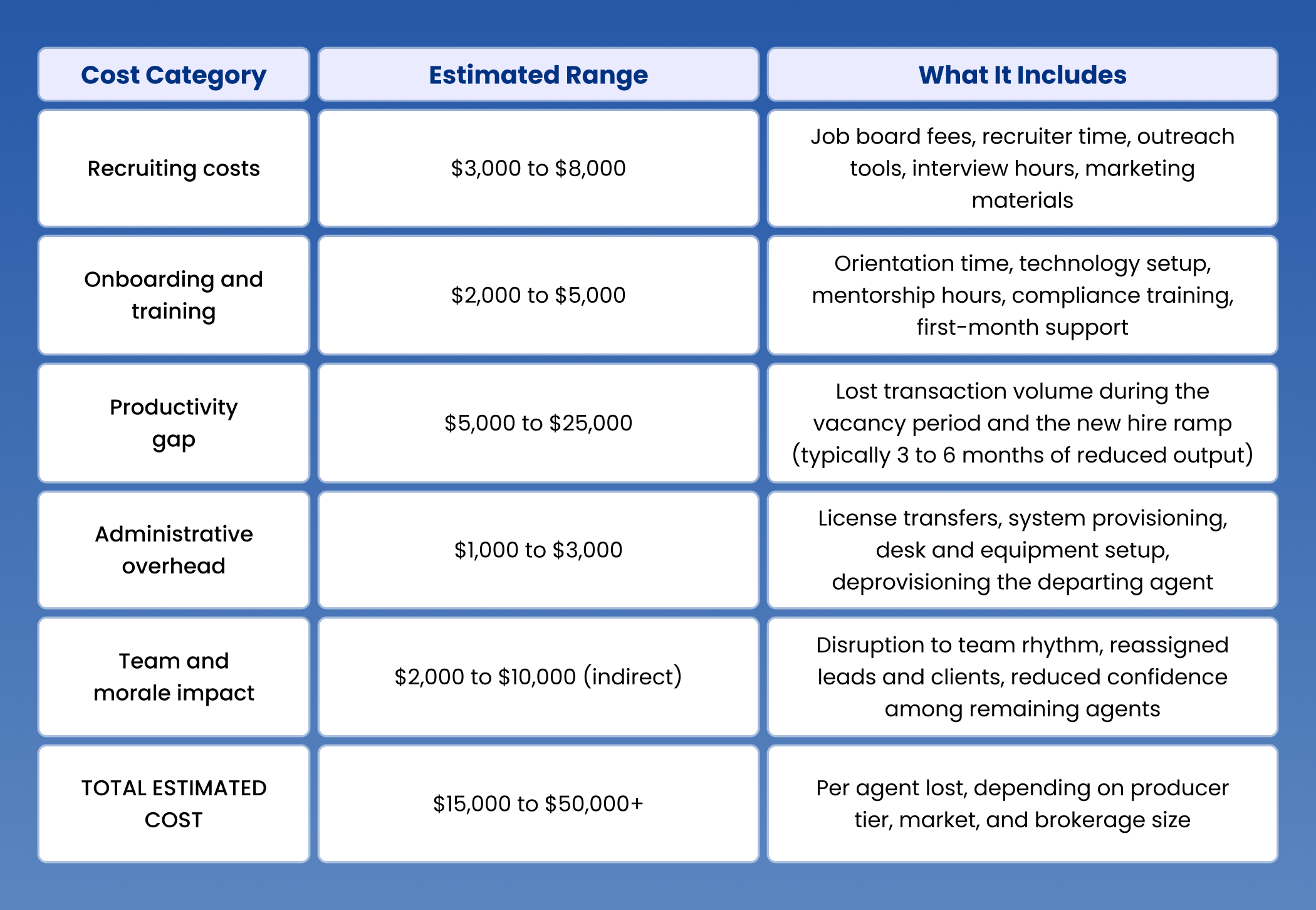
To put this in context: the replacement cost of a single agent typically equals 1x to 2x that agent's annual GCI contribution to the brokerage. A mid-tier agent generating $40,000 in annual GCI for the brokerage can cost $40,000 to $80,000 to replace when you factor in the full cycle. For top producers, the math is even worse because their production is harder to replace and the vacancy period is longer.
Why Do Real Estate Agents Quit Their Brokerage?
Understanding why agents leave is the first step toward reducing real estate agent turnover. Based on industry data and what we see across brokerages using EZRecruits, six factors drive the majority of first-year and early-career departures.
1. No Structured Onboarding
The single biggest predictor of first-year attrition is whether the agent received structured onboarding or was left to figure things out on their own. A new agent who gets a login, a desk, and a "let me know if you need anything" is far more likely to leave within 12 months than one who goes through a 90-day program with clear milestones, technology training, and a dedicated mentor.
2. Financial Distress and Unrealistic Expectations
The 2025 Agent Migration Report found that one-third of agent moves were driven by financial distress (HousingWire). Many new agents enter the business expecting income within 60 to 90 days and run out of savings before their first closing. Brokerages that set realistic income timelines during recruiting and provide structured ramp-up support retain significantly more first-year agents.
3. Poor Cultural Fit
An agent whose working style clashes with the team or the brokerage's operational culture will disengage quickly, regardless of the compensation structure. This is where behavioral hiring makes a measurable difference. DISC-based assessments identify cultural mismatches before the offer, not six months after the agent has already started looking elsewhere.
4. Inadequate Technology and Operational Support
Agents care about speed and efficiency. If your CRM is clunky, your lead routing is slow, or your transaction management requires too many manual steps, productive agents will leave for a brokerage that removes that friction. According to the 2025 Agent Migration Report, leadership quality and operational autonomy were among the top reasons high-producing agents cited for moving firms (HousingWire).
5. Lack of Growth Path or Recognition
Agents, especially those in their first five years, need to see a clear path forward. If the only career trajectory at your brokerage is "keep doing what you are doing and hope your volume goes up," you will lose ambitious agents to competitors who offer team leadership roles, mentorship programs, or equity pathways.
6. Compensation Misalignment
Compensation is rarely the primary reason a top agent leaves, but it is almost always the catalyst that surfaces underlying frustrations. When an agent says they left for a better split, what they usually mean is the value they received at your brokerage did not justify the split they were paying. If your split is not the highest in the market, your value proposition (technology, leads, marketing, admin support) must clearly account for the difference. Document it. Communicate it during recruiting. And revisit it at the 90-day and annual check-in so agents never have to guess whether they are getting a fair deal.
How Structured Onboarding Cuts First-Year Agent Attrition by Up to 40%
The most effective lever for reducing real estate agent turnover is structured onboarding. Not a welcome packet. Not a one-day orientation. A deliberate 90-day program that moves a new agent from signed ICA to consistent production with specific milestones, accountability checkpoints, and support systems.
Here is what a structured onboarding program includes: clear production milestones for week 1, week 4, and week 12; technology training on the CRM, transaction management system, and marketing tools; state-specific compliance training; introduction to referral partners and the agent's sphere-building strategy; a mentor or buddy paired by experience level and DISC behavioral profile; and weekly check-ins with the branch manager during the first 90 days.
EZRecruits' onboarding module automates this entire process. When a new agent enters the system from the recruiting pipeline, they are automatically enrolled in a structured onboarding workflow with task assignments, milestone tracking, and manager dashboards that show exactly where each new hire stands. The DISC profile generated during the hiring process flows directly into the onboarding plan, informing how the agent is coached and communicated with from day one. Brokerages using this workflow report reducing first-year attrition by up to 40%.
A Quarter-by-Quarter Action Plan to Reduce Agent Turnover
Reducing real estate agent attrition is not a single initiative. It is a system that builds over time. Here is a four-quarter action plan for brokerages ready to make turnover reduction an operational priority.
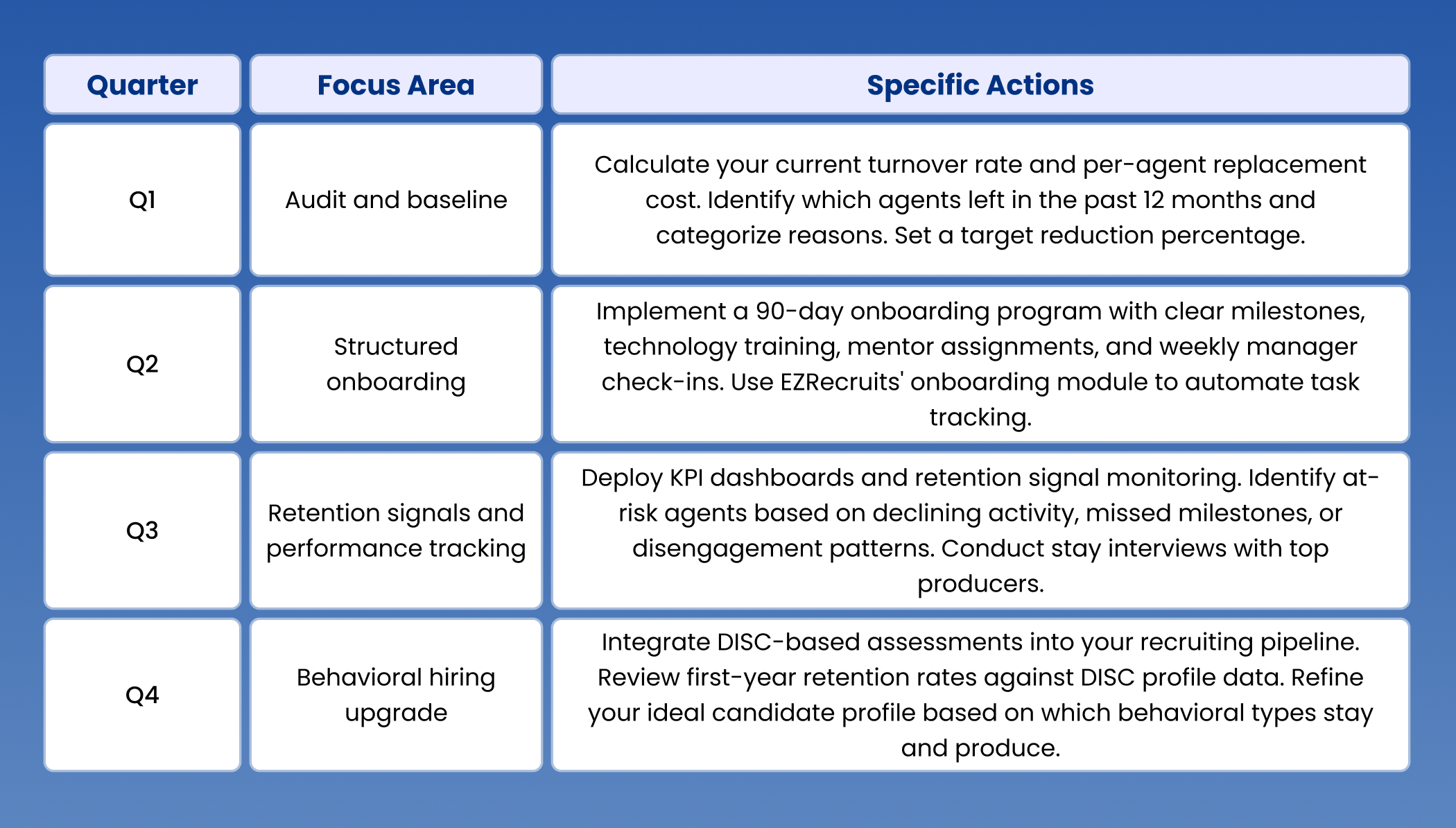
The brokerages that see the biggest retention improvements are the ones that treat turnover as a measurable operational metric, not a cost of doing business. When you know what each lost agent costs, you can justify the investment in the systems, tools, and processes that keep them. Track your turnover rate quarterly. Calculate the per-agent replacement cost using the framework above. Then measure improvement against that baseline after each quarter's initiatives take effect. Within 12 months, the data will show you exactly which investments are paying off and where to double down.
Stop losing agents you worked hard to recruit.
Reduce Turnover with EZRecruits -- Get a Demo
https://ezrecruits.com/real-estate-agent-onboarding
Frequently Asked Questions
How much does it cost to replace a real estate agent?
The total cost of replacing a single real estate agent ranges from $15,000 to $50,000 or more, depending on their production level and your market. This includes recruiting costs ($3,000 to $8,000), onboarding and training ($2,000 to $5,000), the productivity gap during vacancy and ramp-up ($5,000 to $25,000), and indirect costs like team disruption and reassigned clients.
What is the average turnover rate for real estate agents?
NAR data shows that approximately 87% of new agents leave the industry within five years. Annual brokerage-level turnover reached 6.8% in 2025 according to the Agent Migration Report, with external moves accounting for 5.5% and internal transfers at 1.3%. First-year attrition rates are significantly higher, particularly for agents who do not receive structured onboarding.
Why do real estate agents leave their brokerage?
The six most common reasons are: lack of structured onboarding, financial distress from unrealistic income expectations, poor cultural fit, inadequate technology and operational support, no clear growth path, and compensation misalignment. Financial distress and onboarding gaps are the top drivers of first-year departures specifically.
How can brokerages reduce agent turnover?
The highest-impact strategies are structured 90-day onboarding programs, DISC-based behavioral hiring to prevent cultural mismatches, retention signal monitoring through KPI dashboards, and regular stay interviews with top producers. EZRecruits combines all four in a single platform, helping brokerages reduce first-year attrition by up to 40%.
What is the ROI of reducing agent turnover by 40%?
For a 25-agent brokerage losing 5 agents per year at an average replacement cost of $30,000, the annual cost of turnover is approximately $150,000. A 40% reduction means retaining 2 additional agents per year, saving $60,000 annually in direct and indirect costs. Over three years, that is $180,000 in savings before accounting for the compounding value of retained production.
How does onboarding reduce real estate agent attrition?
Structured onboarding gives new agents clear milestones, technology training, mentorship, and regular manager check-ins during the critical first 90 days. This reduces the confusion, isolation, and frustration that drive early departures. When onboarding also incorporates the agent's DISC behavioral profile, coaching and communication are tailored to their working style, further improving retention.
What is a good first-year retention rate for a real estate brokerage?
A strong first-year retention rate for a real estate brokerage is 75% or higher. Many brokerages operate in the 50% to 65% range for first-year agents, which means they are replacing half their new hires annually. Brokerages with structured onboarding programs and behavioral hiring workflows consistently report first-year retention rates above 80%.

