






How Much Does a Realtor Make on a $500,000 Sale? The Real Net After Splits, Fees, and Taxes
The headline number on a $500,000 sale is loud. Six percent commission, $30,000 changing hands, the agent walks away with the kind of paycheck that fuels every "get your real estate license" ad on Instagram. The actual take-home is far quieter, and if you run a brokerage or recruit agents, the gap between the two is where most of your competitive positioning lives. This article breaks down exactly how much a realtor makes on a $500,000 sale across the most common split structures, what gets carved out before the agent sees a dollar, and how brokerage operators can use that math to win the recruiting conversations they keep losing.
How Much Does a Realtor Make on a $500,000 Sale?
A realtor working a $500,000 sale typically nets between $5,000 and $11,000 before taxes, depending on commission rate, brokerage split, and fees. The gross commission on the sale is $25,000 to $30,000 (5 to 6 percent), but that splits in half between the listing and buyer sides, then again between agent and brokerage, then shrinks further after franchise fees, E&O insurance, and transaction costs. After self-employment taxes, the agent's actual deposit is often $3,500 to $8,500 per side, per deal.
That answer assumes a single agent on one side of the deal. The real number depends on six variables: total commission rate, side of the deal, brokerage split, cap status, monthly fees, and tax bracket. The rest of this article breaks each one down so you can model the math for your own market or your own brokerage's recruiting pitch.
The Gross Commission: Where the $25K to $30K Actually Comes From
Real estate commissions are paid by the seller out of sale proceeds at closing, then divided among the parties involved in the transaction. On a $500,000 sale at a 6 percent total commission, that produces $30,000 in gross commission. Five percent produces $25,000. Whether the rate is 5 or 6 (or something else after the 2024 NAR settlement) depends on the local market, the listing agreement, and increasingly, what the buyer agreed to pay their agent separately.
The $30,000 does not go to one person. Traditionally, the listing brokerage and buyer's brokerage each receive half (commonly called the "co-op fee"), so the listing side and buyer side each start with $15,000 in gross commission income on the deal. Each side then runs that $15,000 through its own brokerage split, fees, and overhead before the agent sees their cut.
Since August 2024, the NAR settlement has decoupled buyer's agent compensation from MLS-published cooperating compensation. Buyers now sign written representation agreements specifying how their agent gets paid, and that compensation can come from the seller, the buyer directly, or a combination. The headline gross has not collapsed in most markets, but the path it takes to get there is now more variable, which matters when an agent is modeling their own income.
Brokerage Splits Explained: From $15,000 Gross to Net Commission
Once $15,000 lands at the brokerage on one side of a $500,000 sale, the agent's take is determined by their split agreement. Three structures dominate the industry: traditional split brokerages, capped-split brokerages, and 100 percent commission brokerages. Each calculates the same gross differently, and the choice has a meaningful impact on what an agent makes per deal and per year.
Traditional Split Brokerages
Standard splits range from 50/50 for new agents to 80/20 or 90/10 for top producers. On $15,000 gross, a 70/30 split (a common mid-tier) sends $10,500 to the agent and $4,500 to the brokerage. The brokerage typically covers desk fees, marketing platforms, and admin support out of its share. Higher splits go to higher producers, which is why GCI (Gross Commission Income) tracking matters in any recruiting or retention conversation.
Capped-Split Brokerages
Models like Keller Williams operate on a cap. Agents pay a 64/30/6 split (or similar) until they hit a yearly cap, often $18,000 to $30,000 depending on market center, after which they keep nearly 100 percent for the rest of their anniversary year. On $15,000 gross under that pre-cap structure, the agent nets roughly $9,600. After cap, that same $15,000 goes mostly to the agent minus a small transaction fee.
100 Percent Commission Brokerages
eXp Realty, Real Brokerage, and similar models charge a flat monthly or per-transaction fee in exchange for the agent keeping nearly all commission. eXp uses an 80/20 split with a $16,000 cap. After cap, agents pay roughly $250 per transaction and keep the rest. On a $500,000 sale post-cap, the agent could net close to $14,500 of the $15,000 gross before personal expenses and taxes.
Real Take-Home on a $500,000 Sale: Five Brokerage Scenarios Compared
Here is what a single agent actually nets on one side of a $500,000 sale at a 6 percent total commission ($15,000 gross to one side), modeled across five common brokerage structures. These figures assume no transaction coordinator fee, no referral fee, and no team split, all of which would reduce the take-home further.
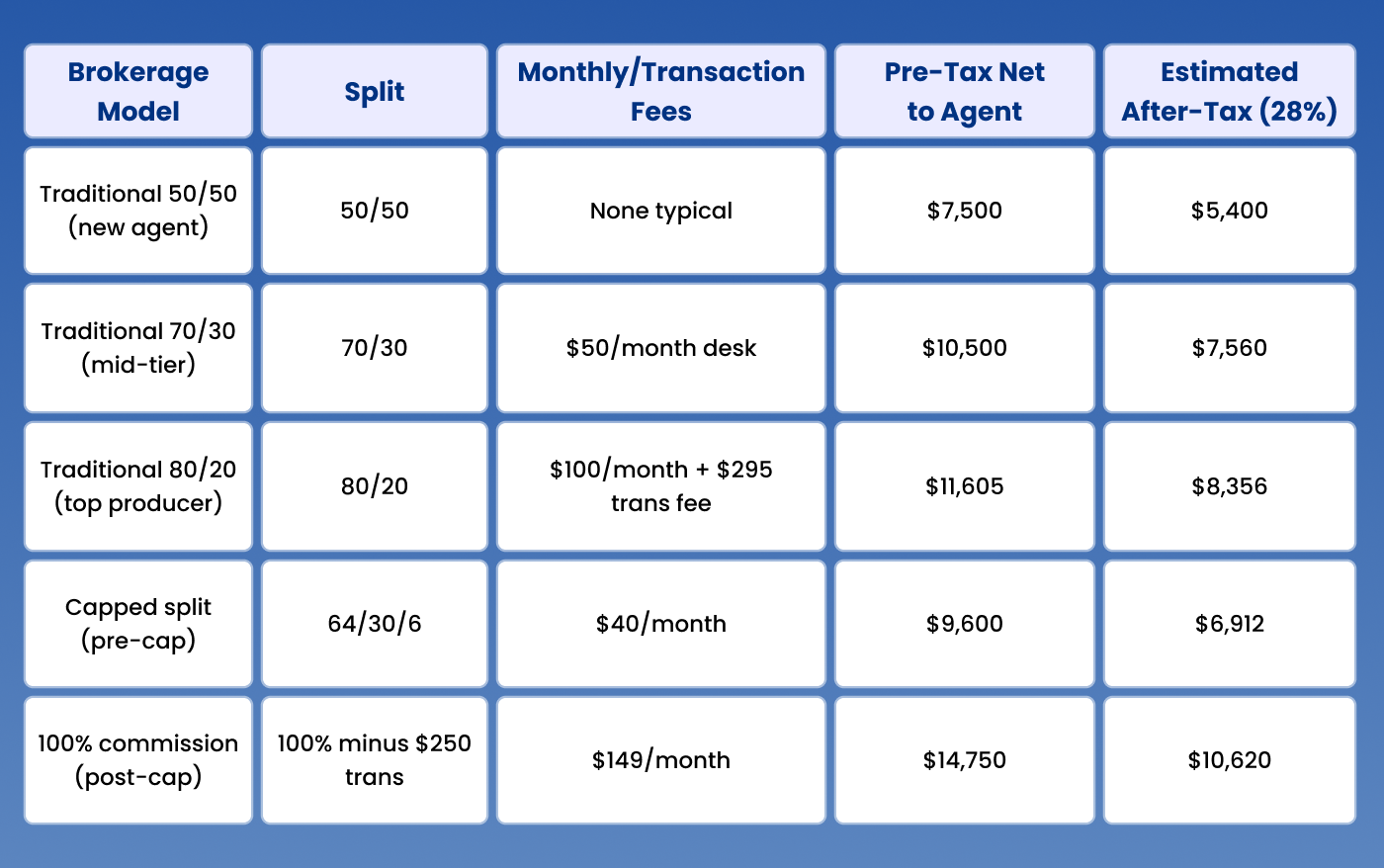
Two patterns jump out. First, the spread from worst-case to best-case net on the same sale is nearly 2x ($5,400 vs. $10,620 after taxes). Second, the brokerage split alone is not the whole story: monthly fees, transaction fees, franchise royalties, and cap status often matter more than the headline percentage. An agent who fixates only on "what's the split?" is missing the variables that drive actual take-home.
The Hidden Costs That Shrink Every Commission Check
Even after the brokerage split, several costs come out of the agent's share before the deposit hits their account. On a $500,000 sale, these can subtract another $1,000 to $2,500 from the gross split number. They are easy to overlook in a recruiting pitch, which is exactly why your agents complain about take-home not matching what they were promised.
The main carve-outs:
Franchise royalty fees: Brands like Keller Williams, RE/MAX, and Coldwell Banker take 6 to 8 percent off the top of agent commission (capped annually at most franchises). On a $10,500 agent commission, that is another $630 to $840 per deal pre-cap.
E&O insurance: Errors and Omissions insurance runs $25 to $75 per transaction at most brokerages, sometimes billed as an annual fee instead.
Transaction fees: Many brokerages charge $200 to $500 per closed deal to cover compliance, broker review, and admin processing.
Team splits: Agents on a team typically pay 25 to 50 percent of their post-brokerage-split commission to the team lead in exchange for leads and support. A new team agent on a 50/50 brokerage split with a 50/50 team split nets just 25 percent of gross.
Referral fees: A 25 percent referral fee, the industry standard for relocation or agent-to-agent referrals, takes another quarter off the top before any other splits apply.
Self-employment taxes: Agents are 1099 contractors. Federal self-employment tax alone is 15.3 percent, plus federal and state income tax. Most agents should plan for a 25 to 32 percent total tax burden.
How Much Does a Realtor Make on a $500,000 Sale After Taxes? A Walkthrough
To answer how much a realtor makes on a $500,000 sale in actual deposit terms, you have to go all the way through to after-tax net. Take a mid-career agent at a 70/30 split brokerage with a $50 monthly desk fee, no franchise royalty, paying a $295 transaction fee, in the 24 percent federal bracket plus state and self-employment tax (roughly 28 to 30 percent effective).
Walking the math:
Sale price: $500,000
Total commission (6 percent): $30,000
Listing or buyer side gross: $15,000
Agent's 70 percent split: $10,500
Less transaction fee: ($295)
Pre-tax net: $10,205
Less 28 percent total tax: ($2,857)
After-tax deposit: $7,348
That $7,348 is what the agent actually has to live on, save, market with, and reinvest in their business after one $500,000 sale. An agent closing 12 such deals a year nets roughly $88,000 after taxes. According to NAR's 2024 Member Profile, the median REALTOR gross income in 2023 was $55,800, which is gross commission and not after-tax take-home. The gap between gross and net is exactly why per-deal modeling matters so much in recruiting.
What This Math Means for Brokerage Recruiting
If you run a brokerage or recruit for one, the gap between gross commission and after-tax net is the most underused recruiting tool in the industry. Most agents have never modeled their own income at this level of detail, which means the brokerage that does the math with them, on their actual deal flow, in their actual market, wins the conversation by default.
Three plays this opens up:
Lead with deal-level net, not split percentages. Saying "we're an 80/20 shop" is generic. Saying "on your last $500,000 closing you would have netted $X more here, here is the math" is specific. Specificity is trust.
Reframe lower splits as higher service. A 70/30 split brokerage that provides leads, coaching, marketing, and admin can compete with 100 percent commission shops by quantifying the time and lead-gen costs the agent would otherwise carry. Show the all-in cost, not just the split.
Surface hidden fees the competitor charges. Many recruits do not know their current brokerage's transaction fee, franchise royalty, or compliance fee structure off the top of their head. Walking through it together is a high-trust conversation that often reveals their net is lower than they thought.
The brokerages winning recruiting in 2026 are not the ones with the highest splits. They are the ones who help the agent see their real number, then build a credible plan to grow it.
Common Mistakes Brokerages Make When Pitching Commission Math
Most brokerage recruiting pitches fail not because the numbers are bad, but because the presentation is generic. Operators repeatedly make the same four mistakes when explaining commission structure to potential recruits, each of which kills conversion.
Quoting splits without context. "70/30" means nothing without monthly fees, transaction costs, cap structure, and average GCI per agent. A recruit who hears only the percentage will compare it apples-to-apples against a different shop where the percentage tells a completely different story.
Hiding fees until onboarding. Surprise fees in week one of onboarding produce immediate buyer's remorse. If E&O is $50 per transaction and you charge $295 per closing, say so on the recruiting call. Trust compounds.
Pitching to the wrong agent profile. A high-volume team-leader recruit cares about cap structure and back-office leverage. A new licensee cares about lead support and training. The same deck, used for both, loses both.
Not knowing the recruit's current numbers. Showing up to a recruiting meeting without asking about deal volume, average sale price, current split, and current fees means you are pitching blind. Asking those questions first, then modeling savings on a $500,000 sale (or whatever their average is) makes the conversation about them, not you.
The fix is operational: standardize your discovery questions, build a simple commission calculator your recruiters can use live, and require every recruiting conversation to end with a personalized "here is what you would have made at our shop" number.
Where EZRecruits Fits in the Recruiting Workflow
Once a brokerage knows its commission story cold, the bottleneck shifts from "what do we say?" to "who do we say it to, and at what scale?" That is where most growth-stage brokerages stall. Manual sourcing, scattered candidate notes, and recruiter follow-up that lives in someone's head or notebook produce a recruiting pipeline that leaks at every stage.
EZRecruits handles that operational layer. It runs a structured recruiting funnel for real estate brokerages and mortgage companies: sourcing candidates by market and license status, sending automated outreach sequences, screening with DISC-based behavioral assessments so you know whether a recruit fits your team's culture before the first call, and tracking every conversation through to signed agreement. The commission math you build for your shop becomes the payload inside a system that actually moves recruits through to close.
If your splits and structure are competitive but your pipeline is not, the gap is process, not pitch.
Frequently Asked Questions
How much commission does a realtor get on a $500,000 sale?
A realtor's gross commission on one side of a $500,000 sale is typically $12,500 to $15,000, half of the 5 to 6 percent total commission. After their brokerage split, fees, and taxes, the actual take-home is usually $5,000 to $11,000, depending on split structure, monthly fees, and tax bracket. Top producers at capped or 100 percent commission brokerages keep more; new agents at 50/50 splits keep less.
Do realtors make 6 percent on every sale?
No. Total commission is negotiable and has always varied by market, listing, and brokerage. Since the August 2024 NAR settlement, buyer-side commissions are no longer published on the MLS and are negotiated separately between buyers and their agents. Many listings now run 5 percent total or use alternative structures like flat fees. The 6 percent figure was always a default, never a rule.
How much does a realtor make a year on average?
According to NAR's 2024 Member Profile, the median gross income for REALTORS in 2023 was $55,800, with experienced agents (16+ years) earning a median of $86,500. Top producers can earn well into six and seven figures. Income varies dramatically by market, brokerage model, deal volume, and average sale price. A realtor closing 10 deals a year at a $500,000 average sale price grosses roughly $80,000 to $105,000 before splits and taxes.
Why do agents at different brokerages make different amounts on the same sale?
Brokerage structure determines net, not just split. A 70/30 split with a $40 monthly fee at a non-franchise brokerage produces different take-home than a 70/30 split with a 6 percent franchise royalty and $295 transaction fee at a national brand. Cap status (pre-cap vs. post-cap) changes the math mid-year. Team splits, referral fees, and E&O costs further differentiate net pay between agents on identical-looking splits.
What is the average commission split for a real estate agent?
New agents typically start at 50/50 with their brokerage, moving to 60/40, 70/30, or 80/20 as production increases. Capped-model brokerages like Keller Williams use a 64/30/6 structure pre-cap. eXp Realty and similar 100 percent commission shops start at 80/20 with a yearly cap. The "average" depends heavily on the brokerage model: traditional shops average around 70/30, while capped and 100 percent models effectively trend toward 90/10 or higher once cap is hit.
How can brokerages use commission math in recruiting?
The strongest recruiting move is modeling a candidate's actual deal flow at your brokerage and showing the side-by-side comparison to their current shop. Ask about their last 12 months of closings, average sale price, and current fee structure, then walk them through what those same deals would have netted under your structure. This shifts the conversation from abstract splits to concrete dollars and makes your pitch nearly impossible for a uninformed competitor to copy.
Conclusion
Knowing how much a realtor makes on a $500,000 sale is not just a curiosity for buyers and sellers. For brokerage operators, it is the foundation of every recruiting conversation that actually converts. The path from $30,000 in headline commission to a $7,000 after-tax deposit runs through brokerage splits, franchise fees, transaction costs, and taxes, and the brokerages that walk recruits through that path explicitly, with their numbers, win the agents whose competitors hand them a generic pitch deck. Build the math, then build the pipeline that puts it in front of the right people. If recruiting agents has become the bottleneck, see how EZRecruits can run the funnel for you.

