






Realtor vs Real Estate Agent: What's the Difference?
Every Realtor is a real estate agent, but not every real estate agent is a Realtor. The distinction comes down to one thing: membership in the National Association of Realtors (NAR), which obligates agents to follow a strict Code of Ethics and pay annual dues for the trademarked Realtor designation. For brokerage owners building recruiting pipelines, this difference matters more than most managing brokers realize.
According to NAR's most recent membership data, there are roughly 1.49 million Realtors in the United States as of late 2025, while the total number of active real estate licensees sits closer to 2 million when measured by the Association of Real Estate License Law Officials (ARELLO). That means a meaningful portion of licensed agents have either chosen not to join NAR or have let their membership lapse. For recruiting managers, that gap is signal, not noise. The Realtor designation tells you something about a candidate before the interview ever starts.
What Is a Real Estate Agent?
A real estate agent is anyone who holds an active state-issued license to help clients buy, sell, or lease real property on behalf of a sponsoring broker. The license is the legal qualification. It is what allows someone to legally show homes, write offers, and earn commissions.
Licensing requirements vary by state. Some states require as few as 40 hours of pre-licensing coursework (Massachusetts and Michigan, for example), while others require 180 hours or more. Every state requires a passing score on a licensing exam, a background check, and continuing education to maintain the license over time.
Importantly, a real estate agent must work under a sponsoring broker. Agents cannot operate independently in most states. They are legally affiliated with a brokerage, and their commissions flow through that brokerage. The license is what makes someone a real estate agent. Nothing else.
What Is a Realtor?
A Realtor is a real estate agent (or broker, appraiser, property manager, or other industry professional) who is an active dues-paying member of the National Association of Realtors. The term "Realtor" is a federally registered trademark. Only NAR members are legally permitted to use it.
Founded in 1908 and headquartered in Chicago, NAR is the largest trade association in the United States, with approximately 1.49 million members across more than 1,600 local boards and associations. Membership is not automatic when someone gets licensed. An agent has to actively join a local NAR-affiliated association, pay annual dues (national dues are $156 in 2026, plus a $45 Consumer Advertising Campaign assessment, on top of state and local board dues that typically push the total to $400 to $600 per year), and complete required Code of Ethics training every three years.
The Realtor designation is, in practical terms, a voluntary professional commitment. Licensure is required by law. NAR membership is a choice.
What Is the Difference Between a Realtor and a Real Estate Agent?
The difference between Realtor and agent comes down to four things: NAR membership, the Code of Ethics, access to the Realtor trademark, and access to certain MLS systems and member-only tools. Here is the side-by-side breakdown most candidates and brokers find useful:
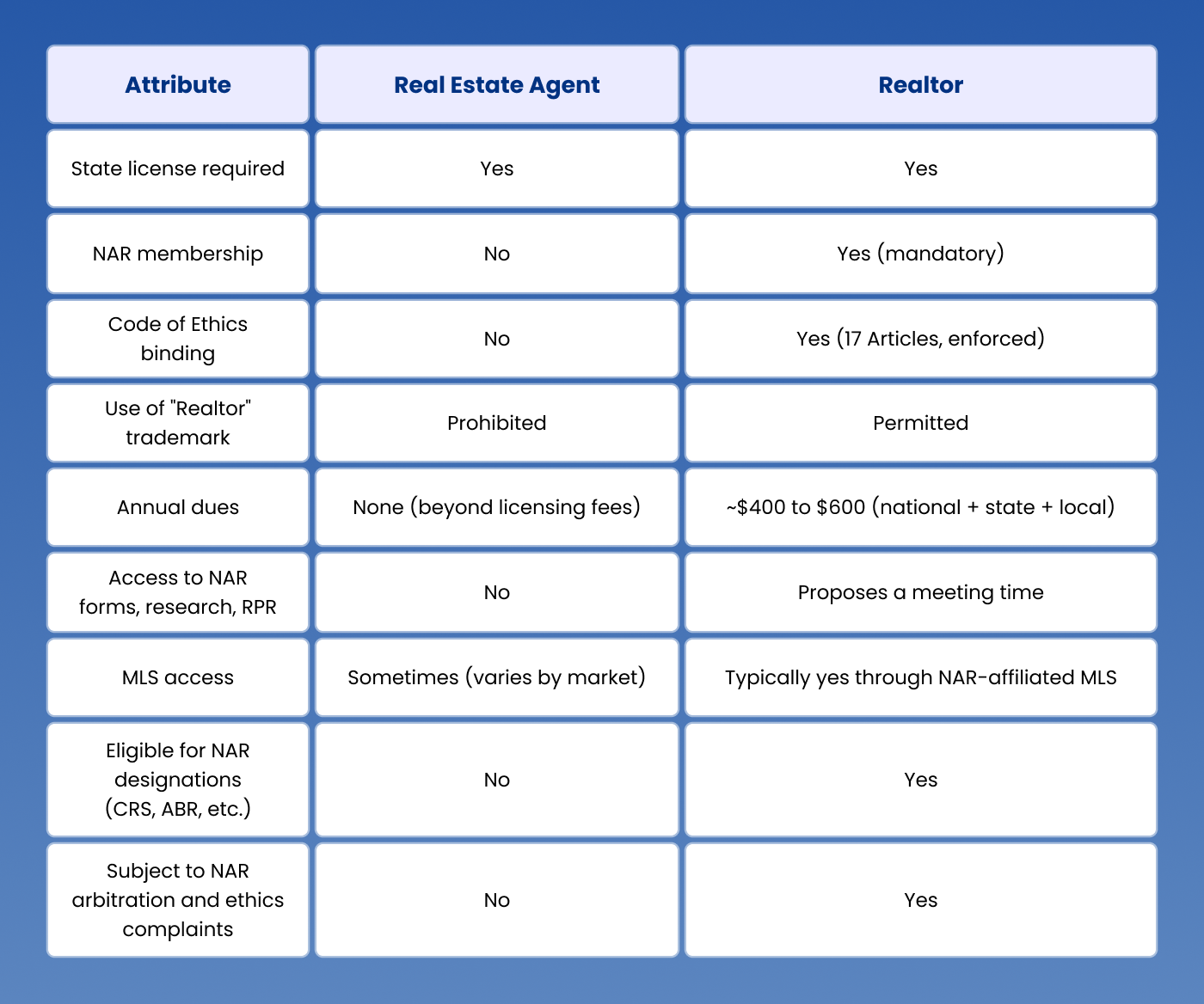
Both can legally close transactions. Both earn commissions the same way. Where they diverge is in the professional infrastructure they operate inside, and the standards they are accountable to.
NAR Membership Benefits: What Realtors Actually Get for Their Dues
NAR membership benefits go well beyond the right to use a trademarked title. For agents weighing whether the $400 to $600 annual cost is worth it, the value typically falls into five buckets.
1. MLS access in most markets. While some MLS systems are independent, the majority require NAR membership for participation. Without MLS access, an agent's ability to list, search, and cooperate with other brokerages is severely limited.
2. Standardized forms and contracts. NAR provides legally vetted purchase agreements, listing agreements, disclosures, and addenda. Replacing those forms independently is expensive and legally risky for solo agents.
3. Realtors Property Resource (RPR). RPR gives Realtors access to detailed property data, comparative market analyses, and reporting tools at no additional cost. For agents who pull CMAs daily, this alone can offset the dues.
4. Designations and continuing education. NAR and its affiliated institutes offer designations like CRS (Certified Residential Specialist), ABR (Accredited Buyer's Representative), and GRI (Graduate, REALTOR Institute). These credentials signal specialization and frequently correlate with higher transaction volume.
5. Legal advocacy and member-only resources. NAR funds legal hotlines, lobbying efforts, and a Realtor benefits program that includes discounts on insurance, technology, and marketing tools. The advocacy alone (mortgage interest deduction defense, fair housing initiatives, license-law reform at the state level) is one of the most cited reasons brokers maintain membership through downturns.
For high-producing agents, the cost-benefit math almost always favors membership. For part-time or low-volume agents, the calculation gets tighter, which explains why a meaningful share of licensees choose to skip it.
Does Being a Realtor Make Someone a Better Agent?
Not automatically, but on average, yes. NAR's annual Member Profile consistently shows that Realtors have more years of experience, complete more transactions per year, and earn more in median gross income than the licensed-but-unaffiliated agent population. The reasons are partly about correlation rather than causation. Agents serious enough to commit annual dues, complete ethics training, and pursue designations tend to also be the agents serious enough to invest in skill development, follow-up systems, and client experience.
For brokerage owners and managing brokers evaluating recruits, the Realtor designation functions as a low-cost signal of professional commitment. It does not guarantee performance. Some excellent agents stay unaffiliated for personal or financial reasons. But across a large recruiting funnel, candidates who have actively chosen to maintain Realtor status generally produce more, stay longer, and present better to clients.
This is exactly the kind of pre-screening signal that scales when you build it into your recruiting workflow. Inside EZRecruits, brokerages can filter and tag candidates by NAR status, license tenure, and production history at the top of the funnel, so recruiting managers spend interview time on candidates who already meet baseline professional thresholds.
Realtor vs Broker vs Real Estate Agent
The Realtor versus agent distinction is sometimes confused with the broker versus agent distinction. They are completely separate concepts.
Real estate agent: Holds a state salesperson's license. Must work under a broker.
Real estate broker: Holds a higher-level state broker's license. Can work independently, sponsor agents, or run a brokerage. Brokers complete additional coursework and typically have minimum experience requirements (often two to five years as an active agent).
Realtor: A designation indicating NAR membership. Can apply to either an agent or a broker. A managing broker who is also an NAR member is a Realtor. A salesperson agent who is also an NAR member is a Realtor.
In other words, "Realtor" is orthogonal to "broker" and "agent." It is a membership status, not a license level.
Why the Realtor Distinction Matters for Recruiting and Retention
For brokerage owners and team leaders, the Realtor versus real estate agent question is not academic. It shows up in three operational decisions every recruiting manager has to make.
1. Compensation and dues structure. Some brokerages cover NAR and local board dues for their agents. Others pass them through. How you structure this affects both your offer competitiveness and your operating margin. Top-producing recruits often expect dues coverage as part of a competitive package.
2. Recruiting messaging. If your brokerage emphasizes Realtor-only standards (some boutique brokerages do), your job postings, outreach scripts, and onboarding materials should reflect it. If you accept both Realtor and non-Realtor agents, your messaging needs to make the path to membership clear for new licensees.
3. Onboarding and compliance training. Realtor candidates already have Code of Ethics training. Non-Realtor candidates do not. Brokerages that recruit broadly need an onboarding workflow that handles both populations cleanly, because mismatched compliance training is a common source of first-year attrition and broker liability.
How EZRecruits Helps Brokerages Recruit Realtors and Top-Producing Agents
EZRecruits is a full-stack recruiting and onboarding platform built specifically for real estate brokerages and mortgage teams. Most generic recruiting tools were not designed around the realities of agent hiring: NAR status as a screening signal, license verification, MLS affiliation, production history, and the long nurture cycles common in this industry.
Inside EZRecruits, recruiting managers can syndicate openings to over 100 job boards in one click, automatically segment candidates by Realtor status and license tenure, and run DISC-based hiring assessments purpose-built for real estate behavioral profiles (not generic sales DISC models). The platform includes structured real estate agent onboarding workflows that have helped brokerages reduce first-year agent attrition by up to 40%, and team performance dashboards that surface retention signals before they become resignations.
For brokerage owners trying to recruit Realtors specifically, the alternative to a purpose-built platform is a patchwork of LinkedIn, spreadsheets, and generic ATS tools that were never designed for the agent lifecycle. EZRecruits replaces that patchwork with one system.
Frequently Asked Questions
Is there a difference between a Realtor and a real estate agent?
Yes. Every Realtor is a licensed real estate agent, but not every real estate agent is a Realtor. The difference is membership in the National Association of Realtors, which requires annual dues, Code of Ethics training, and accountability to NAR's professional standards. About 1.49 million of the roughly 2 million active U.S. real estate licensees are Realtors.
What does a Realtor do that an agent does not?
Functionally, both can list homes, represent buyers, and close transactions. The practical difference is that Realtors operate under NAR's 17-Article Code of Ethics, have access to NAR forms and research, can use the Realtor trademark in marketing, and are eligible for NAR designations like CRS and ABR. They are also subject to NAR's arbitration process if a client or fellow agent files an ethics complaint.
Is it worth becoming a Realtor instead of just a real estate agent?
For most full-time agents, yes. NAR's Member Profile consistently shows Realtors earn more, transact more, and stay in the business longer than non-member agents. The annual dues (typically $400 to $600 between national, state, and local) usually pay back through MLS access, RPR, standardized forms, and member discounts. For part-time or low-volume agents, the math is tighter.
What are the main NAR membership benefits?
The five most-cited NAR membership benefits are MLS access in most markets, standardized legal forms and contracts, Realtors Property Resource (RPR) for property data and CMAs, eligibility for designations like CRS and ABR, and legal advocacy plus member discounts on insurance, marketing, and technology tools.
How much does it cost to become a Realtor?
In 2026, NAR national dues are $156 plus a $45 Consumer Advertising Campaign assessment. State and local board dues vary, but total annual cost typically lands between $400 and $600. New members pay prorated national dues based on the month they join. These fees come on top of the cost of obtaining and maintaining a state real estate license.
Can I call myself a Realtor without joining NAR?
No. "Realtor" is a federally registered trademark owned by NAR. Using it without active NAR membership is a trademark violation and can also be grounds for state licensing complaints in some jurisdictions. Licensed agents who are not NAR members must use "real estate agent" or "real estate salesperson" instead.
Should brokerages only recruit Realtors?
It depends on your model. Some boutique brokerages recruit Realtor-only as a positioning choice. Most growth-stage brokerages recruit both, then provide a clear path to NAR membership during onboarding. Platforms like EZRecruits let you tag and segment candidates by Realtor status, license tenure, and production history, so you can run different workflows for each population without losing pipeline visibility.
Does NAR membership matter for loan officer recruiting?
Generally no. NAR primarily serves real estate agents and brokers. Loan officers are typically members of the Mortgage Bankers Association (MBA) or state mortgage broker associations instead. If you recruit both real estate agents and loan officers, your recruiting platform needs to handle both credential structures. EZRecruits is built to do exactly that across real estate and mortgage workflows.
Build a Recruiting Engine That Filters for Quality, Not Just Volume
The Realtor designation is one of the cheapest, fastest signals of professional commitment available to a recruiting manager. Use it. But do not stop there. Combine NAR status with license tenure, production data, behavioral assessments, and structured onboarding to build a recruiting engine that scales without sacrificing quality.
Book a demo of EZRecruits to see how brokerages are using purpose-built recruiting and onboarding to recruit top Realtors faster, cut first-year attrition, and grow their teams predictably. Visit ezrecruits.com to get started.

