






Types of Real Estate Agents: A Recruiter's Field Guide for Brokerages and Team Leaders
You can't recruit what you don't understand. Most brokerage owners and team leaders treat the agent population as one big pool, then wonder why their outreach gets ignored. The reality is that the different types of real estate agents operate on completely different incentive structures, time horizons, and pain points, and a generic pitch built for "agents" lands flat with all of them. If you run a brokerage with 5 to 50 agents, or a regional mortgage branch hiring loan officers who lean on agent referrals, the segmentation problem is your recruiting problem. This guide breaks down the agent types you should actually be targeting, what each one wants, and how to build a pipeline that doesn't waste your week.
Key Takeaways
The most useful way to categorize the types of real estate agents is by business model, not transaction role. Solo agents, team members, team leaders, and referral-only agents all need different recruiting messages.
Solo agents and team agents look similar on paper but produce, earn, and switch brokerages for different reasons.
Independent agent recruitment is the largest opportunity by volume, but recruiting from teams produces the highest-GCI hires.
Most failed recruiting outreach pitches the brokerage instead of solving the agent's specific friction.
Personality screening (DISC) and stage-aware nurture sequences cut wasted recruiter hours more than any script rewrite.
What Are the Main Types of Real Estate Agents?
The main types of real estate agents fall into two categories: role-based types (what they do in a transaction) and business-model types (how they run their book). For recruiters, business-model types are the ones that matter, because they predict what an agent earns, what they need from a brokerage, and whether they will move. The role-based types tell you about specialization. The business-model types tell you about leverage, autonomy, and switching cost.
Role-based types include buyer's agents, listing agents (also called seller's agents), dual agents where state law allows it, commercial agents, luxury specialists, new construction specialists, and investor-focused agents. These describe what an agent sells and to whom.
Business-model types include solo independent agents, team members on a producing team, team leaders running a team inside a brokerage, mega-agents operating like small businesses, part-time agents, referral-only agents holding a license but not actively producing, and cloud or virtual brokerage agents on platforms like eXp or REAL.
When you build a recruiting list, sort by business-model first, role second. A luxury team member in Scottsdale and a solo investor agent in Cleveland are not interchangeable leads, even if both show up in MLS data as "agents."
Solo Agents vs Team Agents: How They Actually Differ
Solo agents and team agents are the two largest pools you will recruit from, and they behave nothing alike. According to NAR's 2024 Member Profile, roughly one in four REALTORS is part of a team, with the rest operating solo. Both groups are large enough to build entire recruiting strategies around, and both come with different friction points.
A solo agent runs their own marketing, lead gen, transaction coordination, and admin. They keep more of every commission check but absorb every hour of operational work. Their pain is bandwidth: too many tabs open, too few leads, no one to hand the closing checklist to. They switch brokerages when a competitor offers leverage they can't build alone, like better tech, training, marketing co-op, or a cheaper cap.
A team agent trades commission split for leads, training, and coverage. They typically earn less per transaction but close more deals because the team feeds them appointments. Their pain is the cap on autonomy: they want their own database, their own branding, and full splits, but they fear the drop-off in lead flow. They switch when they think they can survive on their own, or when a better team courts them with higher splits and the same lead flow.
These two groups respond to opposite pitches. Solo agents respond to "we'll give you support without taking your independence." Team agents respond to "you can keep producing without the split haircut, and we'll help you build your own brand."
Quick comparison: solo agents vs team agents vs team leaders
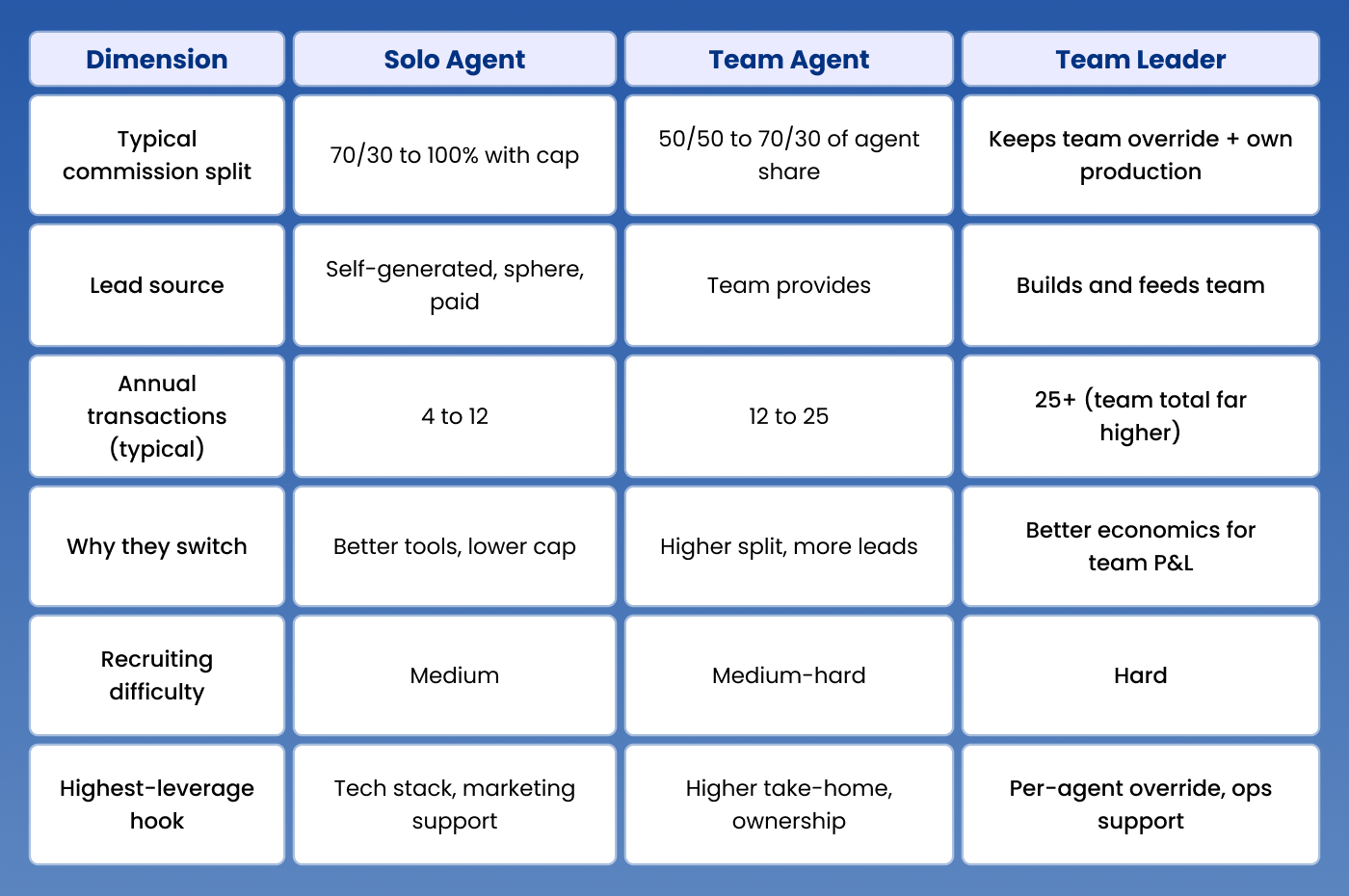
These ranges are directional, drawn from operator experience and NAR data on transaction volume distribution. Your local market will compress or stretch them, but the relative ordering holds.
Independent Agent Recruitment: Where the Real Volume Hides
Independent agent recruitment refers to actively sourcing solo, non-team agents who run their own book. It's the largest volume opportunity in the agent market because the majority of licensed agents are solo, and many of them are quietly unhappy with their current brokerage but not actively looking.
Most brokerages over-index on poaching from competitors and ignore the bigger pool: solo agents who have been at the same brokerage for 3 to 7 years, are mid-tier producers, and have stopped getting attention from their broker. NAR data has consistently shown that the median tenure of agents at a single brokerage sits in the low single digits, which means a large share of solo agents are within 12 to 18 months of being open to a move.
To run independent agent recruitment well:
Build a list, not a feeling. Pull active solo agents from MLS data within your service area, filtered by transaction count over the past 12 months. Aim for the 8 to 25 transaction band; below that, they are too small to move the needle, and above that, they are usually team leaders or already getting recruited weekly.
Segment by tenure and production trend. An agent whose volume dropped 30 percent year over year is in pain. An agent whose volume grew is feeling capable, which is also a moving moment.
Lead with diagnosis, not pitch. First message identifies a specific friction (cap structure, lead flow, marketing support) before mentioning your brokerage.
Build a 90-day nurture, not a 3-touch blast. Most independent agents need 6 to 12 touches over a quarter before they take a meeting.
Score replies and book fast. Once an agent engages, time to first call should be under 48 hours. Anything longer and the moment passes.
The brokerages that win at independent agent recruitment treat it like outbound sales, not like networking.
Recruiting From Teams: The Hardest Pipeline, the Best Hires
Recruiting from teams is the highest-difficulty, highest-yield play in agent recruiting. Team agents typically close 2 to 3x the transactions of solo agents in the same market because they are fed leads and trained on conversion. If you can pull a top-third team producer onto your platform, you are getting an agent who already knows how to close at volume.
The catch is that team agents have a real economic reason to stay. They have signed lead-share agreements, they are dependent on the team's CRM and pipeline, and their personal sphere is often underdeveloped because the team has been their lead engine. Pulling them out without giving them a soft landing is how you burn the relationship.
The framework that works:
Target by team math, not name. Identify teams where the lead split or commission split looks aggressive against the agent. A 50/50 split on team-provided leads is normal. A 50/50 split where the agent is also generating their own deals is leaky.
Sell the build-out, not the move. The pitch is "you can keep producing while we help you build your own database, brand, and lead engine in the background." Most team agents are scared of the post-team cliff, so the offer must include marketing, lead supplementation, and CRM support.
Time the conversation around the comp plan. Many teams reset splits annually. The 30 days after that reset is when team agents are most receptive.
Move slow, then fast. First 60 days is education. Last 30 days is offer, paperwork, transition plan.
Recruiting from teams should never be your only channel. It should be the top 10 to 15 percent of your recruiting effort focused on the highest-LTV hires.
Common Mistakes When Recruiting Different Types of Real Estate Agents
Most recruiting outreach fails for the same handful of reasons, and the failures get worse the more agent types you blur together.
Mistake 1: One pitch for every type of agent. Sending the same "we offer 90/10 splits and great training" message to a solo agent, a team member, and a team leader guarantees that at least two of them ignore you. Each type weighs splits, leads, and support differently.
Mistake 2: Pitching the brokerage before diagnosing the agent. If your first message names your company before it names a problem the agent has, you are writing a brochure. Lead with what you noticed about their book or market.
Mistake 3: No follow-up system. Most agents do not reply to the first message, the second, or the third. Brokerages that quit at touch 3 lose the agents that brokerages who stay at touch 8 eventually win.
Mistake 4: Recruiting on commission alone. Cap and split matter, but most agents who switch in 2025 and 2026 cite tech, training, leads, and culture above pure economics. If your only differentiator is split, you are competing with cloud brokerages who will always undercut you.
Mistake 5: Ignoring fit. A high producer who is wrong for your culture costs more than a lower producer who fits. DISC-style behavioral screening before the first interview filters out the agents who will quit or cause drag in 90 days.
A 6-Step Framework for Segmenting Your Recruiting Pipeline
A clean process for handling multiple types of real estate agents in one pipeline:
Build the universe. Pull every active licensee in your service radius from MLS data, state license records, and LinkedIn. Tag each by business model (solo, team member, team leader, part-time, referral-only).
Score by fit and stage. Rank by production band, tenure at current brokerage, and signals of friction (split rumors, recent listings, social posts about workload).
Segment by recruiting message. Build 3 to 5 distinct outreach tracks, one per agent type, each with its own first message, follow-up cadence, and value prop.
Run a multi-touch sequence. Plan 8 to 12 touches over 90 days using email, SMS, and LinkedIn. Stop guessing; the data shows volume and patience win.
Screen behavior before booking time. Use a short DISC or behavioral assessment to filter for fit before a recruiter spends 45 minutes on a call.
Track stage, not just outcomes. Measure conversion at each step (replied, booked, met, offer extended, joined). The leaks tell you where to fix the funnel.
A brokerage running this framework on 500 names with proper segmentation will outperform a brokerage spraying 5,000 generic emails. The math compounds when you stop wasting touches.
Where EZRecruits Fits
Once you have the framework above, the operational question is who runs it day to day. Most brokerages don't have a full-time recruiting team, and the owner ends up doing it between client calls.
EZRecruits is built for that situation. It runs the recruiting funnel for brokerages and mortgage companies as a single workflow: list-building, multi-channel outreach sequences across email and SMS, DISC-based candidate screening before interviews, automated nurture for agents not yet ready to switch, and pipeline tracking by stage so you see who is hot, who is cooling, and who needs a touch this week. For independent agent recruitment specifically, the platform handles the long-cycle nurture that solo agents need, so your recruiter is only spending time on agents who have already raised a hand. For team-based hires, the DISC screen filters for cultural and behavioral fit before the offer goes out. The brokerages that get the most out of it treat it as the operating layer, not a tool they log into once a month.
If you want to see how it maps to your specific recruiting workflow, you can book a walkthrough.
FAQ
What are the most common types of real estate agents brokerages recruit?
The four most common targets are solo independent agents, team members on producing teams, team leaders, and part-time agents looking to go full-time. Solo agents make up the largest pool by raw count. Team agents and team leaders deliver the highest production per hire but require longer recruiting cycles and more tailored pitches.
Are solo agents or team agents easier to recruit?
Solo agents are easier to reach but require longer nurture, often 90 days or more, before they switch. Team agents are harder to pull because of lead-share dependencies, but they convert faster once they decide to move because their economic case for switching is sharper. Most brokerages should run both pipelines in parallel, with separate messaging.
What is independent agent recruitment and why does it matter?
Independent agent recruitment is the practice of actively sourcing and onboarding solo, non-team agents who run their own books. It matters because solo agents represent the majority of licensed REALTORS per NAR data, and they switch brokerages more frequently than team agents. A consistent independent agent recruitment pipeline is the most reliable growth channel for most brokerages between 5 and 50 agents.
How long should a recruiting nurture sequence run?
For solo agents, plan 8 to 12 touches over 60 to 90 days across email, SMS, and LinkedIn. For team agents, the cycle often runs 90 to 180 days because of comp-plan timing and lead-share friction. Brokerages that quit at three touches leave most of their pipeline on the table.
Should I recruit from teams or focus on solo agents first?
Most brokerages should put 70 to 80 percent of recruiting effort on independent agent recruitment and 20 to 30 percent on recruiting from teams. Solo agents fill the bench faster. Team hires raise your average production per agent. Doing only one or the other leaves either volume or quality on the table.
How do I screen different types of real estate agents for fit?
A short DISC-based behavioral assessment before the first deep interview filters for communication style, drive, and cultural fit faster than a resume review. Pair it with a production-band filter (transactions in the past 12 months) and a tenure check on their current brokerage. Three data points beat a 30-minute getting-to-know-you call every time.
Conclusion
The brokerages that grow in 2026 are not the ones with the loudest pitch. They are the ones who understand the different types of real estate agents in their market well enough to recruit each segment on its own terms. Solo agents need bandwidth and tools. Team members need a soft landing and ownership. Team leaders need better economics for their P&L. The framework is segmentation, sequence, and screening, repeated patiently across a 90-day pipeline. If recruiting agents has become the bottleneck on your growth, see how EZRecruits can run the funnel for you.

