






What Does a Real Estate Agent Do? Complete 2026 Guide
A real estate agent represents buyers and sellers through every stage of a property transaction, from the first market consultation to the closing table. Day to day, that work breaks down into seven core functions: lead generation, market analysis, listing and marketing, property showings, negotiation, transaction management, and client communication. The job is part advisor, part marketer, part project manager, and almost never the same two days in a row.
That variety is exactly why so many brokerages struggle to define the role clearly when they hire. According to the National Association of REALTORS®, there are roughly 1.49 million Realtors in the United States across more than 102,000 brokerages, yet vague job descriptions remain one of the leading causes of first-year attrition. If you're a managing broker building a team, or a new agent trying to understand what you're signing up for, this guide breaks down what a real estate agent actually does, how those duties shift between buyer-side and listing-side work, and what separates the agents who thrive from the ones who churn out within 18 months. Ruby Home
What Is a Real Estate Agent?
A real estate agent is a state-licensed professional who represents clients in the purchase, sale, or lease of residential or commercial property. They act as an intermediary between buyers and sellers, handling everything from market research and contract drafting to negotiation and closing coordination.
Three terms get used interchangeably, but they aren't identical:
Real estate agent: A licensed salesperson who works under a sponsoring broker.
Real estate broker: An agent who has completed additional education and licensing, allowing them to operate independently or own a brokerage.
REALTOR®: A real estate agent or broker who is a dues-paying member of the National Association of REALTORS® and is bound by its Code of Ethics.
The distinction matters when you're writing job postings, building agent scorecards, or onboarding new hires. According to NAR, 86% of home buyers purchase their homes through real estate agents or brokers, which means the agent role sits at the center of nearly every residential transaction in the country. Quicken Loans
What Does a Real Estate Agent Do on a Daily Basis?
There is no standard day. Most agents move between three modes throughout the week: client-facing work (showings, listing appointments, closings), behind-the-scenes work (paperwork, MLS updates, market research), and business development (lead generation, marketing, networking).
A typical day often begins with checking and replying to emails, voicemails, and other messages for appointment confirmations or updates. From there, agents move into a mix of property tours, listing prep, contract review, and lead follow-up. Top producers tend to time-block these activities; struggling agents tend to react to whatever lands in their inbox first. Indeed
Here's a realistic rhythm for a working buyer's-and-seller's agent:
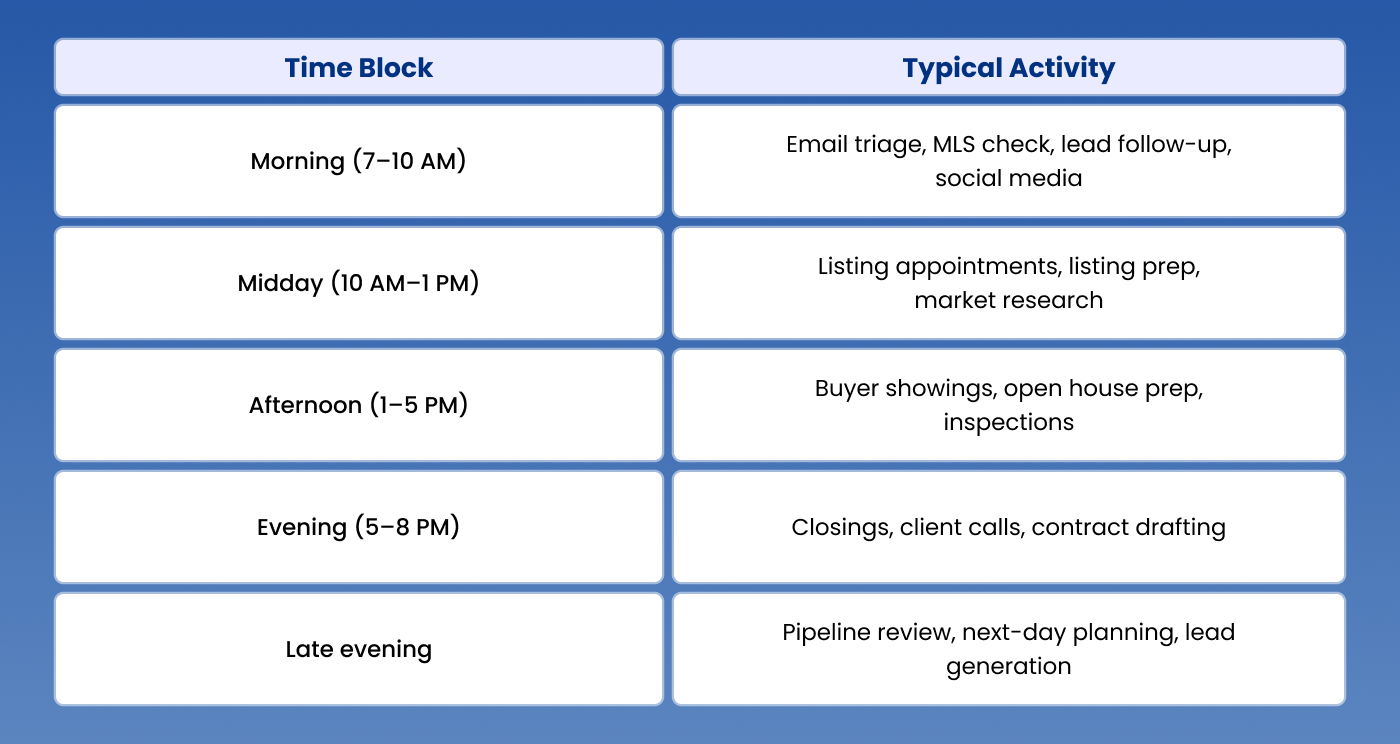
The takeaway for brokers: when you're hiring, you're not hiring someone who "shows houses." You're hiring a small business operator who has to juggle five disciplines simultaneously. Your job description and onboarding plan need to reflect that.
The 7 Core Responsibilities of a Real Estate Agent
Below are the seven functional areas every working agent owns, regardless of whether they specialize in buyers, sellers, or both.
1. Lead Generation and Prospecting
Without a steady pipeline, nothing else matters. Agents generate leads through sphere-of-influence outreach, online lead capture (Zillow, Realtor.com, brokerage websites), social media, open houses, door knocking, expired listings, FSBO outreach, and referral networks. The most consistent producers treat lead generation as a daily discipline, not a "when it's slow" activity.
2. Market Research and Comparative Market Analysis (CMA)
Every listing appointment, every offer, and every price reduction starts with a CMA. Agents pull recent comparable sales, active listings, and pending contracts to advise clients on realistic pricing. A real estate agent prepares a comparative market research analysis to establish a realistic asking price for the property, taking into account recent sales of similar properties in the same neighborhood as well as any trends that may impact the value of the property. Nashvillesmls
3. Listing Marketing and MLS Management
For sellers, the agent is responsible for getting the property in front of buyers. This includes scheduling photography, writing listing descriptions, staging consultation, MLS data entry, syndication to portals, signage, brochures, social campaigns, and open houses. The quality of this work directly affects days on market and final sale price.
4. Property Showings and Buyer Tours
For buyers, agents schedule and conduct property tours, narrate features and concerns, surface red flags the buyer might miss, and provide neighborhood context. This is the most visible part of the job and also one of the most underestimated, because every showing involves logistics, key access, lockbox coordination, and follow-up.
5. Offer Drafting, Negotiation, and Contract Management
Agents draft purchase agreements, counter-offers, addenda, and disclosures. They negotiate price, contingencies, repair credits, closing dates, and concessions. Real estate agents conduct appraisals, negotiations, reports and transactions, which require detailed accounting and specified pricing figures. Strong negotiation skills are what separate average agents from top producers, and they're rarely taught in pre-license courses. Indeed
6. Transaction Management Through Closing
Once a contract is executed, the agent becomes a project manager. They coordinate inspections, appraisals, lender requirements, title work, HOA documents, repair negotiations, and final walkthroughs. They also serve as the central communication hub between the buyer, seller, lender, escrow, title company, inspectors, and attorneys.
7. Client Communication and Relationship Management
Threaded through every other responsibility is constant communication. Real estate agents spend the majority of their time answering texts, calls, and emails from current and prospective clients, often at all hours. Post-closing, top agents stay in touch through quarterly check-ins, anniversary cards, and market updates, which is how they generate the referral business that compounds over a career. 360training
What's the Difference Between a Real Estate Agent and a Realtor?
A real estate agent is anyone with an active state license to sell real estate. A Realtor is a real estate agent (or broker) who has joined the National Association of REALTORS® and agreed to follow its Code of Ethics. Every Realtor is a real estate agent, but not every real estate agent is a Realtor.
In practice, the distinction affects three things: ethical standards, access to MLS systems (which often require Realtor membership), and marketing differentiation. For brokerages, this matters at hire time because dues, board membership, and continuing education requirements should be clearly addressed in your offer letter and onboarding paperwork.
Buyer's Agent vs. Listing Agent: How Duties Shift
Most agents handle both sides of the table at some point, but the workload looks different depending on who they represent.
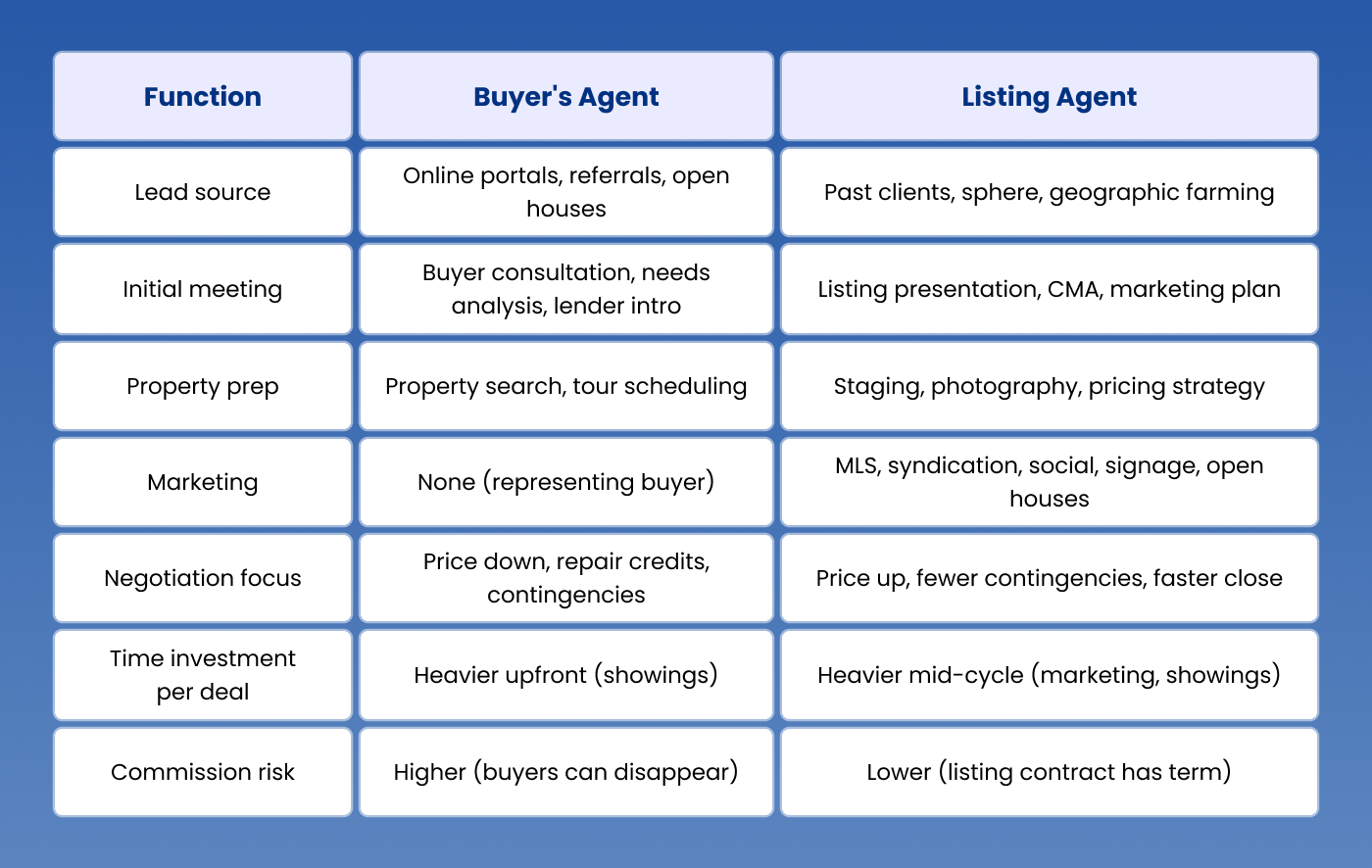
Brokers who treat these as the same role tend to underprepare new hires. The hiring profile, training plan, and KPIs for buyer-focused agents should look measurably different from those for listing-focused agents.
What Skills Does a Successful Real Estate Agent Need?
The license gets someone in the door. The skills below determine whether they're still in the business in 24 months.
Communication and active listening: Agents who ask better questions get better referrals.
Negotiation: The ability to advocate without alienating the other side.
Local market knowledge: Specifics about schools, zoning, comps, and inventory.
Time management: Ruthless calendar discipline. The job punishes reactive operators.
Tech fluency: CRM, MLS, e-signature, transaction management, social platforms, and AI tools.
Emotional intelligence: Buying or selling a home is one of the most stressful events of a client's life. Agents who handle that well earn referrals for decades.
Self-discipline: Most agents are 1099 contractors. No one tells them what to do tomorrow.
When we work with brokerages on hiring, this is where DISC-based assessments earn their keep. Skills like negotiation and self-discipline correlate strongly with specific behavioral profiles. Hiring on resume alone, without behavioral data, is one of the most common reasons brokerages end up with agents who can pass the licensing exam but never close a deal.
How Much Does a Real Estate Agent Earn?
Compensation is almost always commission-based. Real estate agents typically earn a commission of 5% to 6% of the home's sale price, which is split between the buyer's and seller's agents. For example, on a $300,000 home, a 6% commission equals $18,000, divided between the agents and their brokerages, which means each agent might earn around $4,500 to $5,400 per transaction after splits with their brokers. 360training
According to the most recent NAR member report, the typical member's number of transaction sides was 10 deals and typical annual sales volume was $2.5 million, though the spread between top quartile and bottom quartile producers is dramatic. The post-NAR-settlement compensation environment has also pushed brokerages to formalize buyer-broker agreements and rethink commission disclosure, which means hiring conversations now need to address compensation structure with more transparency than they did three years ago. RealEstateNews.com
Why Defining the Real Estate Agent Role Matters for Brokerages
Here's the operational reality most brokers learn the hard way: vague role definition is the single biggest predictor of agent attrition in the first year.
When a new hire's offer letter says "real estate agent," but their actual day involves cold calling for a team lead, running open houses for senior agents, and being expected to source their own buyers without training, the mismatch shows up as quick turnover. The recruiting cost gets eaten, the onboarding investment gets eaten, and the brokerage's reputation in local recruiting circles takes a hit.
Three things solve this:
A specific job description that names the function (buyer's agent, listing partner, team ISA, dual-role) and the expected activities by week, month, and quarter.
A structured onboarding plan that maps the first 30, 60, and 90 days to concrete milestones (first listing appointment, first buyer consultation, CRM proficiency, market mastery).
Behavioral and skills assessments during hiring, so you're not finding out in month four that the candidate hates prospecting.
This is the work that separates brokerages that grow steadily from brokerages that hire 30 agents a year and lose 25.
How EZRecruits Helps Brokerages Hire and Onboard Real Estate Agents
EZRecruits is the only full-stack recruiting and onboarding platform built specifically for real estate brokerages and mortgage teams. The reason that matters for the role we just defined: every feature is designed around how agent hiring actually works, not how generic SaaS hiring works.
For sourcing, our job board syndication pushes a single agent listing to over 100 boards in one click, including industry-specific channels that generic platforms don't touch. For evaluation, our DISC-based hiring software is purpose-built for real estate roles, so you're matching candidates to buyer-agent, listing-agent, or team-lead profiles based on behavioral fit, not a generic personality quiz.
For retention, EZRecruits includes a structured agent onboarding workflow that turns those first 90 days into a guided sequence of milestones, training modules, and accountability checkpoints. Brokerages using structured onboarding inside EZRecruits report up to 40% lower first-year attrition compared to brokerages relying on ad-hoc onboarding. And the entire pipeline lives inside one recruiting CRM, so your sourcing, interviewing, hiring, and onboarding data stays connected from first touch through year-one productivity.
If you're a managing broker who has read this article and recognized the gap between "what an agent does" and "how my brokerage actually hires for it," EZRecruits is the system that closes that gap.
Get Started with EZRecruits
Stop losing agents to vague job descriptions and unstructured onboarding. Book a demo with EZRecruits and see how the only full-stack recruiting platform built for real estate brokerages can help you hire better-fit agents and keep them past year one.
Frequently Asked Questions
What does a real estate agent do every day?
A real estate agent's daily work typically includes responding to client communication, checking the MLS for new listings and changes, conducting property showings or listing appointments, drafting and reviewing contracts, generating leads through outreach and marketing, and coordinating active transactions. The exact mix depends on whether the agent specializes in buyers, sellers, or both, and how many active deals are in their pipeline.
What are the main duties of a real estate agent?
The seven core duties are lead generation, market analysis and CMAs, listing marketing, property showings, offer drafting and negotiation, transaction management through closing, and ongoing client communication. Strong agents also invest time in continuing education, networking, and post-closing follow-up to build a referral-based business.
What is the difference between a real estate agent and a Realtor?
A real estate agent is anyone with an active state license to sell real estate. A Realtor is an agent or broker who is a member of the National Association of REALTORS® and is bound by its Code of Ethics. Every Realtor is a real estate agent, but not every agent is a Realtor.
How much does a real estate agent make per transaction?
On a typical 5–6% total commission split between the buyer's and seller's brokerages, an individual agent generally earns between $4,500 and $5,400 per transaction on a $300,000 sale after the brokerage split, before taxes and expenses. Actual take-home varies significantly based on experience, brokerage cap structure, team splits, and local market price points.
What skills does a successful real estate agent need?
Successful agents combine communication, negotiation, local market knowledge, time management, tech fluency, emotional intelligence, and self-discipline. Behavioral fit matters as much as skill on paper, which is why brokerages increasingly use platforms like EZRecruits with built-in DISC-based hiring tools to match candidate profiles to specific agent roles.
Do real estate agents work alone or for a brokerage?
In most U.S. states, every licensed real estate agent must work under a sponsoring broker, even if they operate semi-independently as a 1099 contractor. Some agents join teams within a brokerage, some operate as solo agents inside a brokerage, and some eventually earn their broker's license to open their own firm.
How long does it take to become a real estate agent?
Most aspiring agents complete pre-license coursework, pass the state licensing exam, and affiliate with a sponsoring broker within four to six months, though exact requirements vary by state. After licensing, most successful agents need an additional 6 to 12 months of structured onboarding, mentorship, and lead generation discipline before they're consistently closing deals.
How do brokerages decide which type of real estate agent to hire?
The best brokerages start with the role they actually need (buyer's agent, listing partner, team ISA, dual-role producer), build a job description around the daily activities that role requires, and use behavioral assessments to match candidates to the right profile. Platforms like EZRecruits combine sourcing, DISC-based screening, and structured onboarding so brokerages can hire intentionally instead of taking whoever shows up first.

