






How Do Real Estate Agents Get Paid? Complete 2026 Guide
Real estate agents get paid through commission, typically a percentage of the home's final sale price, paid out at closing through their brokerage rather than directly from the buyer or seller. Most agents are 1099 independent contractors who never receive a paycheck in the traditional sense. They earn nothing during the transaction, then collect a lump sum when the deal closes, after their brokerage takes its split.
That's the simple version. The reality is more nuanced, especially after the NAR settlement that took effect August 17, 2024, which fundamentally changed who pays the buyer's agent and how commissions get negotiated. For brokerage owners and team leaders, understanding the full payment process matters because compensation is the single biggest factor in agent recruiting and retention. According to the 2025 NAR Member Profile, the median Realtor earned $58,100 in 2024, while agents with two years or less of experience earned just $8,100, a gap that explains why the right comp plan can make or break your roster. Platforms like EZRecruits help brokerages design and communicate competitive compensation structures during the recruiting process, so candidates know exactly what they'll earn before they sign on.
This guide breaks down every stage of the agent payment process: how commissions are calculated, when agents actually receive funds, how brokerage splits work, what changed under the NAR settlement, and what brokerage operators need to know to build comp plans that attract top producers.
How does the real estate commission structure actually work?
A real estate commission is a percentage-based fee paid to a real estate brokerage in exchange for representing a buyer or seller in a property transaction. The commission is calculated on the final sale price of the home and is paid at closing from the proceeds of the sale.
Here's the flow in plain terms. When a home sells, the title or escrow company collects the agreed-upon commission from the closing proceeds. That money goes first to the brokerage, not to the agent. The brokerage then pays the individual agent according to whatever split arrangement they've signed. An agent never gets paid directly by the client.
In a traditional transaction, two commissions are paid:
The listing agent's commission, paid by the seller through closing
The buyer's agent commission, which used to be funded by the seller as a courtesy but is now negotiated separately under post-settlement rules
Each commission then flows through the respective agent's brokerage and gets split based on that agent's contract.
Who actually writes the check?
Nobody, technically. The seller doesn't hand a check to either agent. Instead, the closing attorney or escrow officer disburses funds from the sale proceeds based on what's spelled out in the closing statement. The seller sees the commission as a deduction from their net proceeds. The brokerages receive wire transfers or checks within a few business days of closing, and the agent receives their cut from the brokerage shortly after.
What's the typical real estate commission rate in 2026?
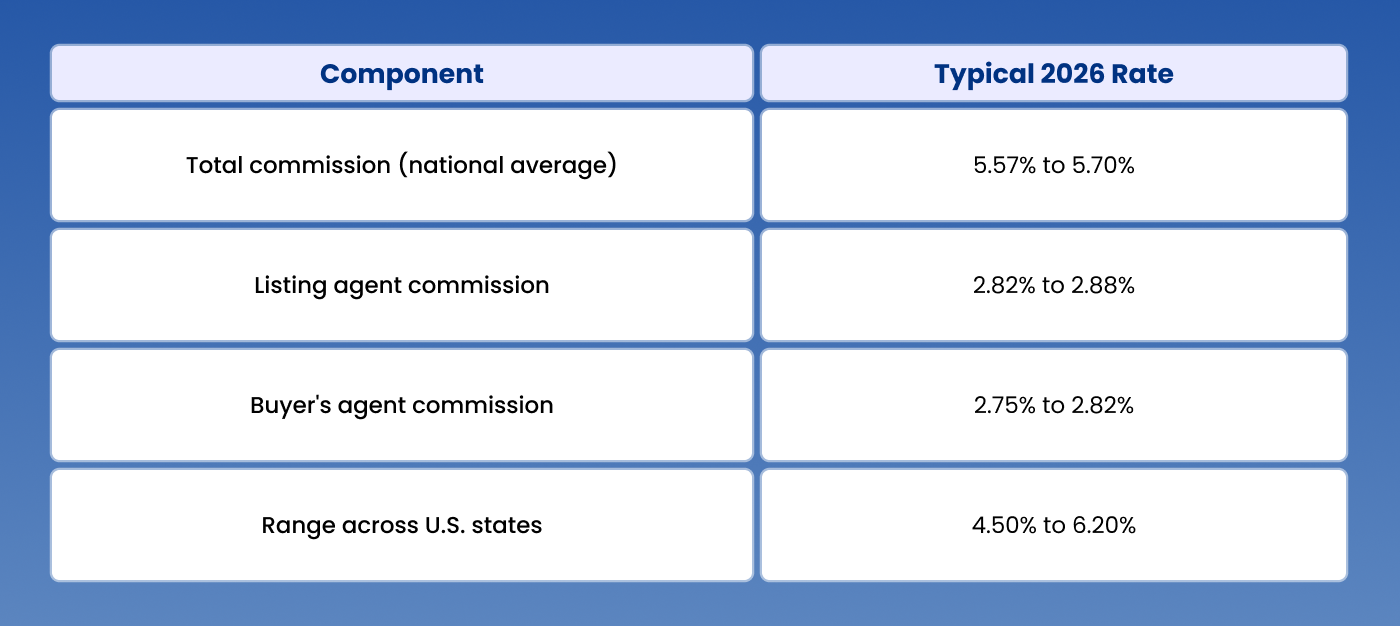
The national average total real estate commission is roughly 5.57% of the home's sale price, split between the listing agent and the buyer's agent, according to September 2025 data from Clever Real Estate, with the listing agent receiving 2.82% and the buyer's agent receiving 2.75%. More recent surveys show rates trending slightly higher in 2026: total realtor commission averages 5.70% nationwide, with the buyer's agent share rising from 2.67% in March 2025 to 2.82% in February 2026. BankrateClever Real Estate
Commission rates are not fixed by law, by NAR, or by any MLS. They are fully negotiable between the agent and the client, and they vary significantly by state, market conditions, and brokerage model.
On a median-priced U.S. home of around $367,000, total realtor fees come to roughly $20,000 before any brokerage splits.
Why commission rates vary so much
Several factors drive the spread:
Property value. Agents often accept lower percentage rates on luxury properties because the dollar amount is still substantial.
Local competition. High-density brokerage markets compress rates, while smaller markets often hold firm at 6%.
Agent experience. New agents rarely have leverage to negotiate; top producers do.
Market conditions. In a hot seller's market, sellers negotiate harder. In a buyer's market, agents earn their full rate.
When do real estate agents get paid after a sale?
Real estate agents get paid at closing, not before. From the moment a contract is signed to the moment commission lands in the agent's bank account, the timeline typically runs 30 to 60 days. There is no progress payment, no advance, no retainer. If the deal falls apart at any point, the agent earns nothing for the work performed.
Here's the standard sequence:
Contract acceptance. Buyer and seller sign a purchase agreement. No commission has been earned yet.
Inspection and financing period. Typically 14 to 45 days. The agent does substantial work here, all uncompensated until closing.
Closing day. The transaction is finalized. Commission becomes earned. Funds disburse from escrow to the brokerages within 24 to 72 hours.
Brokerage processes payment. Most brokerages cut agent commission checks weekly or bi-weekly after receiving funds. Some pay within 24 hours; others take up to 10 business days.
So the realistic timeline from contract to commission deposit is typically 30 to 75 days, depending on the closing timeline and the brokerage's payout schedule.
What happens if a deal falls through?
The agent earns nothing. This is the hardest financial reality of the profession. An agent can spend 50 hours on a transaction, drive thousands of miles, and pay for staging and photography out of pocket, only to have the deal collapse during inspection or financing. Those expenses are unrecoverable.
This payment timing is also why income volatility is the number one driver of agent attrition. A new agent who closes their first deal in month four does not see commission in their account until month five or six. Most run out of savings before they reach that first paycheck, which is why 62% of new agents earn less than $10,000 in their first year. Jamilacademy
How do brokerage commission splits work?
After the closing commission is paid to the brokerage, the brokerage takes its split before paying the agent. This is called the commission split, and it's the single most important number in any agent's contract.
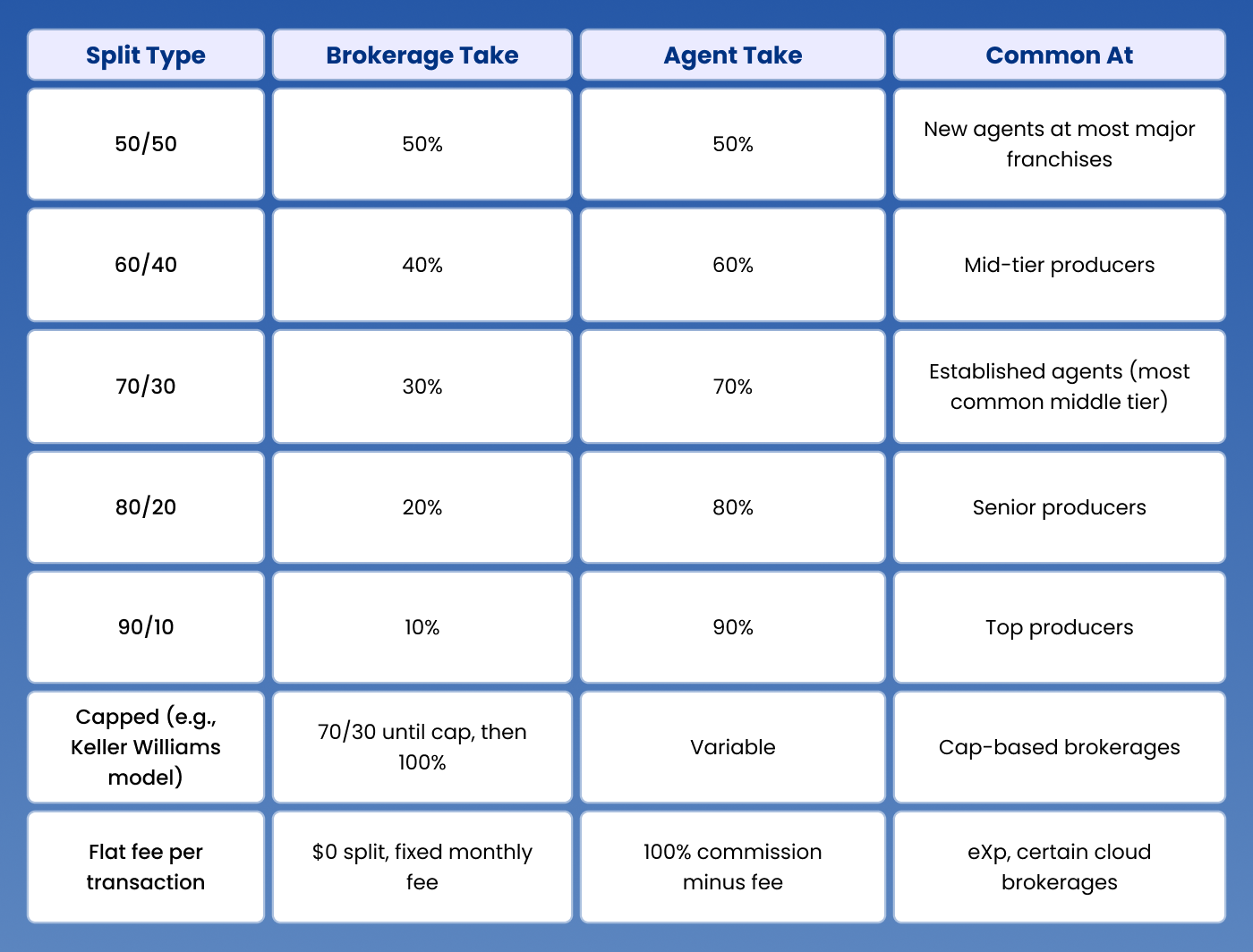
A commission split is the agreed-upon percentage division of gross commission income between the agent and the brokerage. Common formats include:
How a real commission flows through
Take a $400,000 home sale at 5.5% total commission, split 50/50 between the listing and buyer's brokerages. A buyer's agent on a 70/30 split with their brokerage would see this:
Total commission: $22,000 (5.5% of $400,000)
Buyer's side: $11,000
Brokerage's 30%: $3,300
Agent's 70%: $7,700 (gross)
But that's not what hits the agent's account. From that $7,700, a self-employed agent typically owes:
Self-employment tax (15.3%): roughly $1,180
Federal and state income tax (varies, often 20 to 25%): roughly $1,540 to $1,925
Business expenses (MLS dues, transaction fees, marketing, vehicle): typically 8 to 15% of gross
Net take-home on a $7,700 gross commission often lands between $3,500 and $4,500. According to NAR's 2025 Member Profile, the median Realtor's net income after taxes and expenses was $36,600 in 2024, identical to 2023 despite gross income rising. BAM
What top producers negotiate
Experienced agents producing $500K+ in annual gross commission income (GCI) often negotiate 85/15, 90/10, or capped models. They have the leverage. New agents almost never do, which is why brokerages need a clear progression path built into their comp plan to retain talent past year three.
How did the NAR settlement change real estate agent payments?
The NAR settlement, which took effect August 17, 2024, is the most significant change to agent compensation in modern real estate history. The National Association of Realtors agreed to pay $418 million in damages and make significant policy changes, including that home sellers are no longer automatically responsible for paying commissions to both their own agent and the buyer's agent, and a seller's agent can no longer specify on a Multiple Listing Service how much the buyer's agent will be paid. Apslaw
Three practical changes affect how agents now get paid:
1. Buyer's agent compensation is no longer published on the MLS
Before the settlement, listing agents posted the buyer's agent commission directly on the MLS. Buyer's agents could see exactly what they'd earn before showing a property. That's gone. Offers of compensation may no longer be made on the MLS in the old blanket format. Sellers can still cover that cost, but any offer must be negotiated outside the MLS or written into the purchase contract. US Real Estate Training
2. Buyers must sign written agreements before touring homes
Buyers now sign a buyer-broker agreement before viewing properties. This document spells out exactly what the buyer's agent will be paid and who pays it: the buyer directly, the seller as a concession, or some combination.
3. Buyer's agent commission is now a negotiation point in every offer
Buyers now negotiate their agent's compensation directly. Many buyers ask sellers to cover that fee as a concession. According to HomeLight's 2025 agent survey, 73% of agents named offering to pay the buyer's agent fees as the top seller incentive. The money still moves the same way at closing, but the negotiation now happens in the open. HomeLight
What it means for agents in practice
The fundamental payment mechanism has not changed: agents still earn commission, paid at closing, through the brokerage. What changed is the conversation. Agents now must articulate their value before showing a single property and justify their fee in writing. Brokerages that train agents on consultation skills, value articulation, and buyer agreement conversations are seeing higher conversion and better retention. Those that don't are watching newer agents flame out.
Real estate agent payment models beyond commission-only
While the vast majority of agents work commission-only, a few alternative compensation models exist:
Salary plus commission. Common at certain large brokerage models and team structures. Agents earn a small base ($30K to $50K) plus reduced commission percentages.
Team splits. Agents on a team typically pay an additional split to the team leader on top of their brokerage split. A team agent on a 50/50 brokerage split with a 50/50 team split nets just 25% of gross commission.
Salaried buyer's agents. A small number of teams pay buyer's agents on salary in exchange for company-generated leads.
Flat fee per transaction. Some agents work for discount brokerages that charge a flat listing fee and pay agents a per-transaction bonus.
Referral fees. Agents can earn a percentage (typically 25%) for referring a client to another agent who closes the deal.
For mortgage-side teams, loan officer compensation follows a different structure entirely, governed by Loan Officer Compensation Rule under TILA. Pay is per-loan or basis-points-based, and structures are far more regulated than real estate agent comp.
Why agent compensation matters for brokerage growth
Compensation is the number one reason agents join a brokerage and the number one reason they leave. Most brokerage owners we work with at EZRecruits learn this the hard way: a comp plan that looks generous on paper doesn't always translate into recruiting wins, because top producers don't evaluate splits in isolation. They evaluate the full economics, including caps, fees, lead support, technology stack, and the speed and reliability of commission disbursement.
This is where most brokerages lose recruits. A candidate asks, "What's the split?" The recruiter answers "70/30," and the conversation moves on. But the candidate is silently calculating monthly desk fees, transaction fees, technology fees, mandatory training costs, and how those add up against a competitor's higher-friction model. Without a clear, documented comp plan in your recruiting materials, you're losing candidates to brokerages that are simply better at communicating value.
EZRecruits is built specifically for real estate brokerages and mortgage companies that want to systemize this process. Inside the platform, you can document your full compensation structure (splits, caps, fees, bonus tiers) once and surface it inside every recruiting conversation, automated email sequence, and onboarding flow. Combined with DISC-based hiring, structured agent onboarding, and team management tools, brokerages using EZRecruits report reducing first-year agent attrition by up to 40%, the single biggest economic lever available to a growth-stage brokerage. Better recruits, better onboarding, and a transparent comp story together compound into the kind of roster that actually produces.
Frequently Asked Questions
How do real estate agents get paid step by step?
Real estate agents get paid in five steps: (1) the home sale closes, (2) escrow disburses commission to the brokerage from sale proceeds, (3) the brokerage receives the gross commission within 1 to 3 business days, (4) the brokerage applies the agreed-upon commission split, and (5) the agent receives their net commission, typically within 1 to 10 business days of closing depending on brokerage payout schedules.
When do realtors get paid after closing?
Realtors typically receive their commission within 1 to 10 business days after closing. Escrow releases funds to the brokerage within 24 to 72 hours of the deal closing, and the brokerage then issues the agent's check on its standard payout schedule. Some brokerages pay daily, most pay weekly or bi-weekly, and a few pay only on the 1st and 15th of each month.
Do real estate agents get paid hourly or on salary?
The overwhelming majority of real estate agents are commission-only 1099 independent contractors. They receive no hourly wage, no salary, and no benefits from their brokerage. A small minority work in salary-plus-commission roles, mostly on structured real estate teams or at certain corporate brokerage models, but these are the exception. Most agents only earn money when a transaction closes.
Who pays the real estate agent commission, the buyer or the seller?
In 2026, this is fully negotiable. Traditionally, the seller paid both the listing agent and buyer's agent commissions. After the NAR settlement effective August 17, 2024, buyers must now sign a written agreement with their agent that specifies their commission obligation. Sellers can still offer to cover the buyer's agent fee as a concession, and many do, but it is no longer automatic.
How much do real estate agents make per sale?
On a median-priced U.S. home of about $367,000, with a total commission around 5.57% split between two brokerages, each side's brokerage receives roughly $10,200. After the brokerage's split (typically 30% to 50% for newer agents), the individual agent grosses between $5,000 and $7,500 per side. After self-employment taxes and business expenses, net take-home is typically $3,000 to $5,000 per closing.
What is the average real estate commission split with a brokerage?
New agents typically start at a 50/50 split, meaning the brokerage keeps half of every commission. Mid-career agents commonly negotiate 70/30 splits, and top producers can reach 80/20, 90/10, or capped models where they keep 100% of commissions after hitting an annual cap. The split structure should match agent production: a strong recruiting and team management platform like EZRecruits helps brokerages model and communicate progression paths to candidates upfront.
How does the NAR settlement affect when agents get paid?
The NAR settlement did not change when agents get paid; commission is still paid at closing through the brokerage. What changed is how the buyer's agent commission is negotiated. Buyers now sign written agreements specifying their agent's fee, and sellers are no longer assumed to be paying it. Mechanically, the funds still flow through escrow to the brokerage on the same timeline, but the negotiation must be documented before showing a property.
How can a brokerage attract top-producing agents with compensation?
Top producers don't just compare splits; they evaluate the full compensation package, including caps, fees, lead generation support, technology, onboarding quality, and payout reliability. Brokerages that document their full economic story, automate their recruiting outreach, and reduce time-to-first-deal through structured onboarding outperform on retention. Tools built for the industry, like EZRecruits, give brokerage owners a single platform to recruit, hire using behavioral assessments, onboard, and track agent performance.
Ready to build a brokerage that recruits and retains top agents?
EZRecruits is the all-in-one recruiting, onboarding, and team management platform purpose-built for real estate brokerages and mortgage companies. Stop losing recruits to broken comp conversations and slow onboarding.
Book a demo with EZRecruits and see how growth-stage brokerages are cutting agent attrition by up to 40%.

