






Is Real Estate Investment Trusts a Good Career Path? (2026)
Yes, real estate investment trusts (REITs) can be a strong career path for professionals who want exposure to commercial real estate without the volatility of commission-only sales roles. REIT careers offer competitive base salaries, structured career ladders, and roles spanning finance, asset management, acquisitions, property operations, and capital markets, with median compensation often outpacing traditional real estate brokerage roles for experienced professionals.
The REIT industry now manages roughly $4 trillion in commercial real estate assets across the United States and supports more than 3.4 million full-time equivalent jobs, according to Nareit. That scale creates continuous demand for analysts, asset managers, acquisitions associates, and property-level operators, even when residential transaction volume cools. For job seekers evaluating real estate careers, and for brokerage owners using EZRecruits to recruit against REIT employers and other competitors for the same talent, understanding how these paths compare is no longer optional.
What Is a Career in Real Estate Investment Trusts?
A real estate investment trust is a publicly traded or privately held company that owns, operates, or finances income-producing real estate. A career in REITs means working for one of these companies in roles ranging from financial analyst and acquisitions associate to property manager, asset manager, capital markets associate, or investor relations specialist.
Unlike a residential real estate agent who earns commissions on transactions, REIT employees typically receive a base salary plus bonus and, at senior levels, equity-based compensation. The work centers on portfolio strategy, deal underwriting, and operating performance rather than client-facing sales.
REIT Sectors You Can Build a Career In
REITs are organized by both structure and asset class. Major structural categories include:
Equity REITs (own and operate properties)
Mortgage REITs (finance real estate via debt instruments)
Hybrid REITs (combine equity and debt)
Public non-listed REITs and private REITs
By asset class, the major sectors are residential, industrial, retail, office, healthcare, hospitality, data centers, and self-storage. Each sector has its own career economics. Industrial and data center REITs have outpaced office and retail in both stock performance and hiring velocity over the past five years.
How Many Jobs Are Available in Real Estate Investment Trusts?
Nareit estimates the REIT industry supports more than 3.4 million full-time equivalent jobs in the United States, including direct REIT employees, contractors, and ancillary services. Publicly traded REITs alone post thousands of new roles each year on platforms like LinkedIn, Indeed, and SelectLeaders.
REIT roles cluster into five operational buckets:
Investment and acquisitions
Asset and portfolio management
Property operations and management
Capital markets and finance
Corporate functions (legal, IR, ESG, HR, marketing)
For brokerage owners and team leaders, this matters because REIT employers are actively recruiting from the same talent pool you draw from for commercial agents, financial analysts, and operations managers. Candidates evaluating real estate careers increasingly compare a REIT analyst offer against a brokerage opportunity. The brokerages winning those candidates are the ones with structured systems behind their pitch.
What Are the Highest-Paying REIT Career Paths?
Compensation in REITs scales with deal complexity, asset class, and capital responsibility. Entry-level analyst roles typically pay $70,000 to $95,000 base in major markets. Acquisitions associates earn $110,000 to $180,000 all-in. Asset managers and portfolio managers reach $200,000 to $400,000 or more at the VP level. C-suite roles at large public REITs frequently exceed $1 million in total compensation.
The highest-paying REIT career paths tend to be:
Investment and acquisitions
Capital markets (debt and equity)
Portfolio management
Development and redevelopment
Property-level operations roles pay less but offer steadier hours and clearer paths into asset management. Mortgage REIT roles, which are more capital-markets-driven, often pay closer to traditional finance comp at hedge funds and credit shops.
Is Real Estate Investment Trusts a Good Career Path Compared to Other Real Estate Roles?
The honest answer: it depends on your tolerance for risk, your timeline, and how you want to be paid.
REITs offer salary stability, structured advancement, and exposure to institutional-scale deals. Real estate agents and loan officers offer uncapped earning potential, geographic flexibility, and the ability to build a personal book of business. Both can produce excellent careers. They are different jobs.
A practical comparison:
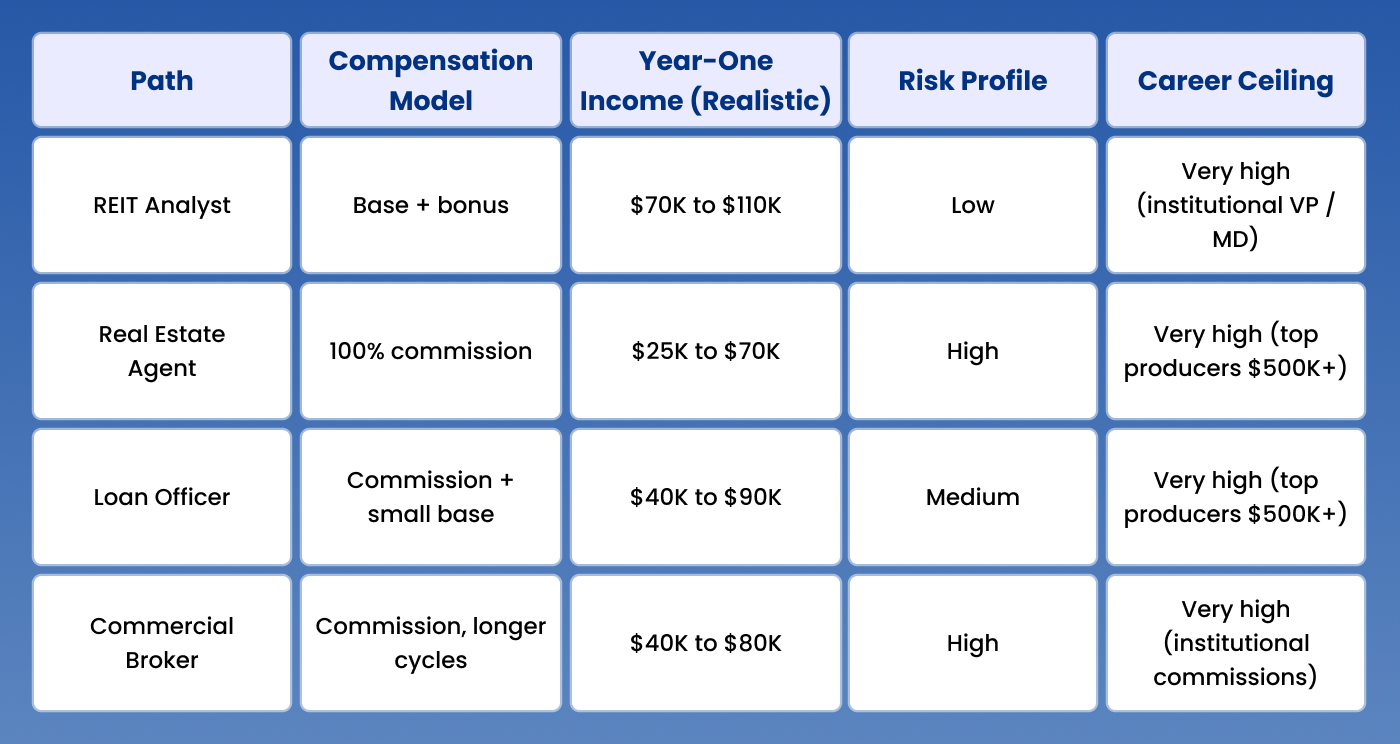
For brokerages competing to recruit talent, this comparison is operationally critical. Candidates increasingly weigh REIT careers against agent roles because pay-stub stability is attractive, especially in slower transaction markets. Recruiting against that requires a clear story about onboarding, lead infrastructure, and ramp time, not just commission splits.
What Are the Pros and Cons of a Real Estate Career?
Real estate spans dozens of distinct career paths. The pros and cons of a real estate career look different depending on whether you mean REITs, residential brokerage, mortgage origination, commercial brokerage, or development.
Pros of a Real Estate Career
Income potential is uncapped in commission-based roles and well above national medians in REIT roles
Tangible asset class, you can see and touch what you work on
Multiple entry points, no single required degree path
Strong network and referral economy
Geographic flexibility, especially in residential
Long-term wealth-building through ownership and equity participation
Cons of a Real Estate Career
Income volatility in commission-based roles, especially in years one and two
Cyclical industry tied to interest rates and capital markets
High first-year attrition in residential brokerage
Long deal cycles in commercial and REIT acquisitions
Compliance burden, especially in mortgage origination and securities-adjacent REIT roles
For brokerage leaders, the first-year attrition issue is the one that matters most operationally. NAR data has consistently shown that the majority of new real estate agents leave the business within their first two years, primarily due to lack of structured onboarding and mentorship rather than market conditions. That is a recruiting and retention problem with a documented solution: structured systems and accountability frameworks.
Real Estate Career Outlook for 2026 and Beyond
The Bureau of Labor Statistics projects employment of real estate brokers and sales agents to grow about 2% through 2032, roughly average for all occupations. Loan officer roles are projected to grow at a similar pace. REIT and commercial real estate roles are tied more closely to capital markets activity and asset-class shifts than to BLS occupational projections.
The real estate career outlook for 2026 reflects three structural trends:
Industrial, data center, and senior housing REITs continue to outhire office and retail. Capital flows are following demographic and technology demand, not legacy asset classes.
Residential brokerage is consolidating. Team-based models are capturing market share from solo agents, and team leaders need recruiting and onboarding infrastructure to scale.
Mortgage hiring is recovering as rates normalize. Branch-level loan officer recruiting is accelerating, and the brokerages with the best recruiting tech are winning the talent.
The brokerages winning in 2026 are not the ones with the biggest brand names. They are the ones with the best recruiting and onboarding systems.
Is Being a Realtor Worth It in Today's Market?
For the right person at the right brokerage, yes. For someone joining a brokerage with no onboarding, no lead source, and no mentorship, the math is brutal.
The candidates who succeed share three traits:
They join a brokerage with a defined onboarding program, not a "here's your desk" approach
They have 6 to 12 months of financial runway
They are coachable and follow a documented productivity system
Top-producing agents at well-run brokerages routinely earn $200,000 to $500,000 or more annually. Median residential agent income is significantly lower, around $52,000 according to NAR. That gap is almost entirely a function of brokerage support, training, and lead infrastructure, not raw talent. If you are evaluating whether being a realtor is worth it, evaluate the brokerage as carefully as you evaluate the career itself.
How EZRecruits Helps Brokerages Compete for Real Estate Talent
The talent question cuts both ways. Brokerages and mortgage companies are not just competing with each other. They are competing with REIT employers, fintech mortgage platforms, and adjacent commercial real estate firms for the same ambitious, real estate-curious candidates who could go anywhere in the industry.
EZRecruits is built specifically for that fight. Our real estate recruiting platform combines pipeline CRM, automated outreach, and one-click job board syndication across 100+ boards so your openings show up wherever candidates are looking, including alongside REIT and institutional listings.
Once a candidate signs, the work is not over. Structured real estate agent onboarding is the single biggest lever for reducing first-year attrition. Brokerages using EZRecruits onboarding workflows reduce new-agent attrition by up to 40% and shorten time-to-first-deal.
Our DISC-based hiring software is purpose-built for real estate and mortgage roles, not a generic personality test repurposed across industries. Combined with real estate team management dashboards, EZRecruits gives team leaders the same operational visibility that REIT asset managers have over their portfolios, applied to the people side of the business.
If REITs are winning candidates on stability and structure, brokerages have to win on growth ceiling, culture, and systems. EZRecruits is the systems part.
Ready to Recruit Like an Institution?
Whether your candidates are weighing your offer against a REIT analyst job or another brokerage, your recruiting and onboarding systems are what close the gap. Book a demo with EZRecruits to see how the platform combines recruiting, DISC hiring, and structured onboarding in one workflow.
Frequently Asked Questions
Is real estate investment trusts a good career path for finance majors?
Yes, REITs are one of the strongest career paths for finance majors who want to work in real estate without going into brokerage sales. Entry-level analyst and acquisitions associate roles directly use financial modeling, valuation, and capital markets skills. Compensation is competitive, career structure is well-defined, and exit opportunities into private equity real estate, hedge funds, and corporate development are strong.
How many jobs are available in real estate investment trusts?
Nareit estimates the REIT industry supports more than 3.4 million full-time equivalent jobs in the United States, including direct employees, contractors, and ancillary services. Public REITs alone post thousands of new roles each year across acquisitions, asset management, property operations, and capital markets functions.
What is the difference between working for a REIT and being a real estate agent?
REIT employees earn a base salary plus bonus and work on institutional-scale portfolios, focusing on underwriting, operations, and capital markets strategy. Real estate agents are typically independent contractors paid on commission for individual transactions. REITs offer income stability and structured advancement. Brokerage offers uncapped commission upside and geographic flexibility. They are fundamentally different career paths inside the same industry.
Is being a realtor worth it in 2026?
Being a realtor is worth it in 2026 if you join a brokerage with structured onboarding, an active lead source, and documented training. Top producers at well-run brokerages routinely earn $200,000 or more, while agents without proper support often struggle to break even in their first two years. The brokerage you choose matters more than the macro market conditions.
What are the pros and cons of a real estate career compared to a REIT career?
A real estate brokerage career offers uncapped commission income, geographic flexibility, and a low barrier to entry, but comes with income volatility and high first-year attrition. A REIT career offers salary stability, structured advancement, and institutional deal exposure, but requires more formal credentials and offers less geographic flexibility. Both can produce strong long-term careers, depending on your risk tolerance and timeline.
Which pays more, a REIT job or a real estate agent role?
In years one and two, REIT analyst and associate roles typically pay more reliably than residential agent commissions. Over a 10-year horizon, top-producing real estate agents and team leaders often outearn mid-level REIT professionals because brokerage income is uncapped. The right answer depends on your risk tolerance, your timeline, and the quality of the brokerage you join.
What is the real estate career outlook for the next five years?
The real estate career outlook through 2030 favors specialized roles: industrial and data center REIT positions, mortgage loan officers in recovering markets, and team-based residential agents at well-run brokerages. The Bureau of Labor Statistics projects steady, near-average growth for agent and loan officer roles, while REIT hiring tracks capital markets activity and asset-class shifts.
How do brokerages compete with REITs for top talent?
Brokerages win against REIT employers by emphasizing growth ceiling, culture, and systems, not just commission splits. Platforms like EZRecruits help brokerages compete by combining recruiting CRM, DISC-based hiring assessments, and structured onboarding so candidates see a clear path from offer to first commission to top-producer status, with the same operational rigor a REIT employer would offer on the salary side.

