






Real Estate Commission Calculator: Splits, Caps & Take-Home
A real estate commission calculator estimates an agent's gross commission, brokerage split, and net take-home from a closed sale. The accurate version is not a single formula. It is a layered model that accounts for the sale price, the commission rate, the listing versus buyer side split, the brokerage cap structure, and recurring fees.
For brokerages, this calculation matters far beyond payroll. Commission structure is now one of the most scrutinized factors in agent recruiting and retention. Following the NAR settlement that took effect on August 17, 2024, buyer agent commissions are no longer offered through the MLS by default, and every commission conversation has become more transparent and more negotiable. Industry surveys consistently show that the majority of new licensees leave the business within their first five years, with compensation transparency ranking among the top drivers of agent retention.
This guide breaks down exactly how to calculate real estate commissions across every common brokerage model, what fees actually erode agent take-home, and how brokerage owners can use commission transparency as a recruiting advantage. At EZRecruits, we work with brokerages and mortgage companies that use commission modeling as the foundation of their real estate recruiting and onboarding workflows.
How Real Estate Commissions Actually Work in 2026
Real estate commissions are paid as a percentage of the final sale price of a home, typically ranging from 4% to 6% of the gross sale price. The commission is paid by the seller at closing and split between the listing brokerage and the buyer's brokerage. Each brokerage then splits its share with its agent according to that agent's compensation plan.
The post-settlement reality is that commission rates are explicitly negotiable, and buyer's agents must now have a written agreement with their client specifying compensation before showing homes. This has not eliminated commission, but it has made the structure more visible to consumers and more strategic for brokerages.
A typical transaction looks like this:
Sale price: $400,000
Total commission (5%): $20,000
Split between listing and buyer side (50/50): $10,000 each
Brokerage to agent split (70/30 in agent's favor): Agent receives $7,000 gross before fees and taxes
That $7,000 is the starting number. The real take-home is significantly lower once brokerage fees, business expenses, and self-employment taxes are factored in.
The Core Real Estate Commission Calculator Formula
A complete real estate commission calculator uses a five-step formula:
Total commission = Sale price × commission rate
Side commission = Total commission × side split (typically 50%)
Agent gross = Side commission × agent split %
Agent net before tax = Agent gross − transaction fees − monthly fees (prorated) − E&O insurance
Agent take-home = Agent net before tax − self-employment tax − business expenses
Most online realtor commission calculators stop at Step 3. That is the version that gets quoted on recruiting websites. The version that actually matters to your agents is Step 5.
Here is a worked example for a $500,000 sale at a 5% commission, 50/50 buy-side split, with a 70/30 agent-favorable brokerage split:
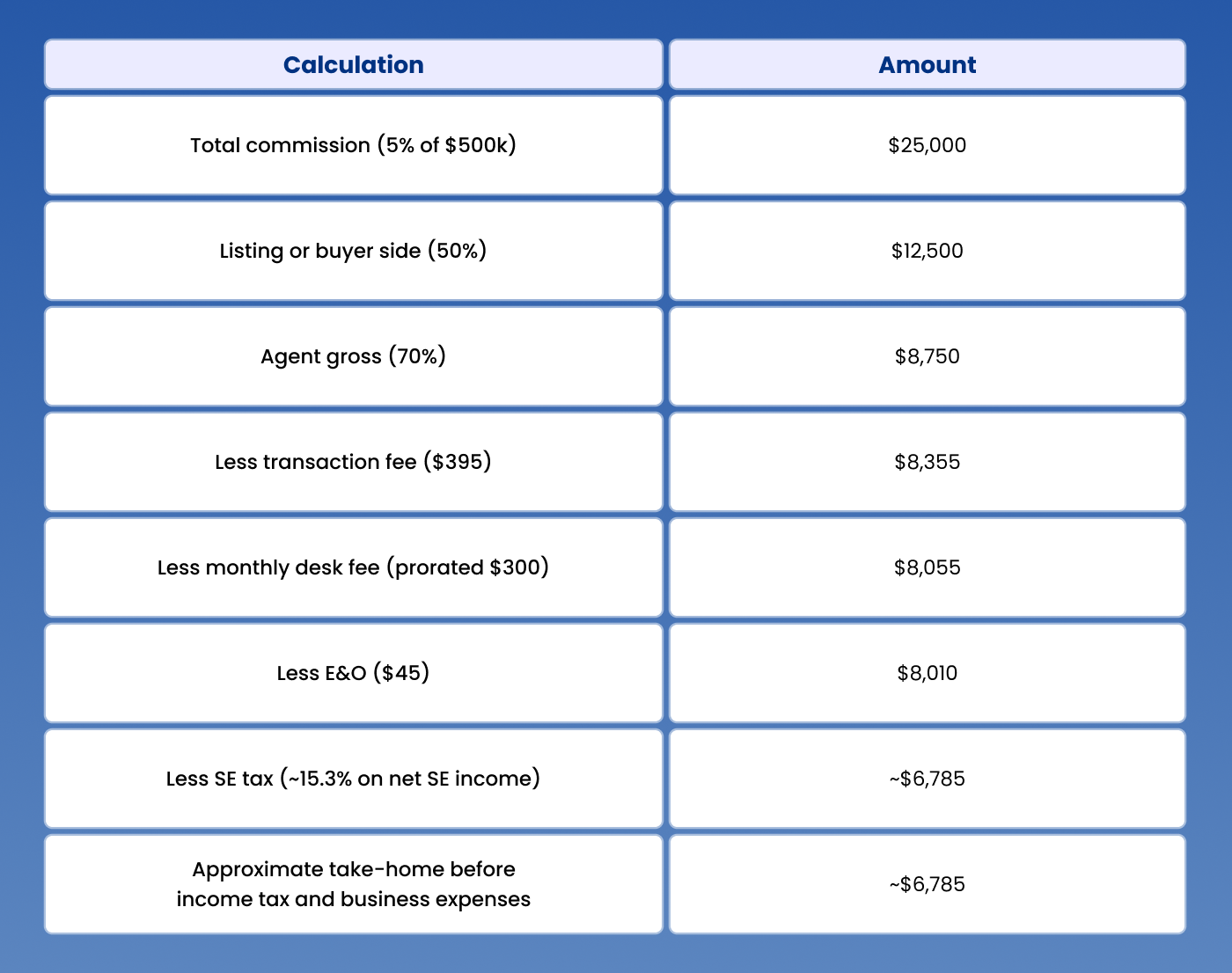
That is a 22% reduction from the headline $8,750 number, before income tax, marketing costs, MLS dues, mileage, or technology stack.
What Are the Most Common Commission Split Structures?
Brokerages use four primary commission models, and an agent take home calculator should be able to handle all four.
Traditional Split
The brokerage and agent share each commission on a fixed percentage. Common splits range from 50/50 for new agents to 80/20 or 90/10 for top producers. The brokerage typically covers some operating expenses (office, basic marketing, broker oversight). This model is straightforward to calculate but requires renegotiation as an agent's production grows.
Cap-Based (Keller Williams Style)
The agent earns at a defined split (often 64/30/6 or similar) until they hit an annual cap on the brokerage's portion, after which the agent keeps 100% of every commission for the rest of the cap year. A commission split calculator for this model needs to track year-to-date GCI against the cap threshold.
100% Commission with Fees (eXp, RE/MAX style variations)
The agent keeps the full commission and pays the brokerage flat monthly fees plus per-transaction fees. This favors high-producing agents but punishes lower-volume agents who still pay fees during slow months.
Hybrid or Tiered Models
The agent moves through escalating split tiers based on year-to-date production. A common structure is 60/40 up to $50,000 GCI, 70/30 from $50k to $150k, and 80/20 thereafter. These models reward production growth without an explicit cap.
How Do Brokerage Caps Change the Math?
A cap is a ceiling on how much the brokerage takes from an agent in a given anniversary year. Once the agent hits the cap, every dollar of commission flows to the agent (minus per-transaction fees).
Here is the broker-side calculation for a $20,000 annual cap with a 70/30 split:
Agent must generate $66,667 in GCI before the cap is hit ($66,667 × 30% = $20,000)
For an agent producing $200,000 GCI, the brokerage receives $20,000 (the cap), and the agent keeps $180,000 minus fees
Effective split at $200k GCI: agent retains 90%
The cap structure is a powerful recruiting argument for top producers because it has a clear, transparent ceiling. It is also a structural challenge for brokerages, because high-producing agents become disproportionately profitable to retain in their first few months of the cap year and disproportionately expensive to retain late in the year.
Hidden Fees That Reduce Agent Take-Home
Headline split numbers rarely reflect actual agent economics. The fees that compress real take-home include:
Transaction fees: $250 to $700 per closing, charged separately from the split
Desk or monthly fees: $50 to $1,200/month depending on model
E&O insurance: $25 to $75 per transaction
Franchise fees: 6% to 8% of gross commission for franchised brokerages, often deducted before the agent split
Technology fees: $25 to $200/month for CRM, MLS, and tools
Compliance or admin fees: $50 to $150 per transaction
For a brokerage running a 70/30 split with a $395 transaction fee, $300 monthly desk fee, and a 6% franchise fee, the effective agent split on a $10,000 commission is closer to 62%, not 70%. This gap between marketed split and effective split is one of the most common reasons agents leave within their first 18 months.
A realtor commission calculator that ignores fees overestimates agent earnings by 15% to 30%, which is the gap between recruitment promises and the first paycheck.
How Much Does a Real Estate Agent Actually Take Home?
After fees, self-employment taxes, and business expenses, the average real estate agent's take-home is roughly 50% to 60% of their gross commission income (GCI), depending on production volume and brokerage model.
A practical estimate for an agent earning $100,000 in GCI at a 70/30 split:
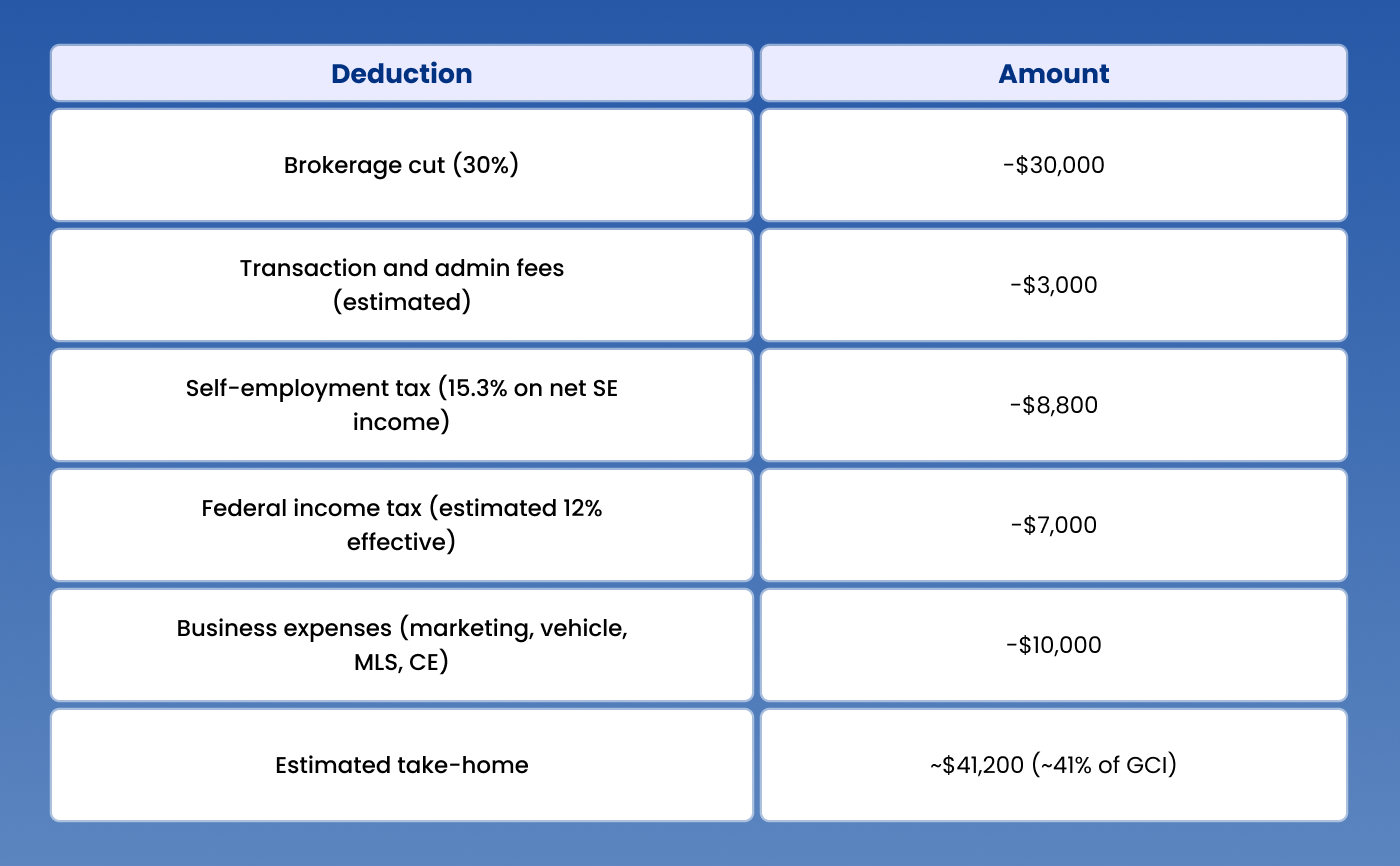
This is why high-producing agents fixate on cap structures and why new agents underestimate how long it takes to actually clear a livable income. The agent take home calculator that brokerages share during recruiting should reflect this full picture, not just the gross split.
Why Commission Transparency Is a Recruiting Advantage
Agents who feel surprised by deductions in their first six months are statistically the most likely to leave. Brokerages that publish a clear commission calculator during recruiting consistently outperform those that obscure structure until onboarding. The reason is simple: agents who understand the math walk in with realistic expectations, hit production milestones faster, and are far less likely to leave for a competitor offering a "better split" that turns out to be worse on a net basis.
The most effective recruiting brokerages now treat their commission structure as a transparent, modelable asset. They build interactive commission calculators that prospects can run with their own production assumptions, and they integrate that transparency into their structured real estate agent onboarding sequences.
How EZRecruits Helps Brokerages Use Commission Structure to Recruit and Retain Agents
EZRecruits is a full-stack recruiting and onboarding platform built specifically for real estate brokerages and mortgage companies. While the platform is not a commission calculator itself, its recruiting and onboarding workflows are built to integrate commission transparency into every stage of the agent lifecycle.
Inside the platform, brokerages can:
Document and present commission models as part of the structured recruiting pipeline, so prospects see realistic earnings projections before they sign
Use DISC-based hiring software to match agent personality types to commission models that fit (high-D agents typically prefer cap models, while high-S agents often perform better on stable splits)
Build onboarding sequences that walk new agents through the full take-home math in their first week, eliminating the "surprise deduction" attrition trigger
Track agent performance and GCI against cap thresholds inside the real estate team management dashboard, so brokers can intervene before retention risk peaks
Brokerages using the platform typically see first-year agent attrition drop by up to 40%, in part because compensation expectations are aligned from day one rather than litigated mid-cycle.
What to Look For in a Real Estate Commission Calculator
Whether you are building one for your brokerage or evaluating an existing tool, a complete real estate commission calculator should include:
Sale price and commission rate inputs with adjustable side splits
Brokerage split calculation with support for tiered, capped, and 100% models
Cap year tracking with year-to-date GCI against threshold
Itemized fee deductions (transaction, desk, E&O, franchise, technology)
Tax estimates for self-employment and federal income tax
Business expense slot for agent-side modeling
Comparison view showing two or more brokerage models side by side
Tools missing any of points 3 through 6 will systematically overstate agent earnings, which damages trust during recruiting and retention.
Build a recruiting and onboarding workflow that turns commission transparency into your competitive advantage. Book a demo with EZRecruits and see how full-stack recruiting changes your retention math.
Frequently Asked Questions
How do you calculate real estate commission?
Multiply the sale price by the commission rate (typically 5% to 6%), divide that by 2 to get the listing or buyer side commission, and multiply that by the agent's split percentage with their brokerage. For a $400,000 sale at 5% with a 70/30 split, the agent's gross commission before fees is $7,000.
What is the most common real estate commission split?
The most common splits are 70/30, 80/20, and 50/50 in the agent's favor, though cap-based models are increasingly popular at growth-focused brokerages. New agents typically start at 50/50 or 60/40 and move up as production grows. The actual effective split is usually 5% to 10% lower than the marketed split once fees are deducted.
How does a brokerage cap work?
A cap is the maximum amount a brokerage takes from an agent's commissions in a single anniversary year. Once the agent hits the cap, they keep 100% of subsequent commissions (minus per-transaction fees) until their cap year resets. Caps reward high producers and provide a transparent ceiling on what the agent pays the brokerage.
How much does the average real estate agent actually take home?
After brokerage splits, transaction fees, self-employment tax, federal income tax, and business expenses, agents typically take home 40% to 55% of their gross commission income. An agent earning $100,000 GCI usually nets $40,000 to $55,000 in actual take-home, which is why production volume is the single biggest driver of agent income.
Did the NAR settlement change how commissions are calculated?
The NAR settlement, effective August 17, 2024, did not change the math of commission calculations, but it changed how commissions are negotiated and disclosed. Buyer agents must now have a written compensation agreement with their client before showing homes, and seller-paid buyer commissions are no longer offered through the MLS. The percentage and split math remains the same.
Is a commission split calculator different from a cap calculator?
A commission split calculator computes the agent share of a single transaction at a fixed split percentage. A cap calculator tracks cumulative annual GCI against the cap threshold to determine whether the agent has hit 100% commission status for the rest of the year. A complete real estate commission calculator includes both functions.
How can brokerages use commission transparency to recruit better agents?
Brokerages that publish transparent commission models, including all fees and realistic take-home projections, recruit higher-quality agents and retain them longer. EZRecruits enables brokerages to document and present full commission scenarios as part of the structured recruiting and onboarding workflow, which reduces first-year attrition and aligns expectations from day one.
What fees are typically not included in commission calculators?
Most online commission calculators exclude E&O insurance, franchise fees, technology fees, MLS dues, continuing education costs, vehicle and marketing expenses, and self-employment tax. These deductions can reduce headline gross commission by 30% to 45%, which is why agents often feel "shorted" on their first paycheck despite the math on the recruiting page.

